
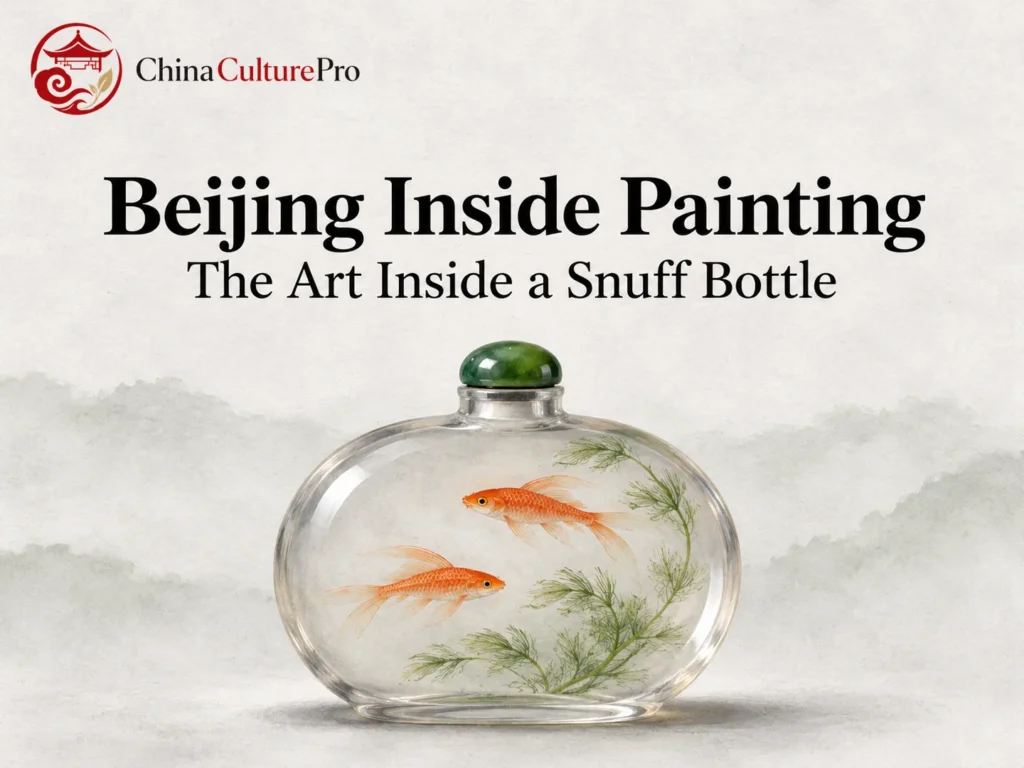

Quick Answer: What Is Beijing Inside Painting?
Beijing inside painting (北京内画, Běijīng nèihuà) is the craft of painting the inner wall of a transparent vessel. Its best-known form is the inside-painted snuff bottle (鼻烟壶, bíyānhú). Painters guide a fine brush through the narrow neck, and viewers see the finished image through glass or rock crystal. [1][3][4][6]
- Surface: The design is on the inner wall of the bottle.
- Method: The details nearest the viewer often go down before the layers behind them.
- Tradition: Beijing is one of several regional schools in China. [1][3][6]
The method describes how the image was made. Other decoration on the same bottle can be part of the vessel itself. [2][5]
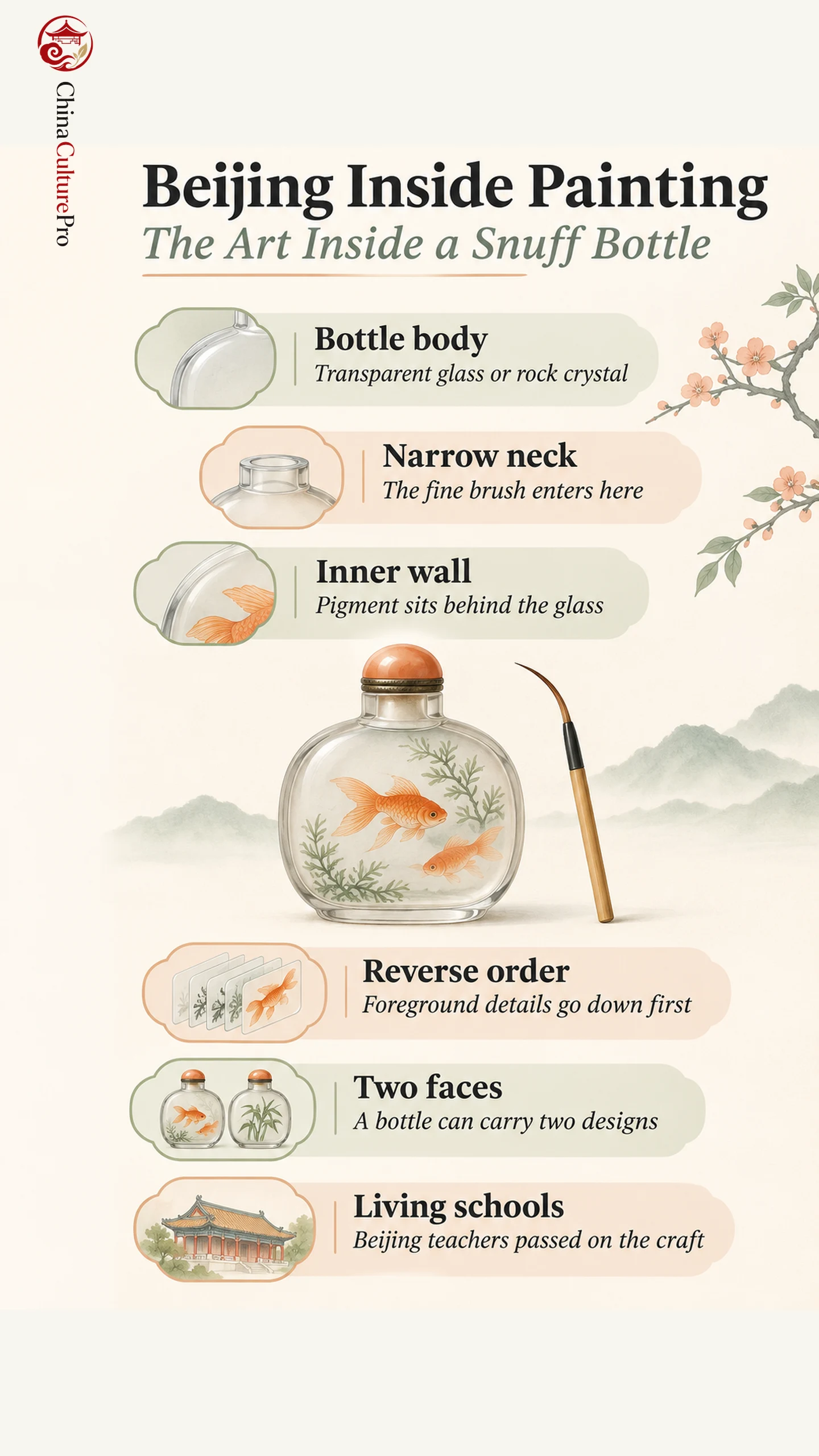
An inside-painted bottle rewards a look at both faces. A portrait may occupy one side while an inscription or a second subject appears on the other. The opening is the same, but each broad wall gives the painter a separate surface.
The Bottle Is Both Container and Painting Surface
A snuff bottle originally held powdered tobacco. In Qing Beijing, the court and people with social standing used these containers. Workshops both within and outside the palace made them. The wider tradition of Chinese snuff bottles includes opaque materials and exterior decoration. Inside painters work with bodies transparent enough to reveal the image. A flattened form gives the painter two broad surfaces on a pocket-sized object. A finished image still has to read clearly through a curved wall. [1][2][5][6]
A Beijing bottle in the Corning Museum of Glass, dated 1812, gives an early example. Black inscriptions sit inside its glass body, while red glass overlay frames them from outside. The overlay and the inscriptions were made in different ways. A viewer looking straight at the bottle sees them together, as a frame and the work it surrounds. [2]
Why Painters Work in Reverse
The craft has two practical constraints. The brush enters through a small neck, so a fine angled tip makes it possible to reach the broad inner walls. The pigment needs a surface it can grip. A British Museum record describes a slightly roughened interior on which the painter works. [3][4]
Layers also read in reverse. Seen from outside, the paint touching the wall is in front of what the artist adds behind it. In a portrait, small features such as eyes can therefore come before the broader color of the face and the background. That order matters because a painter cannot put the eye on top from the viewer’s side. The first mark remains the one closest to the viewer. [3][6]
What Two Museum Bottles Show
The Palace Museum dates a glass bottle by Ye Zhongsan (叶仲三, Yè Zhòngsān) to 1903. Fish and aquatic plants appear on both broad faces, while carved animal-mask ring motifs decorate the sides. One face has an inscription locating the work in Beijing. Look at the narrow sides for the carved masks, then at the wide faces for the painted fish. The two locations make the difference between carving and painting particularly easy to see. [5]
The Hong Kong Museum of Art holds a rock crystal bottle painted by Ma Shaoxuan (马少宣, Mǎ Shàoxuān) in 1907. It depicts the Qing official Duan Fang. The museum notes the portrait’s likeness to photography. The narrowness of the opening is easier to appreciate against a portrait, where a small change in the position of an eye can alter the likeness. Ye’s bottle uses the same method to a different end: making fish and plants legible in a space barely wider than a hand. [5][6]
How the Beijing School Passed Down the Craft
The national heritage record traces a teaching line from Ye’s family through Beijing’s arts and crafts institute. In the 1950s, Ye’s sons helped train painters who included Wang Xisan and Liu Shouben. Wang went on to establish a school in Hebei, while Liu became a leading figure in the Beijing tradition. The named schools describe regional lines of practice. Wang’s training in Beijing is a reminder that the lines share part of their history. [1][4][6]
Beijing’s Xicheng district was entered in China’s national intangible cultural heritage register for this practice in 2008. The designation concerns the skills and their transmission, so the registered tradition is part of the wider story of Chinese traditional crafts as well as the study of historic bottles. [1]
FAQs About Beijing Inside Painting
Is the design painted on the inside or the outside?
The image in an inside-painted bottle sits on its inner wall. A single bottle can also have exterior ornament, as the red overlay on the Corning example shows. [2][3]
Are all inside-painted snuff bottles made of glass?
No. Museum collections include both glass and rock crystal examples, with paintings visible through the vessel wall. [2][5][6]
Is Beijing the only school of Chinese inside painting?
No. The national heritage register also identifies traditions associated with Hebei, Shandong and Guangdong. The line from Beijing’s teachers to Wang Xisan illustrates how schools could develop through shared training. [1][6]
Источники
[1] China Intangible Cultural Heritage Digital Museum. Inside Painting: Beijing Inside-Painted Snuff Bottles
[2] Corning Museum of Glass. Snuff Bottle, 1812
[3] Beijing Municipal Bureau of Culture and Tourism. Peking Glass Snuff Bottles
[4] British Museum. Glass Snuff Bottle Made by Liu Shou-ben
[5] The Palace Museum. Glass Snuff Bottle with Fish and Aquatic Plants by Ye Zhongsan
[6] Hong Kong Museum of Art. Fuyun Xuan Collection of Chinese Snuff Bottles