

Quick Answer: What Does Kitchen Feng Shui Look At?
Kitchen feng shui (风水, fēngshuǐ) typically considers where the kitchen sits, how it relates to the entrance and where the stove is placed. Modern advice often adds the sink, the cook’s view of the room and the direction a stove is said to face.[1][4][5]
- Placement: Some readings compare the kitchen or stove sector with other parts of the home.[1][4]
- Orientation: A stove’s position in the plan and the direction assigned to it are separate questions.[5]
- Fire and Water: Some modern guides read the stove as Fire and the sink as Water, then favor some separation.[5][6]
These are symbolic interpretations. For an existing kitchen, a clear path, usable counter and good ventilation are practical priorities.[5][7]
The direction you face to cook and the direction the stove controls face can be opposite. Ask how “facing” was defined before comparing the answers.
Why the Stove Mattered in Older House Manuals
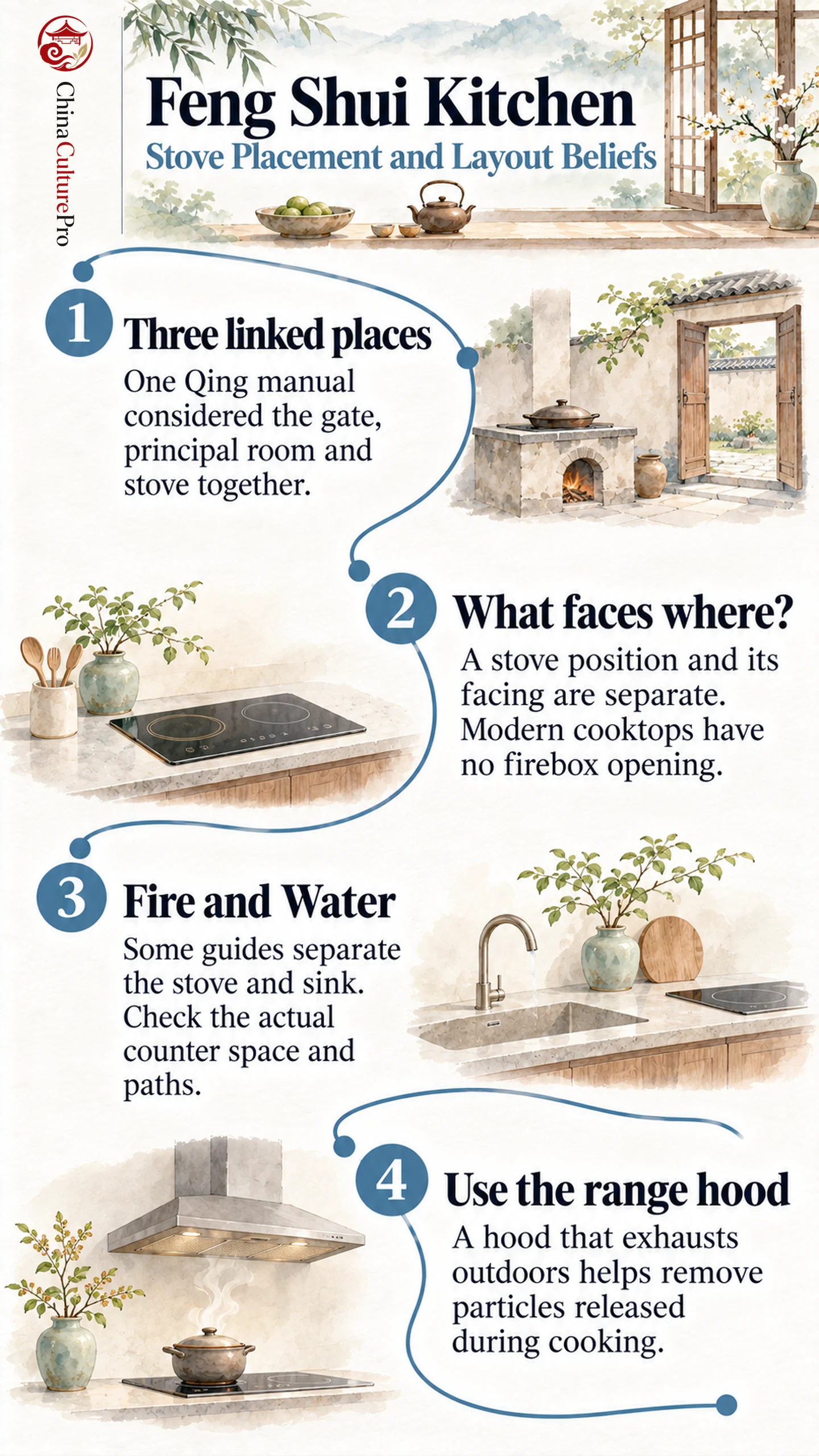
The Qing-period Yangzhai Sanyao (阳宅三要, Yángzhái Sānyào), or Three Essentials of Dwellings, looks at three parts together: the entrance or gate, the principal room and the stove. The manual considered their positions in relation to one another.[1][2]
The hearth also has a religious history. The Kitchen God (灶君, Zàojūn) appears in household observances connected with the Lunar New Year. A ritual honoring the hearth and a method for interpreting the floor plan are different uses of the same domestic place.[1][3]
Where Schools Disagree About Stove Direction
A form-based and compass-based reading can start with different evidence. A layout-oriented reading might ask what the cook sees or whether people pass behind the stove. A directional system asks how an object or a room sits within the plan.[4][5]
In one interpretation of Eight Mansions (八宅, Bāzhái), practitioners distinguish the stove’s sector from the way its firebox opening faces. A built hearth had an opening for fuel. An electric hob has no comparable opening, so one practitioner may use the control side while another considers the cook’s position. A direction suggested without explaining the method is difficult to compare with a second reading.[5]
How to Read Common Kitchen Layout Claims
The Five Phases (五行, wǔxíng) supply the terms Fire and Water. Modern guides use them to interpret fixtures, while the layout gives you separately observable details to assess.[2][5][6]
| Распространённое утверждение | What you can check in the room |
|---|---|
| Keep the stove away from the sink | Some guides treat this as separating Fire from Water. Check whether there is enough clear counter to prepare ingredients and set things down.[5][6] |
| Avoid a stove facing an entrance | Check whether the entrance sends people directly through the working area. Some guides are also concerned with what the cook can see.[5][6] |
| Avoid a stove and bathroom door directly opposite each other | Some modern guides flag this arrangement. In an existing plan, check privacy, door swings and how the two rooms are used. See how comparable sightlines are interpreted in bathroom feng shui.[6] |
What to Improve in a Kitchen You Already Have
Start with the cooking path. If the cook and someone walking through the room get in each other’s way, see whether you can keep frequently used tools and ingredients closer to where you prepare or cook them. Leave usable counter space where you need to set a bowl or tray down. A restaurant layout also has to account for the separate routes people take to get seated, serve food and pay.
Use an existing range hood while you cook. A hood that exhausts outdoors helps remove particles released during cooking. Check that the hood actually vents outdoors if it was installed to do so.[7]
FAQs About Kitchen Feng Shui
Which Direction Is Best for a Kitchen?
Different methods consider the building’s orientation, its room layout and the relationship between the entrance and stove. A single compass direction does not answer all those questions.[1][4][5]
Does an Induction Cooktop Have a Feng Shui Facing?
People may assign an orientation to an induction cooktop, but the old firebox criterion cannot be applied literally. Ask which part of the appliance a particular reading uses.[5]
Is It Bad Feng Shui to Have a Sink Next to the Stove?
Some modern guides prefer separation because they associate the fixtures with Water and Fire. A short distance alone does not establish a practical problem. Check whether you have room to prepare food and set pans down safely.[5][6]
Источники
[1] Virginia Tech University Libraries. The Door as a Ritualistic and Cosmological Element
[2] Sun Xingyan. 相宅书叙
[3] Oakland Museum of California. Secret World of the Forbidden City and Change and Continuity
[4] Ole Bruun. Cosmological Principles, Schools of Interpretation and the Feng Shui Compass
[5] FengShui.info. The Kitchen
[6] Geomancy.Net. The Kitchen
[7] U.S. Environmental Protection Agency. Sources of Indoor Particulate Matter