


Quick Answer: What Do Feng Shui Directions Mean?
In feng shui (风水, fēngshuǐ), directions can refer to a room’s location, the way a building faces or a person’s recommended orientation. Those are different questions.
- Eight broad compass directions have traditional trigram and phase associations.
- Some compass methods subdivide the circle into 24 named sectors.
- A building’s sitting direction is opposite its facing direction.
- Personal favorable directions depend on a particular calculation system.
Directional classifications describe traditional methods; they do not guarantee health, wealth or compatibility.
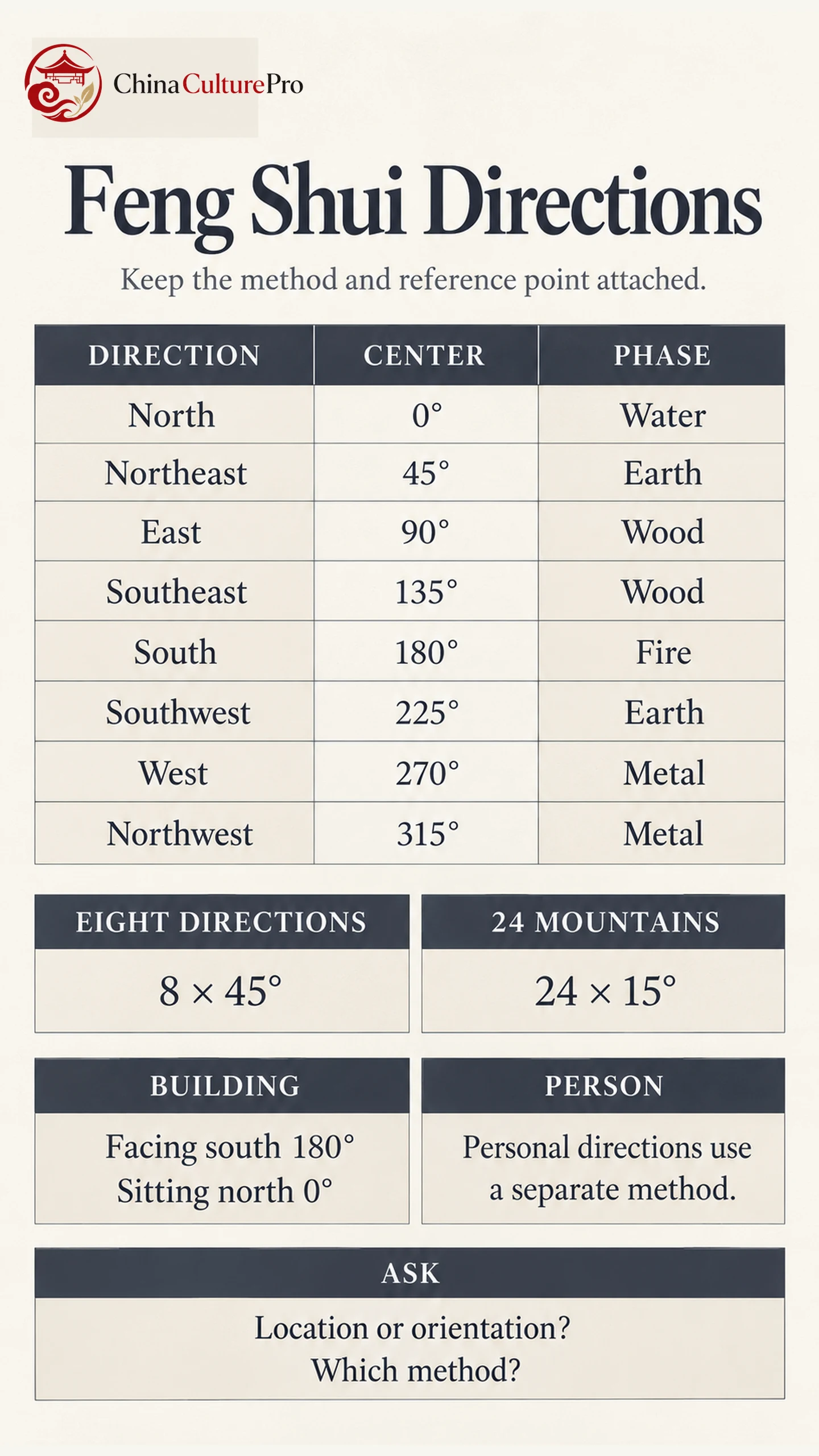
“Put it in the north” and “face north” do not mean the same thing. The first concerns location within a plan; the second concerns orientation. Much confusion in feng shui begins when a chart or instruction leaves out that distinction.
Before moving furniture, identify what is being assessed: the whole building, one room, a desk, a bed or a person. Then identify the method supplying the recommendation.
The Eight Directions and Their Associations
The bagua (八卦, bāguà), or eight trigrams, can be arranged in more than one way. The Later Heaven (后天, hòutiān) arrangement gives the familiar directional pattern below.[1] The table runs clockwise from north; degrees mark sector centers, not the entire span of a direction.
| Сторона света | Center bearing | Trigram | Five-phase association |
|---|---|---|---|
| Север | 0° | Kan (坎, Kǎn) | Вода |
| Северо-восток | 45° | Gen (艮, Gèn) | Земля |
| Восток | 90° | Zhen (震, Zhèn) | Дерево |
| Юго-восток | 135° | Xun (巽, Xùn) | Дерево |
| Юг | 180° | Li (离, Lí) | Огонь |
| Юго-запад | 225° | Kun (坤, Kūn) | Земля |
| Запад | 270° | Dui (兑, Duì) | Металл |
| Северо-запад | 315° | Qian (乾, Qián) | Металл |
The phase assignments belong to the traditional correspondence system.[2] They do not mean that a northern room physically consists of water or that a western room must contain metal furniture. See the eight trigrams reference for names and images, and the Five Elements guide for the phase framework.
What a Luopan and the 24 Mountains Add
A luopan (罗盘, luópán) combines a magnetic compass with rings of traditional classifications. One important ring is the Twenty-Four Mountains (二十四山, èrshísì shān): 24 directional sectors of 15° each. Three such sectors fit within each broad 45° direction.[3]
“Mountain” here names a directional division, not necessarily a hill outside the house. The names draw on twelve Земные ветви, eight of the ten Небесные стволы and four trigrams. The north-centered sector spans 352.5° through 0° to 7.5° in this common division.[3]
A report using a broad word such as “north” therefore contains less directional detail than one specifying a named mountain and bearing. More numerical detail does not, by itself, demonstrate the accuracy of predictions attached to it. It simply identifies the classification more precisely.
Facing and Sitting Describe a Building
Facing describes the direction regarded as the building’s front or active aspect in the method being used; sitting is the opposite direction. The main door can help identify the facing, but a side entrance or an unusual building layout can make that identification less straightforward.[5] The front-door guide treats the entrance itself separately.
For a simple example, a house facing due south at 180° sits north at 0°. In one Eight Mansions (八宅, bāzhái) teaching, the house trigram is determined from the sitting side, so that example is a Kan house, despite facing south.[4] Calling it a Li house merely because Li corresponds to south would confuse the direction table with the method for naming the house.
Record the reference point and convention behind a reading. If the building’s facing is disputed, repeating a calculation with more decimal places does not settle the underlying disagreement.
Personal Directions Use a Different Calculation
Eight Mansions teaching also assigns personal trigrams through a birth-based calculation. These yield favorable and unfavorable directions within that system. A personal trigram and a house trigram answer different questions, even when they use the same eight names.[4]
Consequently, one person’s preferred facing cannot be assumed to suit every occupant or every room. Nor should a general north-for-career label automatically replace a personal-direction table. Keep the calculation convention attached to the recommendation.
Other approaches add further information, including time, while entrance-aligned BTB mapping uses the entrance rather than compass directions as its reference.[6] Compare Form and Compass approaches и bagua map methods before combining their instructions.
Before You Apply Directional Advice
Ask whether the advice describes a sector, a facing, a house type or a personal orientation. Check the map’s north arrow and whether its label denotes a center bearing or a sector boundary. Those details are more useful than a generic list of lucky directions.
Keep the room’s actual job in view too. A desk turned toward a preferred bearing still needs a usable screen and chair arrangement; a bed still needs workable access. The office и bedroom guides apply those practical checks without treating symbolic direction as the only consideration.
FAQs About Feng Shui Directions
Is north the best direction for everyone?
No. A general directional association is different from a personal favorable direction, and schools use different methods.
Why do some charts put south at the top?
South-up is a traditional presentation convention. Read the direction labels rather than assuming the top of every chart means north.
Is the front door always the house facing?
No. A door on a side elevation or an ambiguous building layout can require a method-specific judgment about the building’s facing.
Do all feng shui schools use a compass?
No. Compass methods use directional bearings, while entrance-aligned BTB mapping uses the entrance as its reference.
Источники
[1] David K. Jordan, University of California San Diego. The Eight Trigrams, the Canon of Changes, and Tally Divination
[2] Get Chinese Astrology. Bagua: Eight Trigrams and Two Heaven Arrangements
[3] Andrew Tan, FengShui BaZi Centre. What is 24 Mountains?
[4] American Feng Shui Institute. FS101: Beginning Feng Shui
[5] FengShui.info. Finding your facing direction
[6] Mindful Design Feng Shui School. Q&A with Mindful Design