

Quick Answer: Who Is Tu Youyou?
Tu Youyou (屠呦呦, Tú Yōuyōu), born in Ningbo in 1930, is a Chinese pharmaceutical researcher known for the discovery of artemisinin (青蒿素, qīnghāosù). She led a team within China’s Project 523 (523项目, wǔ èr sān xiàngmù) malaria research program and received half of the 2015 Nobel Prize in Physiology or Medicine.[1][2][4]
- Clue: A historical text suggested changing the way the plant was extracted.
- Research: The team identified a promising extract, and subsequent work isolated and characterized the compound.
- Legacy: The discovery contributed to the development of antimalarial medicines.
The historical plant, a laboratory extract and a pharmaceutical compound are three different things.
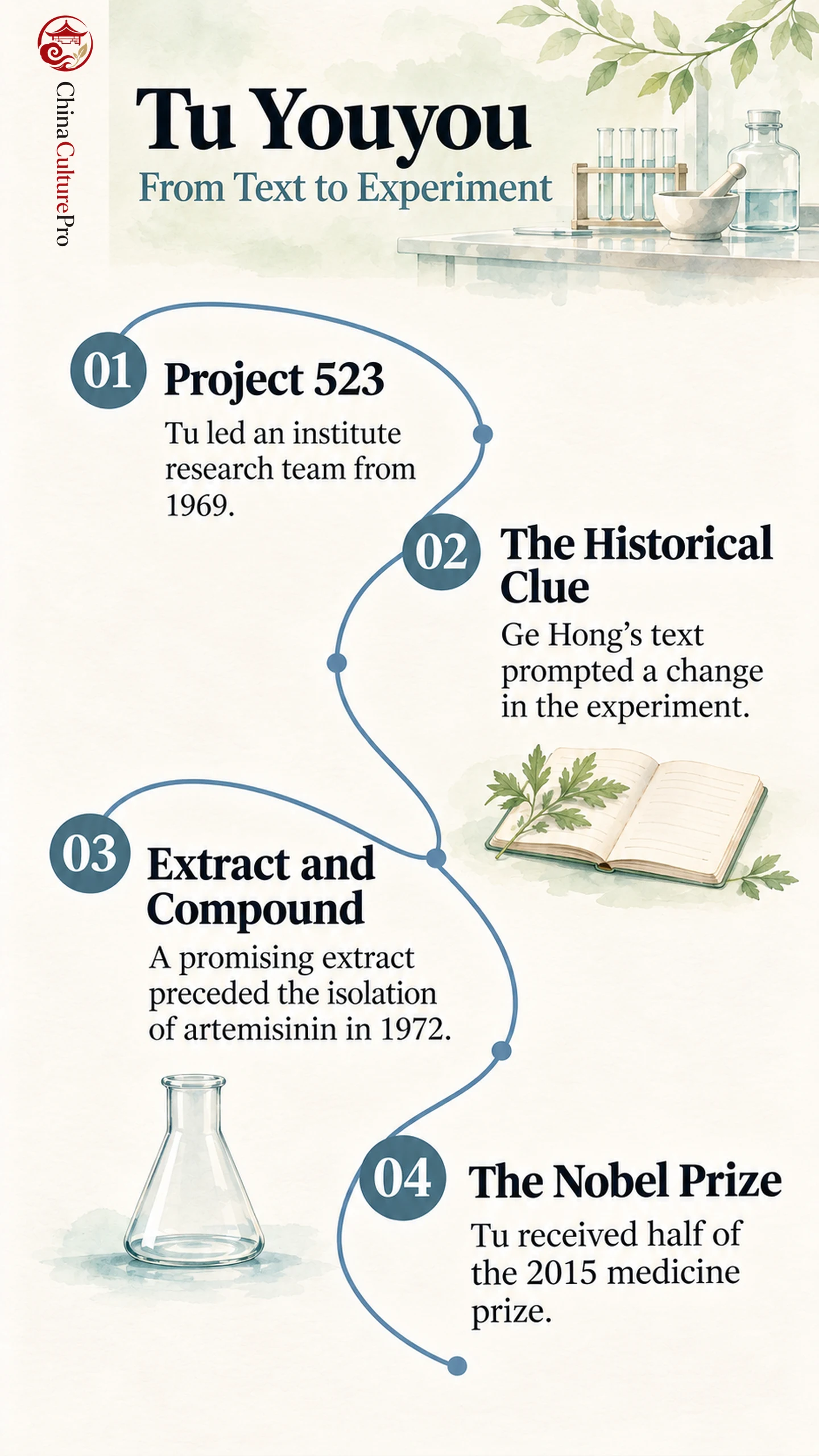
In the search for artemisinin, one problem was getting consistent results from a plant extract. An extract that showed promise did not always perform the same way. Tu Youyou’s response linked a historical clue to a redesigned experiment, then to work that other research teams could build on.
Pharmacy Training and Project 523
Tu studied pharmacy in Beijing and graduated in 1955. She went to work at the Institute of Chinese Materia Medica in the Academy of Traditional Chinese Medicine. Her training and work brought laboratory study into contact with the study of medicinal materials. That combination was important to a project that needed to decide which claims from a large body of texts deserved experimental attention.[3][4]
China organized Project 523 in 1967 to coordinate research on malaria. In 1969, Tu was asked to lead a group at her institute tasked with investigating leads from Chinese medicine. The group was one of several groups in a national program. The date a nationwide program began and the date its organizers assigned her group to the search describe different events.[2][4]
How a Historical Text Changed the Experiment
In her Nobel lecture, Tu recalled returning to the writings attributed to Ge Hong (葛洪, Gě Hóng), including a handbook on emergency prescriptions attributed to him. The lecture reproduces the passage she had revisited. The passage concerns qinghao (青蒿, qīnghāo) and recurring fevers. The important detail for her was that it described a preparation without the heating she associated with many other herbal preparations.[2]
The passage gave her a reason to change an experimental condition. It left other questions open, including which plant material and which fraction would yield useful activity. This is an example of how a text from Chinese medicine history can suggest a hypothesis that laboratory work can examine. The modern compound’s identity and its medical role come from subsequent research.[2][3]
One way to follow the reasoning is to ask what could be changed and then tested again. In the lecture, the clue about heating is followed by a change in how the team prepared its samples for comparison. A reader can trace the sequence from historical passage to test result without treating the old text as a modern clinical report.[2]
From Plant Extract to a Defined Compound
In 1971, Tu’s group obtained a promising qinghao extract and observed antimalarial activity in an animal model. She reported the results at a national Project 523 meeting in 1972. The presentation helped bring other institutes into the research. Her lecture reproduces part of the laboratory record and correspondence about sharing the findings, evidence of how a local result entered a larger collaboration.[2]
The extract used in early work was still a mixture. The group tested the extract in an early human study in 1972. It isolated artemisinin from sweet wormwood, Artemisia annua, later that year. The lecture’s chronology places an early trial of the isolated compound in 1973. Work across institutions helped establish its structure. The plant supplied the material, while isolation and characterization gave researchers a compound they could identify.[2][3]
The figures in the lecture make the stages visible. One reproduces a laboratory notebook entry for an extract. Another shows correspondence from other institutes. Later figures document chemical characterization of the isolated compound. The records support different claims about what happened in the laboratory, how the research spread and what substance had been found.[2]
These distinctions matter for the history of the discovery. A promising result in an animal model, an early clinical observation and the characterization of a molecule each answer a different question. The dates identify different stages between finding activity and developing a medicine.[2]
What the Nobel Prize Recognized
The Nobel award recognized Tu’s discoveries concerning a new malaria therapy. The other half of the 2015 prize went jointly to William C. Campbell and Satoshi Ōmura for a separate line of work on parasitic disease. The award identifies Tu’s discovery contribution. The research history also includes her group and the institutions that worked on characterization and development.[1][2][6]
Among Chinese historical figures, Tu’s lecture lets readers follow her group’s decisions and see where work by other institutes entered the story. It also shows why claims about traditional Chinese medicine require attention to the product being discussed. The World Health Organization does not support use of Artemisia plant material to prevent or treat malaria.[1][2][5]
FAQs About Tu Youyou
Did Ge Hong discover artemisinin?
A text attributed to Ge Hong provided a clue that Tu used to reconsider extraction. The isolation and identification of artemisinin were results of twentieth-century research.
Is artemisinin the same as sweet wormwood?
Artemisinin is a defined compound found in sweet wormwood. The plant contains many substances, and the WHO advises against using Artemisia plant material for malaria prevention or treatment.[5]
Did Tu Youyou share the 2015 Nobel Prize?
Tu received half of the 2015 prize. Campbell and Ōmura jointly received the other half for a separate discovery involving parasitic infections.
Источники
[1] Nobel Prize Outreach. Tu Youyou: Facts
[2] Tu Youyou. Artemisinin: A Gift from Traditional Chinese Medicine to the World
[3] Journal of Clinical Investigation. From branch to bedside: Youyou Tu is awarded the 2011 Lasker–DeBakey Clinical Medical Research Award
[4] Ministry of Science and Technology of China. Tu Youyou: biographical introduction
[5] World Health Organization. The use of non-pharmaceutical forms of Artemisia
[6] Nobel Assembly at Karolinska Institutet. The Nobel Prize in Physiology or Medicine 2015: press release