


Quick Answer: Who Was Qi Jiguang?
Qi Jiguang (戚继光, Qī Jìguāng, 1528–1588) was a Ming dynasty commander who served on the southeast coast and later on the northern frontier. His writings record problems of military organization in both settings.[2]
- Coast: He helped suppress raids by groups known as wokou (倭寇, wōkòu) in Zhejiang and Fujian.[1]
- North: He helped reorganize the Jizhou (蓟州, Jìzhōu) defense region near Beijing.[3]
- Books: His two best-known works grew out of different appointments and priorities.[2]
The Ming moved experienced men from the coast to help reorganize forces around Beijing.[3]
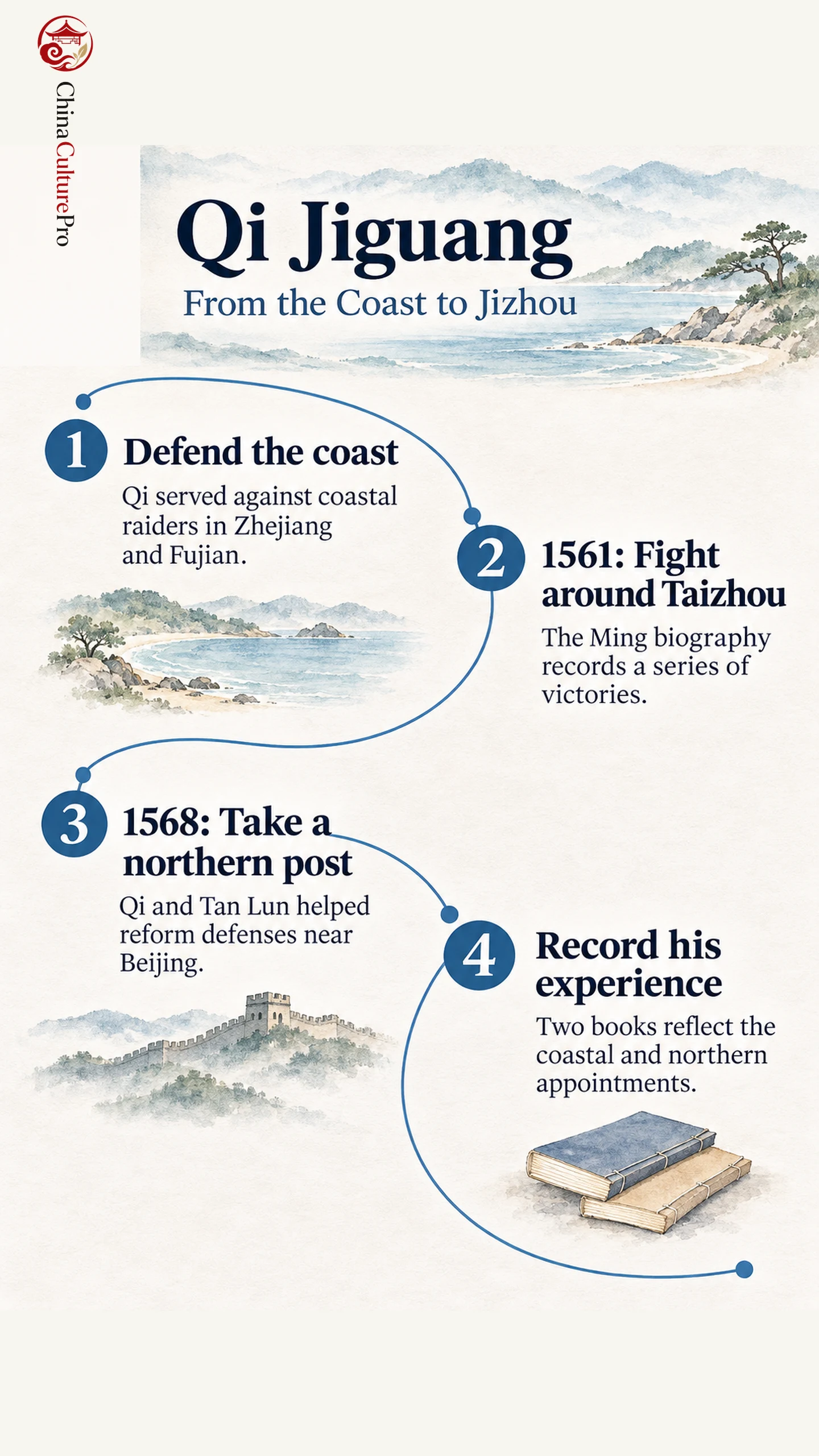
Qi first made his reputation in the southeast, where seaborne raiding and illicit trade overlapped. The Ming court later sent him north, where long-term defense also meant managing garrisons and fortifications.
What Qi Jiguang Did on the Ming Coast
Qi came from a military family and inherited a post associated with the Dengzhou garrison in Shandong. He later served in Zhejiang, where he recruited men from the Yiwu area. The official biography records a series of victories around Taizhou (台州, Tāizhōu) in 1561. Qi went on to serve in Fujian, where he served alongside commanders including Yu Dayou.[1][2]
The label wokou is often translated as “Japanese pirates.” In the sixteenth century, the networks officials called by that name included Chinese and foreign participants. They operated in a maritime trading world shaped by demand for Japanese silver and restrictions on private overseas trade.[4]
What Changed When Qi Went North to Jizhou
The court assigned Qi to northern defense in 1568. He worked alongside Tan Lun (谭纶, Tán Lún), a senior official who helped lead the reform of defenses around Beijing. Soldiers who had served under Qi in Zhejiang became instructors for local troops.[3][6]
The reforms also included work on local forts along the wall system. That work belongs to one phase of Great Wall history and involved a wider Ming program of maintaining the defenses around the capital.[3]
What Qi Jiguang’s Books Tell Historians
The Jixiao Xinshu (纪效新书, Jìxiào Xīnshū) grew out of Qi’s work in Zhejiang. Its introductory material includes documents about gaining official approval for training, showing that changes required cooperation from civil authorities.[5]
The Lianbing Shiji (练兵实纪, Liànbīng Shíjì) took shape in the north and was completed in 1571. Its date and subject connect it to the reorganization of the Jizhou, Changping and Baoding commands.[6]
FAQs About Qi Jiguang
What Does Wokou Mean in This Period?
Ming officials applied it to maritime raiders and networks involved in unauthorized commerce. The people it described in the sixteenth century came from several places.[4]
Did Qi Jiguang Build the Great Wall?
He helped build and repair fortifications in the Jizhou region as part of a broader reform program. The wall system developed through many projects over time.[3]
Which Books Did Qi Jiguang Write?
Two works associated with his career are Jixiao Xinshu and Lianbing Shiji, which historians read in the context of his different appointments.[2]
Источники
[1] Zhang Tingyu and others. History of the Ming, Biography of Qi Jiguang
[2] Academy of Chinese Studies. Qi Jiguang
[3] Lee Hua-yen. Military Reform Around Beijing From the Longqing to the Early Wanli Era
[4] Richard von Glahn. The Political Economy of the East Asian Maritime World in the Sixteenth Century
[5] Bibliographic introduction. Jixiao Xinshu
[6] Chinese Text Project, catalog introduction. Lianbing Shiji