
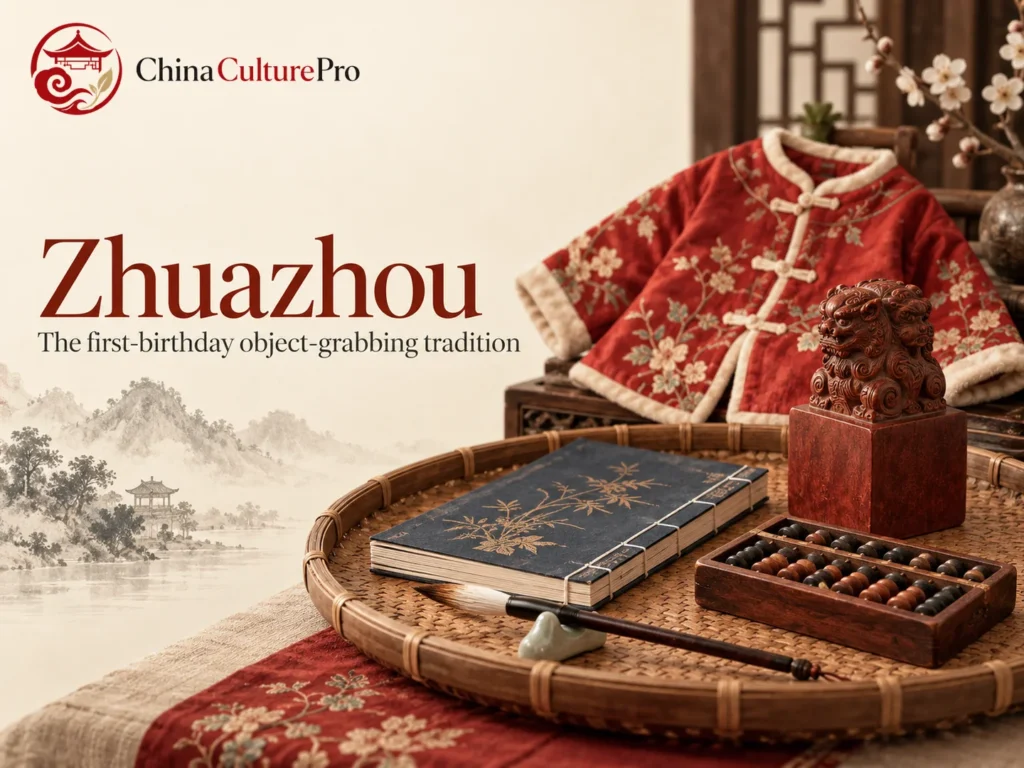

Quick Answer: What Is Zhuazhou?
Zhuazhou (抓周, zhuāzhōu) is a Chinese first-birthday custom in which a child reaches for objects arranged nearby. Family members interpret the selection through symbolic associations with learning, work or other hopes for the child’s life.
- Occasion: The custom belongs to the first birthday, after a year of life.
- Activity: Adults arrange objects and watch what interests the child.
- Meaning: The choice provides a story and a blessing, rather than reliable evidence of a future career.
- Variation: Objects, accompanying rites and interpretations differ between families and periods.
A family can adapt the activity or leave it out. There is no universal object set, compulsory number of selections or “wrong” result.
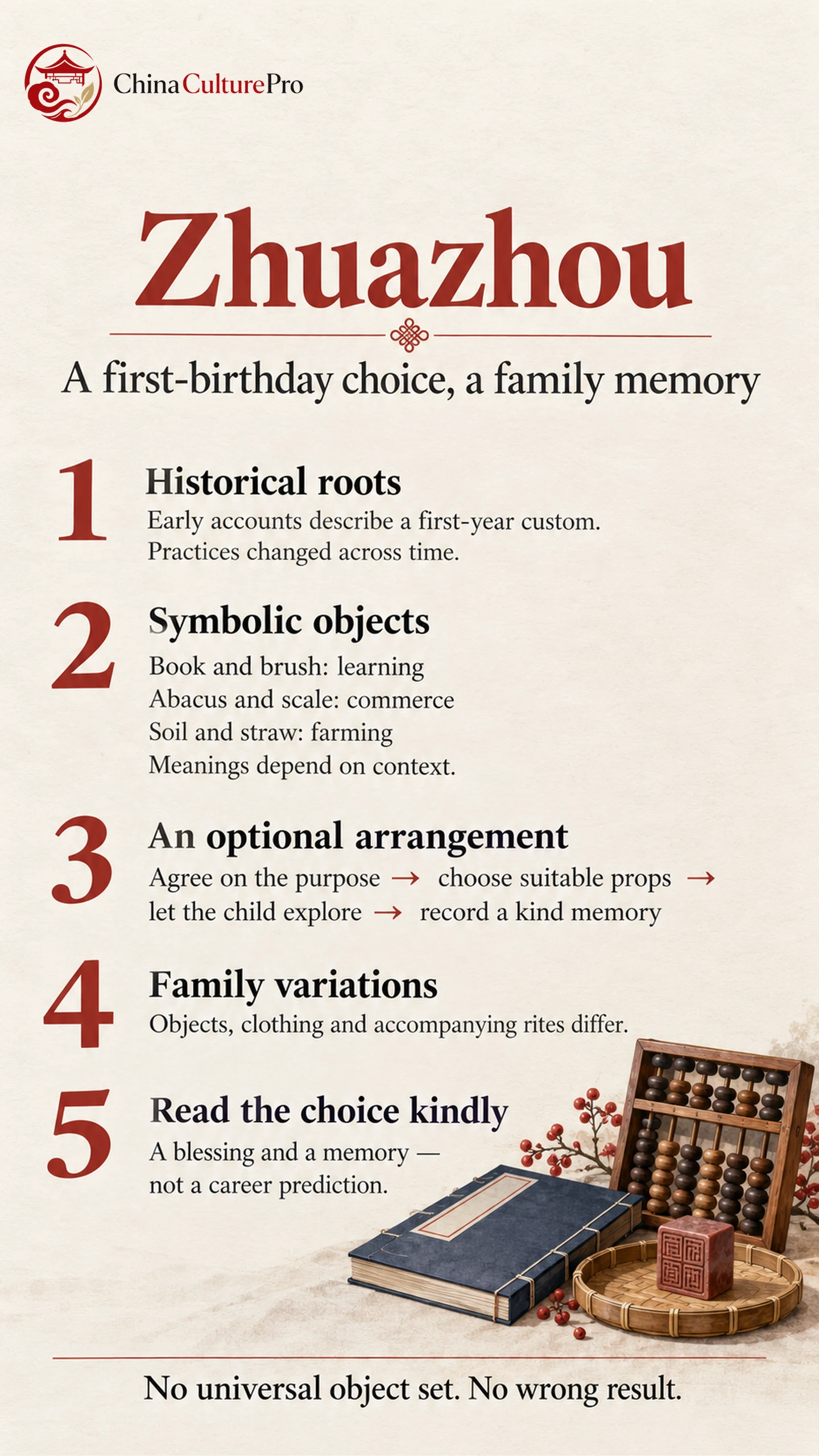
A book, a brush and an abacus can turn a first-birthday gathering into a conversation about the child’s future. The appeal comes from watching a small person make a choice while relatives imagine the possibilities ahead.
The custom has a long written history, but historical descriptions do not form a single instruction manual. Understanding the setting behind an object’s meaning helps keep the celebration affectionate and prevents a moment of curiosity from becoming a label that follows the child.
A First-Birthday Custom with Historical Roots
Zhuazhou (抓周, zhuāzhōu) is the first-birthday object-grabbing tradition. Here the idea is completing the first year: it should not be translated as “grabbing the week.” It is distinct from the full-month celebration earlier in infancy.
A sixth-century account in Yan Zhitui’s Family Instructions describes a Jiangnan custom held when a child had lived a year. New clothing, washing and adornment preceded the presentation of objects. Boys and girls were offered different tools, alongside food, valuables and playthings, and adults interpreted what they took. The text calls the practice a test of the child.[1]
This establishes an early written description, rather than the precise moment the custom was invented. It also reveals how adults projected the social expectations of their own time onto a child’s selection. Gendered tools in an old text are evidence about that society, not a requirement for a birthday today.
Within Chinese baby traditions, the first birthday is one milestone among several. Families may mark it with a meal and cake, an object-grabbing activity, religious observances or a combination chosen for their own circumstances.
What Zhuazhou Objects Can Represent
Objects work through associations understood by the people present. An abacus suggests calculation and commerce because of its use; a writing brush connects with literacy and scholarly work. The same object need not carry an identical modern career title in every household.
Taiwan’s folklore dictionary records a historical arrangement of twelve to sixteen items. Books, a seal, brush and ink belonged to a scholarly group; an abacus, small scale and money related to business; soil and straw suggested farming. These are examples from that account, not a prescribed kit for all Chinese families.[2]
| Object or group | Association in the historical account | A useful distinction |
|---|---|---|
| Book, brush and ink | Learning and scholarly life | They need not indicate a single profession |
| Seal | Scholarly or official standing | Meanings reflect the object’s historical setting |
| Abacus, small scale and money | Commerce and calculation | Modern households may explain them differently |
| Soil and straw | Agricultural work | Rural livelihoods also appear in the record |
The dictionary also includes foods and additional actions surrounding the ceremony. A heritage description is not a reason to hand small coins, ink, sharp tools or food props to a child. Symbolic substitutes can convey an association without reproducing the historical material literally.
One father’s firsthand Shanghai family account offers a vivid modern contrast: his son picked up a mobile phone, briefly touched chopsticks and later took a calculator. The writer explicitly noted that meanings were not fixed and parents could decide how to interpret the objects.[4]
A Simple Family Arrangement
The following is an optional way to organize the activity, rather than a reconstruction of one regional rite. Discuss any ceremonies important to relatives separately, so a short object-grabbing game is not mistaken for the whole first-birthday observance.
- Agree on the purpose: Explain that the activity celebrates the child and expresses family hopes.
- Choose suitable props: Use clean, age-appropriate objects or large symbolic substitutes with an adult supervising.
- Let the child explore: Offer the objects without forcing a choice or repeating the activity to obtain a preferred result.
- Record a kind memory: Describe the moment warmly and respect the parents’ preferences about photographs.
A book-shaped toy can stand for learning, for example, if the family agrees on that meaning. The value lies in a shared explanation rather than buying an elaborate professional kit. Keep the surface comfortable, the gathering manageable and the activity brief enough to follow the child’s interest.
Objects shown in a historical photograph or museum display may be intended for viewing rather than infant handling. Check actual suitability instead of assuming a traditional-looking prop is appropriate. If a child is tired or unwilling, end the activity; the birthday does not need a successful selection to be complete.
Regional Additions and Modern Choices
Clothing, blessings, offerings and food can surround the object selection. Their presence depends on the particular family and community, and they should not be merged into a national sequence.
A Taiwanese folklore record describes a historically male-only version. The much earlier Yan account discusses both boys and girls, with different objects. The contrast is a reminder that “traditional” can describe more than one practice; neither source proves that all families in its period behaved alike.[1][2]
Modern public heritage experiences provide another setting. Taipei’s Lin An Tai Historic House offers families equipment for first-birthday and other infant customs. Its program distinguishes the first-birthday activity from the earlier four-month observance. This is an example of a cultural venue making the practice available, not proof that a family must use a venue or follow its program.[3]
Families abroad may add objects meaningful to several cultural backgrounds. A contemporary object can express a family’s interests, but it is more accurate to call it that household’s addition than to present it as an ancient standard. The wider Chinese birthday traditions also leave room for a modern cake or a simple shared meal.
Reading the Result Without Limiting the Child
The historical language of prediction is part of the custom’s history. It does not establish that reaching for an object measures aptitude or determines an adult occupation. A child may be drawn to an object’s color, shape or familiarity; the gathering cannot distinguish those possibilities from a supposed future calling.
A generous interpretation makes every selection welcome. “Perhaps you’ll love stories” is a lighter family memory than “You have to become a writer.” Choosing no object, several objects or the container is also something the family can remember without assigning a disappointing result.
The lasting value can be a photograph, a note explaining who attended or a record of the blessing a grandparent offered. Within Chinese family traditions, that record tells a child they were welcomed and imagined with affection. It need not become a prediction they are expected to fulfill.
FAQs About Zhuazhou
Is Zhuazhou held at one month or one year?
It belongs to the first birthday, after one year of life. A full-month celebration marks a different occasion much earlier in infancy.
How many objects does Zhuazhou require?
There is no universal number. Historical accounts and modern family arrangements use different sets, so choose a manageable selection rather than treating one count as compulsory.
Is Zhuazhou only for boys?
No. Some historical records describe male-only versions, while other early accounts include boys and girls with different objects. Families today can welcome any child without using gendered restrictions.
What if the baby chooses nothing?
Stop or let the child explore without pressure. The celebration expresses welcome and good wishes; it does not require a particular result.
Sumber
[1] Chinese Text Project. Yan Family Instructions: Virtue and Conduct, original Chinese text
[2] Taiwan Historica. Dictionary of Taiwanese Folk Objects: Zhuazhou
[3] Lin An Tai Historic House and Museum. Self-service infant customs experience
[4] Wang Jianshuo. Zhuazhou: Gift Picking at 1 Year Old, a family account