

Quick Answer: Who Was Zhu Da?
Zhu Da (朱耷, Zhū Dā), better known as Bada Shanren (八大山人, Bā Dà Shān Rén), was a Chinese painter and calligrapher who lived from 1626 to 1705. A descendant of the Ming imperial house, he became a Buddhist monk and later worked as a professional artist. [1]
- Subjects: Birds, fish, plants, rocks and landscapes appear across his work.
- Gaya: Strong contrasts of ink and empty space can make ordinary subjects feel unfamiliar.
- Range: Paintings belong beside his calligraphy and personal letters.
- Context: Ming loyalism matters, but a political interpretation needs evidence from the particular work.
Begin with an identified museum object, not a detached image carrying only the artist’s name.

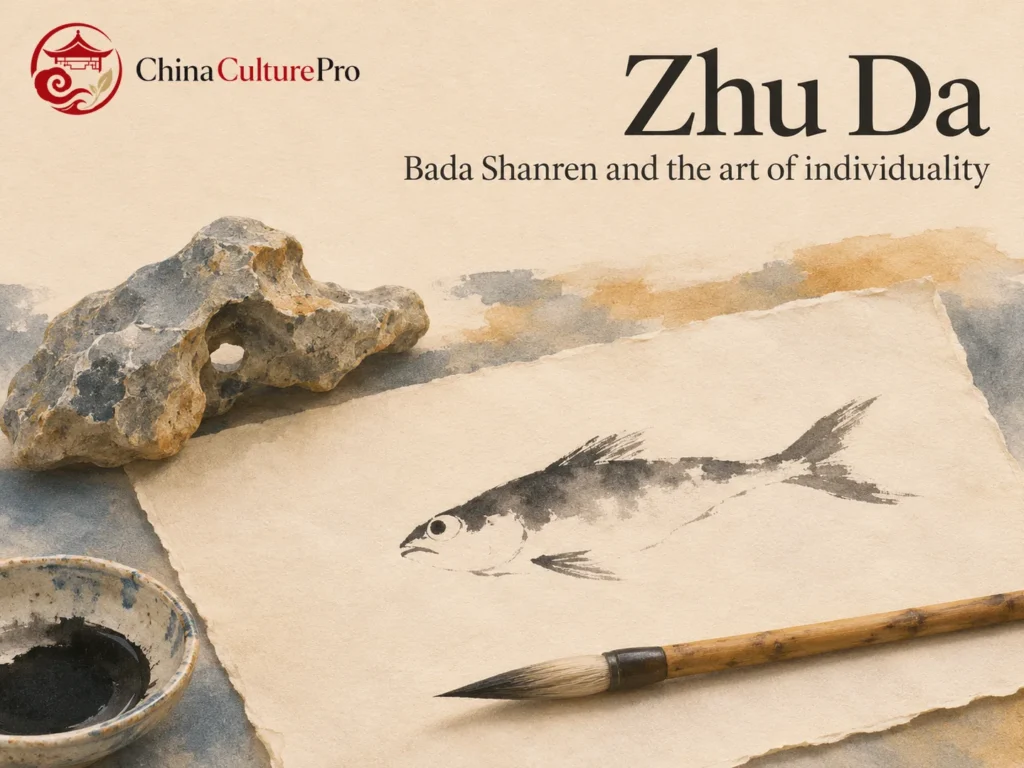
Zhu Da’s paintings can look startlingly spare: a small fish, a large rock and an expanse of untouched paper may carry the whole composition. Their force comes from relationships within the image. Use his biography to deepen a close reading of the image, keeping the historical setting and the visible evidence together.
A Ming Descendant Working in the Qing World
The fall of the Ming in 1644 transformed the world of the imperial family to which Zhu Da belonged. His life moved through princely origins, Buddhist seclusion and a later professional career in painting and calligraphy. Use those phases to place a work in his changing circumstances. [1]
His mature career includes works from the 1680s and 1690s as well as a substantial late period in the early 1700s. A painting dated near the end of his life need not be read as the same response as an earlier work. Changes in scale, subject and pictorial density deserve attention too. [1]
The Qing dynasty supplies the political setting. For an individual work, however, first establish its date and medium. The historical turning point is background to an interpretation, not a substitute for the object record.
Four Documented Works to Compare
These four works provide different entry points into the artist’s practice. The dates below follow their collection records; the letter album has an approximate date range rather than one dated inscription.
| Work | Tanggal | Format and medium | Useful comparison |
|---|---|---|---|
| Fish and rocks | 1699 | Hanging scroll; ink on paper | Tiny fish against large separated rock forms. [2] |
| Landscape album | 1699 | Twelve album leaves; ink and color on paper | Earlier landscape models transformed in a small format. [3] |
| Letters to Fang Shiguan | ca. 1688–1705 | Ten-leaf album; ink on patterned and plain paper | Personal communication as calligraphy. [4] |
| Two eagles | 1702 | Hanging scroll; ink on paper | Forceful bird imagery and a historically grounded reading of defiance. [5] |
Keep collection identity attached to a title. Cleveland’s Fish and Rocks is a different ink-on-paper handscroll, catalogued to the mid- to late 1600s. It should not inherit the date or vertical composition of the 1699 hanging scroll in New York. [6]
This distinction matters when comparing reproductions: a shared English title identifies a subject, not necessarily a unique artwork. Save the collection and object number with your notes if you want to return to the same image.
Look at Space, Brushwork and Format
In the 1699 Fish and rocks, seven small fish establish a body of water without a painted horizon. Their scale makes the two rock forms feel disproportionately imposing. One fish is shown from a different viewpoint from the others, interrupting a stable reading of the scene. [2]
Look first at the intervals around the fish rather than searching for a complete pond. The unpainted field becomes active because a few marks change how it is understood. This is a useful way into Chinese painting: describe what a mark does within the composition before assigning it a symbolic meaning.
The landscape album offers another kind of looking. Dry brushwork, bare trees and empty pavilions connect some leaves with Ni Zan, while simplified mountain masses recall Dong Qichang. These are starting points for improvisation, not evidence that every leaf merely copies an earlier master. [3]
Compare the physical formats as well. A small album leaf invites attention to a bounded surface; a hanging scroll presents a different scale of encounter. Examine one whole image before isolating an attractive detail.
Read Political Meaning without Reducing Every Image to a Code
The term yimin (遗民, yí mín) refers here to subjects who remained after the dynasty they served had fallen. The1699 Fish and rocks has been interpreted within that Ming-loyalist context. Its unsettling spatial relationships give the historical reading a visual basis. [2]
Yet a proposed meaning is not the same as a decoded inscription. The Cleveland handscroll is described as possibly autobiographical, with fish suggesting displaced survivors. Preserve that possibility rather than changing it into a proven message shared by every fish painting. [6]
Two eagles offers a different case: the bird imagery has been read as defiance and loyalty, with reference to earlier powerful eagles and hawks painted by Lin Liang. The connection involves a specific subject and pictorial tradition, not a rule that every bird expresses the same emotion. [5]
For your own notes, separate a visible feature, the relevant historical context and the interpretation proposed from them. That makes the reasoning clearer without denying the painting’s emotional force.
A Legacy of Individuality within a Learned Tradition
Zhu Da’s individuality did not require forgetting earlier art. The landscape album draws on recognizable models while altering their spatial logic and selected motifs. Read such relationships as creative transformations rather than as a choice between tradition and originality. [3]
His letters make the artistic life less remote. The surviving album addressed to Fang Shiguan concerns health, meetings, favors, gifts and painting, including looking at other artists’ work and selling his own. It records social and professional exchanges alongside expressive handwriting. [4]
The calligraphy guide explains why handwriting belongs in the discussion. When examining an inscription, distinguish identifying the script from reading its content; the calligraphy-reading guide develops that separate task. Compare one painting with one letter, paying attention to how spacing and brush movement organize each surface.
FAQs About Zhu Da
Are Zhu Da and Bada Shanren the same person?
Yes. Bada Shanren is an artistic name associated with Zhu Da, the painter and calligrapher discussed here.
Did Zhu Da paint only birds and fish?
No. His surviving practice also includes landscapes and calligraphy. Compare the dated landscape album with the letter album for two different examples.
Are the two museum works called Fish and Rocks identical?
No. The New York work discussed here is a 1699 hanging scroll; Cleveland’s is a differently dated horizontal handscroll. Keep their collection records separate.
Sumber
[1] Smithsonian National Museum of Asian Art. Enigmas: The Art of Bada Shanren (1626–1705)
[2] The Metropolitan Museum of Art. Fish and rocks
[3] The Metropolitan Museum of Art. Landscape album
[4] The Metropolitan Museum of Art. Letters to Fang Shiguan
[5] The Metropolitan Museum of Art. Two eagles
[6] Cleveland Museum of Art. Fish and Rocks