

Quick Answer: Who Was Zhang Juzheng?
Zhang Juzheng (张居正, Zhāng Jūzhèng), who lived from 1525 to 1582, was a leading statesman of the Ming dynasty. As senior grand secretary (首辅, shǒufǔ) from 1572 to 1582, he directed government during the early reign of the Wanli Emperor (万历皇帝, Wànlì Huángdì) and helped educate the young ruler.[1][3][6]
- Administration: He demanded that officials complete assigned work and account for delays.
- Finance: Land registration and consolidated taxation supported attempts to stabilize revenue.
- Politics: Court alliances sustained his authority, while punishment of critics deepened resentment.[1][2][3]
His personal dominance, specific reform measures and changing reputation should be distinguished.
Zhang Juzheng sought reliable work from officials and revenue from the tax system while educating a young emperor. His career shows how administrative reform could depend on court alliances, and how a minister’s fall from favor differed from the fate of individual policies.
Scholar, Imperial Tutor and Senior Grand Secretary
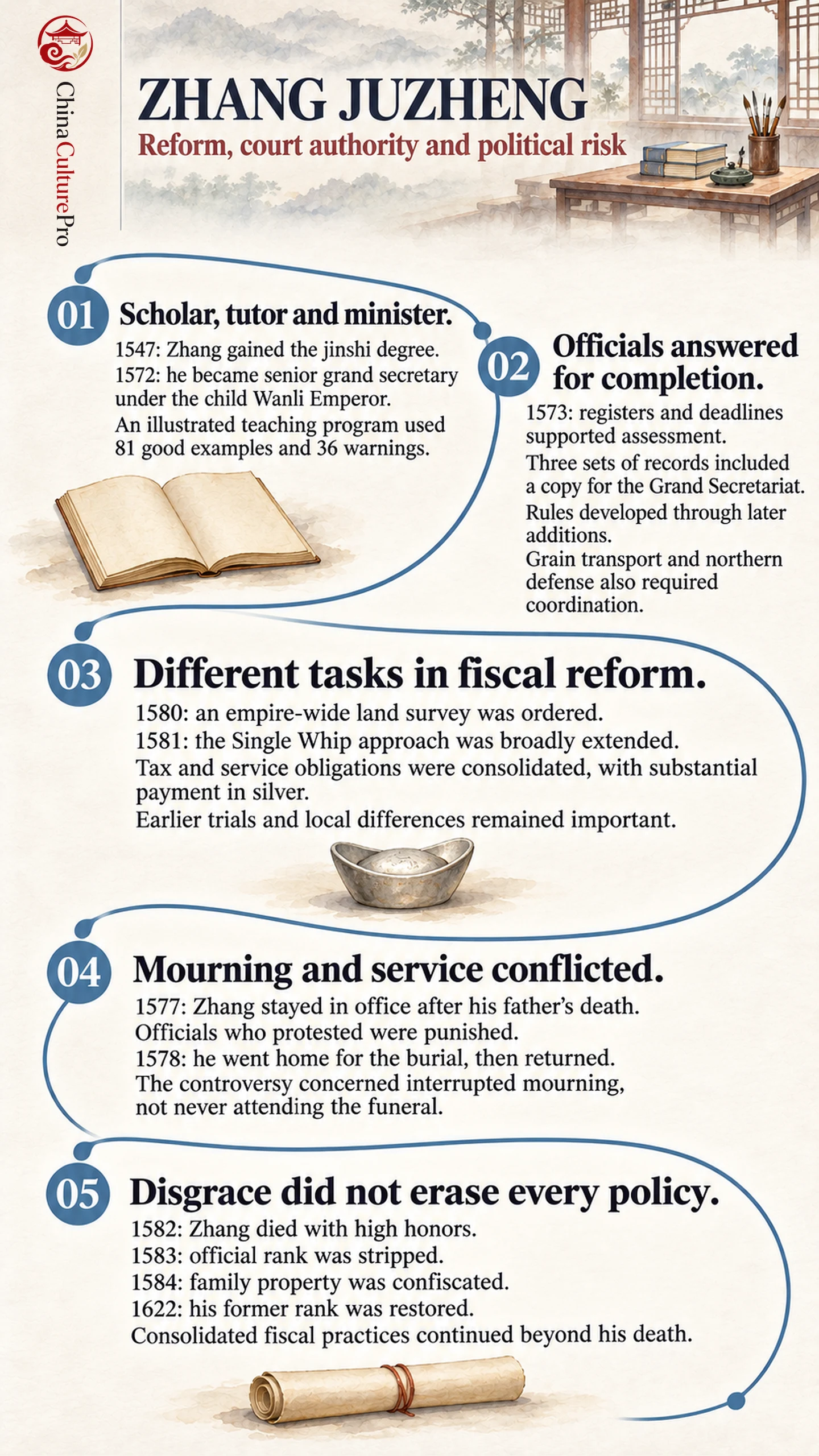
He came from Jiangling and gained the jinshi (进士, jìnshì) degree through the imperial examinations in 1547. Scholarly appointments and service as a princely tutor brought him into high politics; he entered the Grand Secretariat (内阁, Nèigé) in 1567.[1][6]
After the accession of the child Wanli in 1572, Gao Gong (高拱, Gāo Gǒng) was dismissed and Zhang became senior grand secretary. Support from Empress Dowager Li (李太后, Lǐ Tàihòu) and Feng Bao (冯保, Féng Bǎo), a powerful palace eunuch, helped sustain his position. He exercised exceptional authority in the emperor’s name, not as a sovereign in his own right.[1][3]
Teaching was part of that authority. His presentation memorial for the Dijian Tushuo (帝鉴图说, Dìjiàn Túshuō) describes a compilation made with fellow lecturers: 81 examples of conduct to imitate and 36 to avoid. Pictures, historical passages and plain explanations were intended to make lessons in rulership accessible. The memorial presents the teaching team’s intentions; the ruler’s later decisions must be examined separately.[4]
Making Officials Answer for Results
Kaocheng fa (考成法, Kǎochéng Fǎ) made officials answerable for the completion of assigned business. Orders issued in 1573 required registers and deadlines, with checks on delayed or unfinished matters. The Grand Secretariat acquired a supervisory role alongside ministries and censorial offices, strengthening Zhang’s ability to follow orders through the administration.[1][3][5]
The three-register arrangement preserved records at different levels, including a copy for the Grand Secretariat. Responsibility could therefore be traced beyond the office that first handled a case. Later supplementary rules dealt with matters such as deadlines and responsibility when an official changed posts. The rules developed through successive additions and departmental practice.[5]
Resources and appointments also mattered. Zhang adjusted the timing of grain shipments to reduce exposure to seasonal water problems in canal transport. He supported Li Chengliang (李成梁, Lǐ Chéngliáng) and Qi Jiguang (戚继光, Qī Jìguāng) in northern defense. [1]
Land Surveys and the Single Whip Reform
Fiscal policy involved several related tasks. Measuring taxable land, combining obligations and enforcing payment were connected, but they did not do the same job.[1][2][3]
| Measure | Purpose and boundary |
|---|---|
| Land survey and registration | An empire-wide survey order appears in the annals in 1580. Measurement sought to align the taxable register with land actually held; an order did not guarantee a perfectly complete survey. |
| Single Whip reform (一条鞭法, Yītiáo Biān Fǎ) | Tax and service obligations were consolidated, with substantial commutation into silver and government arrangements for hiring labor. It built on earlier experiments. |
| Enforcement and economy | Closer collection and limits on expenditure aimed to improve the treasury. Revenue gains did not prove that every household’s burden declined. |
The Single Whip approach had been tried during the Jiajing era (嘉靖, Jiājìng). Zhang’s government promoted its broader implementation in 1581. Local practices and surviving obligations remained important, so it should not be described as the instant disappearance of all grain payments or all labor service.[2]
The Mourning Controversy of 1577
When his father died in 1577, Zhang remained in service under an exception known as duoqing (夺情, duóqíng), instead of withdrawing for the normal mourning period. The decision brought the duties of office into conflict with filial piety (孝, xiào), a central moral obligation of an official’s public standing.[1][3]
Officials who protested were beaten, dismissed or sent away. Imperial support kept Zhang in office, but the coercive response gave opponents grounds to attack the gap between his demands on others and the exceptional treatment he received. The dispute concerned political authority as well as private grief.[1][3]
He did go home to bury his father in 1578, then returned to court. He did not, however, withdraw for the full normal mourning period. Even while he was away, major decisions were referred to him, revealing the extent to which administration centered on his person.[1][3]
Death, Disgrace and the Survival of Reform
Zhang died in 1582 with high honors. The court’s subsequent reversal unfolded in stages: official rank was stripped in 1583, and the family’s property was confiscated in 1584. The investigation brought deaths and exile within the household. The biography records his eldest son’s suicide under interrogation.[1][3]
His opponents attacked both personal wealth and political domination. His biography also records favoritism and the punishment of critics, alongside its account of more effective administration. In 1622, his former rank was restored, and later Ming decisions further revised the treatment of his family.[1][6]
The fall of his allies weakened the personal networks through which he had governed. The later tax history continues to discuss levies imposed on the existing framework. Distinguishing political purges from institutional survival gives historical judgment a firmer basis.[2]
FAQs About Zhang Juzheng
Was Zhang Juzheng an emperor?
No. He was the senior grand secretary, a powerful minister working in the emperor’s name during Wanli’s early reign.[1]
Did Zhang Juzheng invent the Single Whip system?
No. Earlier trials preceded him. His government promoted wider implementation, associated with 1581.[2]
Did he refuse to attend his father’s funeral?
No. He went home for the burial in 1578. The controversy concerned remaining in office rather than completing the normal withdrawal for mourning.[1][3]
Were all his reforms reversed after his death?
No. His allies and reputation suffered, but fiscal practices such as consolidated assessment continued beyond his death.[1][2]
Sumber
[1] History of Ming, chapter 213. Biography of Zhang Juzheng
[2] History of Ming, chapter 78. Taxation and Labor Service
[3] History of Ming, chapter 20, Siku text. Annals of Emperor Shenzong, part one
[4] Zhang Juzheng. Memorial Presenting the Dijian Tushuo
[5] Chen Guoping / China Legal Science journal publisher. A Study of the Kaocheng System in Zhang Juzheng’s Reforms: Published Excerpt
[6] Palace Museum. Zhang Juzheng