


Quick Answer: What Does Yi Culture Include?
Yi(彝族,Yízú)culture encompasses varied communities of southwestern China, with regional languages, writing traditions, textiles, festivals and forms of ritual and artistic knowledge.
- Communities: Major areas include Yunnan, Sichuan, Guizhou and Guangxi. [1]
- Language: Regional speech varieties and written traditions require more precise labels than “Yi” alone.
- Festivals: Torch celebrations combine community gathering, performance and local ritual.
- Material arts: Embroidered garments and painted wooden objects use different skills and materials.
- Everyday life: Food, song and family practices differ between places and generations.
An ethnic category does not imply one costume, one calendar or identical beliefs. The most useful introduction locates each example in a particular community.
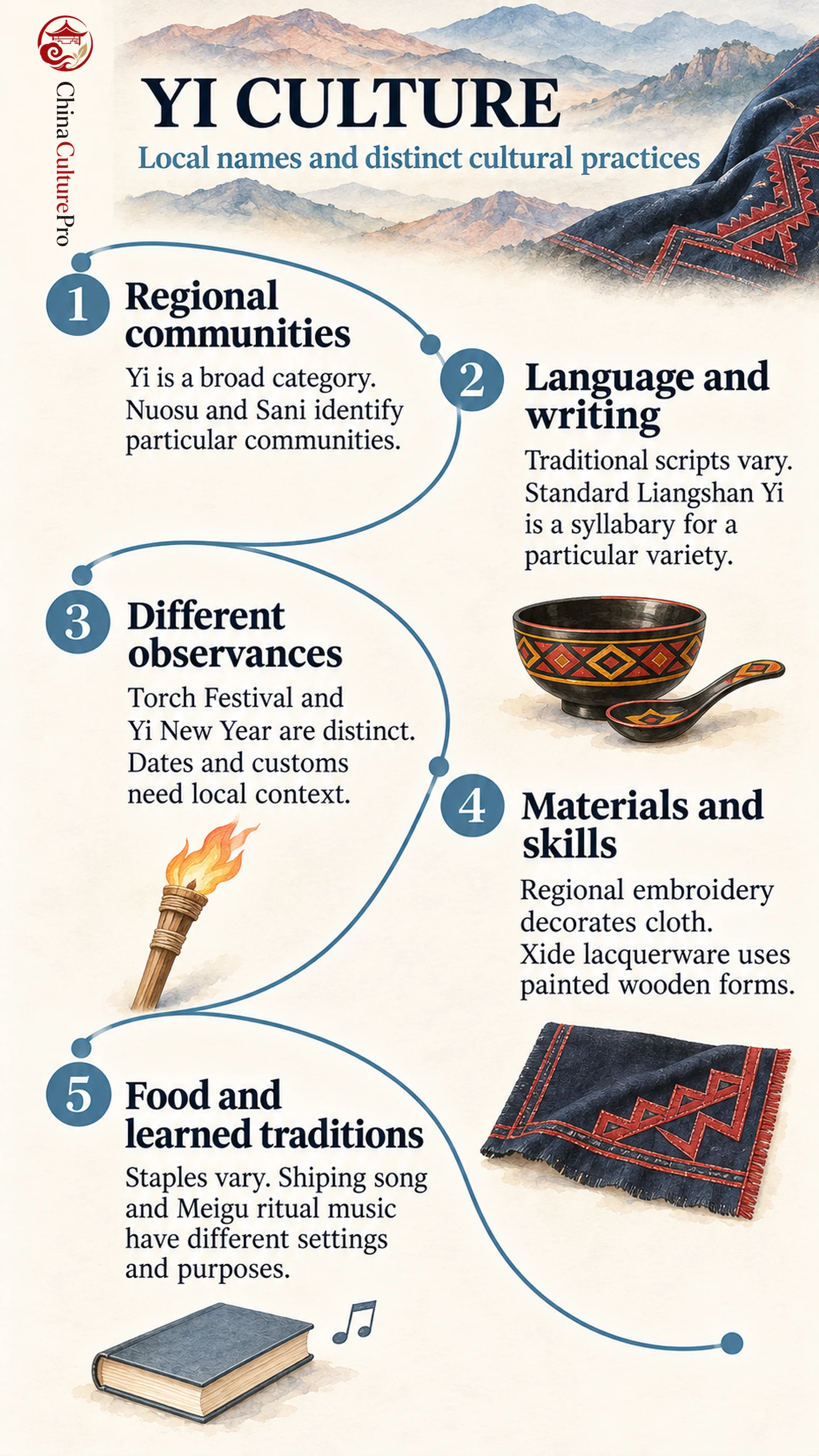
A torchlit gathering in Sichuan, an embroidered garment in central Yunnan and a vocal suite from Shiping represent different cultural settings. Reading them together reveals connections, while their local names and functions explain why a single image cannot stand for all Yi life.
Yi Communities and Regional Names
Within China’s ethnic categories, Yi is a broad designation. Communities live in Sichuan’s Liangshan, Yunnan’s Chuxiong and Honghe, parts of Guizhou and northwestern Guangxi, as well as elsewhere. The same label crosses markedly different upland, valley and agricultural environments. [1]
Nuosu(诺苏,Nuòsū)is an important self-name associated with Liangshan communities. Sani(撒尼,Sāní)identifies a Yi community in Yunnan associated with the oral narrative tradition of Ashima. Neither name is interchangeable with every group classified as Yi. [1][10]
This regional perspective connects the subject to Yunnan culture and Guizhou culture without making either province culturally uniform. In Chinese cultural geography, landscapes help explain different livelihoods and local connections; they do not predetermine people’s personalities.
Yi Languages and Traditional and Standard Scripts
The Yi language(彝语,Yíyǔ)label covers substantial internal diversity. A common Chinese linguistic classification distinguishes six main dialect groups, themselves containing further varieties. This is not a promise that speakers from every region can readily understand one another. [1]
Yi script(彝文,Yíwén)also has both traditional and standardized forms. Older manuscripts record ritual texts, genealogies, poetry, calendars and other knowledge, with local differences in character forms and readings. Written heritage therefore extends beyond modern schoolbooks. [1]
The standardized Liangshan system, officially promulgated in 1980, is a syllabary: its signs represent syllables rather than individual alphabetic sounds. It was designed for Liangshan Yi, rather than as a unified script for all Yi varieties. [2]
Two questions help clarify any example: which spoken variety does it record, and is it a traditional manuscript or standardized text? A modern printed page cannot automatically stand for every earlier writing practice, while a ritual manuscript does not describe all contemporary literacy.
The Torch Festival and the Yi New Year
The Torch Festival(火把节,huǒbǎ jié)is widely associated with Yi communities. In Chuxiong and Liangshan, the twenty-fourth day of the sixth lunar month is a prominent calendar reference. Documented activities include lighting torches, music, dancing, sporting contests and social exchange. The lunar date shifts against the Gregorian calendar. [3]
Torches may appear in village and agricultural settings as well as organized performances. Local observances and public celebrations need not present the same sequence. Stories explaining the festival’s beginnings belong to the communities’ narrative traditions; they should not be treated as a single proven historical event.
The Yi New Year(彝族年,Yízú nián)is a separate named observance. Dates and practices vary locally, including celebrations selected during the tenth or eleventh lunar months. It should not simply be renamed “the Torch Festival” or assigned one universal Gregorian date. [4]
A public stage show offers one view of a festival. It cannot by itself establish how every household marks that occasion or which ceremonies an individual participates in.
Regional Dress, Embroidery and Lacquerware
Traditional dress varies with region, community, age, gender and occasion. Chuxiong clothing includes locally distinguished Dayao, Longchuanjiang and Wuding types. These categories describe regional traditions, rather than a single mandatory outfit. New materials and decorative choices also enter living dress practices. [5]
Liangshan embroidery supplies a more detailed comparison. Work from Ganluo, Yuexi and Zhaojue differs in stitches, appliqué, motifs and color choices. Dark cloth can carry bright decorative work on collars, cuffs, garments, bags and other objects. Decoration and reinforcement may serve the same piece. [6]
A photograph of festival dress therefore needs a place and occasion, not just an ethnic caption. Nor does a repeated animal or plant motif carry one guaranteed meaning across every district.
Xide lacquerware is another material tradition. Wooden forms are prepared and coated, commonly with red and yellow patterns against a black ground. The colored surface is lacquer decoration, not embroidered cloth. Its relationship to domestic objects broadens the picture beyond clothing. [7] Shared colors alone do not establish that different objects were made by the same technique.
Foods, Songs and Ritual Knowledge
Regional food descriptions include potatoes, maize, buckwheat and rice, alongside meat, beans and vegetables. [4] This variety matters: a celebratory meal is only one setting, and no single staple describes all Yi households. The wider context of Chinese food culture helps distinguish everyday meals from foods selected for gatherings.
Vocal traditions also have different purposes. Haicaiqiang(海菜腔,hǎicàiqiāng)is associated with Nisu communities around Shiping in Yunnan. A bimo(毕摩,bìmó)is a ritual specialist; the music documented in Meigu, Sichuan, belongs to particular ceremonial settings. [8][9]
| Tradisi | Form and setting |
|---|---|
| Shiping Haicaiqiang | Extended, multi-section vocal suites can combine solo, antiphonal and group singing in a local song tradition. |
| Meigu bimo music | Recitation and singing accompany ceremonies, carrying ancestral, historical and cosmological knowledge. |
Both require learned skills, but they should not be collapsed into a generic “tribal song.” Haicaiqiang belongs within the diversity of Chinese performing arts; ritual chanting has a different immediate purpose. [8][9]
The presence of bimo traditions does not establish a single religion followed by every Yi person. Likewise, an inherited account can preserve cultural memory without every episode becoming independently verified history. Local context identifies what a performance does and how its knowledge is transmitted.
FAQs About Yi Culture
Is Nuosu Another Name for Every Yi Community?
No. Nuosu is a regional self-name, particularly associated with Liangshan. The wider Yi category includes other community names and cultural traditions.
Do All Yi People Read the Same Script?
No. Traditional writing varies locally. The standardized Liangshan syllabary was designed for a particular speech variety, rather than all Yi languages.
Is the Torch Festival the Yi New Year?
They are distinct named observances. Torch celebrations are associated with the sixth lunar month in major regional examples, while new-year dates vary locally.
Do All Yi People Wear the Same Traditional Dress?
No. Dress differs by locality, community, age and occasion. Ceremonial garments also should not be assumed to represent everyone’s daily clothing.
Sumber
[1] National Ethnic Affairs Commission. Yi: overview
[2] Unicode Consortium. The Unicode Standard, Chapter 18: East Asia
[3] China Intangible Cultural Heritage Network. Yi Torch Festival: Chuxiong
[4] National Ethnic Affairs Commission. Yi customs
[5] China Intangible Cultural Heritage Network. Yi clothing: Chuxiong
[6] China Intangible Cultural Heritage Network. Liangshan Yi embroidery
[7] China Intangible Cultural Heritage Network (Jaringan Warisan Budaya Takbenda Tiongkok). Yi lacquer finishing techniques: Xide
[8] China Intangible Cultural Heritage Network. Yi Haicaiqiang
[9] China Intangible Cultural Heritage Network. Bimo music
[10] China Intangible Cultural Heritage Network. From heritage project to living tradition: Ashima protection