


Quick Answer
Tu’er Shen (兔儿神, Tù’ér Shén), often translated as the Rabbit Deity, is the title given to Hu Tianbao (胡天保, Hú Tiānbǎo) in a Qing story about desire between men. The writer Yuan Mei (袁枚, Yuán Méi) records the story in Zibuyu (子不语, Zǐ Bù Yǔ). At Wei Ming Tang (威明堂, Wēimíng Táng) in New Taipei City, the deity is honored as a protector of LGBTQ+ people and their relationships.[1][2][3]
- The story: Hu Tianbao returns in a dream after his death and says he has been given responsibility for love between men.[1]
- The historical record: Historian Michael Szonyi found evidence of devotion to Hu Tianbao in eighteenth-century Fujian.[4]
- The temple: Wei Ming Tang identifies the deity by name and welcomes people seeking blessings for same-sex relationships.[2][3]
The Qing tale, historical evidence and the modern temple’s account each describe a different part of the tradition. The temple’s language of LGBTQ+ belonging describes its present community. The Qing tale speaks more narrowly about desire between men.[1][2][3][4]
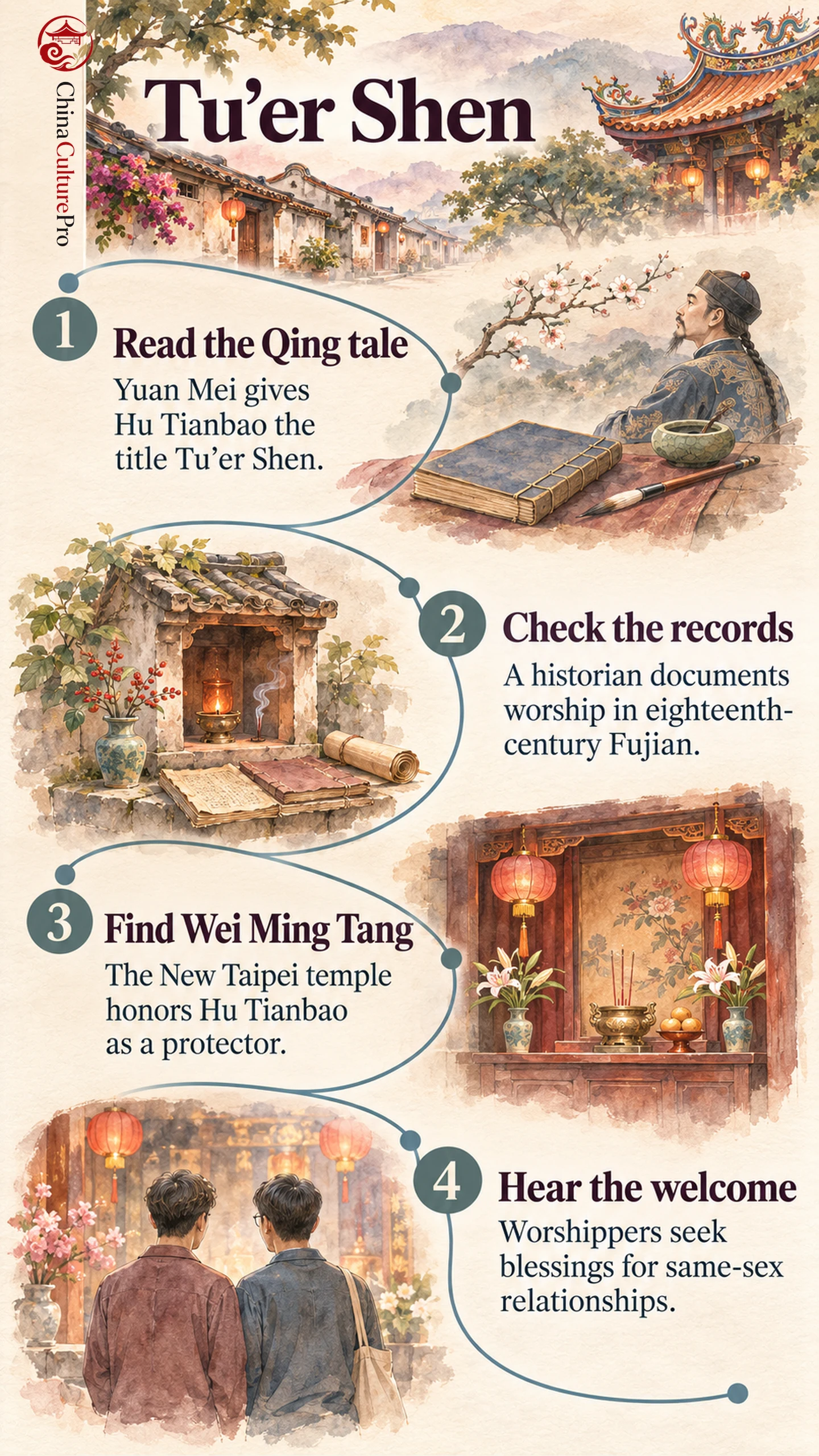
In Yuan Mei’s story a dream gives Hu Tianbao a divine title. In today’s Taiwan, that title can mean that a couple is welcome to ask for a blessing at a temple. The connection becomes clearer when the written tale and the temple’s practice are read in their own settings.[1][2][3]
What Yuan Mei’s Story Says About Hu Tianbao
Yuan Mei tells of a man in Fujian who is drawn to a visiting imperial inspector. The inspector has Hu Tianbao killed after discovering him spying on him in a private place. Hu later appears in a dream to someone from his home village. He says officials of the underworld have made him the Rabbit Deity and asks for a shrine where offerings can be made. The tale ends with the villagers making an image and worshipping him.[1]
The story speaks specifically of men desiring men. It records that desire within a supernatural tale told by a Qing writer. The modern temple draws on the story’s figure of protection while describing a wider welcome, including women in same-sex relationships.[1][2][3]
What Historical Sources Say About the Worship
Szonyi examines records of Hu Tianbao worship in eighteenth-century Fujian, including official attempts to curb it. The records he discusses describe an image of two men embracing. That detail is useful when explaining why the name “Rabbit Deity” cannot by itself tell us what a historic shrine looked like. The evidence ties the worship to a named figure and particular social settings.[4]
For the same reason, a rabbit image should be read in context. Beijing’s Rabbit Lord, Tu’er Ye (兔儿爷, Tù’ér Yé), appears in records of folk craft and temple-fair objects. Wei Ming Tang identifies the subject of its dedication as Hu Tianbao. Where the English names sound similar, the Chinese title, temple and story help separate these traditions within <a href="/id/”https://www.chinaculturepro.com/chinese-folk-religion/”/">Chinese folk religion</a>.[2][5]
What Wei Ming Tang Offers in New Taipei City
Wei Ming Tang’s list of deities names Hu Tianbao as a protector of LGBTQ+ people. Taiwan’s Central News Agency interviewed a temple priest in 2019 who described people coming to seek a partner or ask for blessings for an existing relationship. The priest also described offering a ceremony in which couples could seek the god’s witness to their union.[2][3]
For people who have felt unwelcome in religious settings, the priest said, an explicit welcome is part of what the temple offers. That aim gives the story of Hu Tianbao a public role in present-day New Taipei City. The source of that welcome is explicit in the temple’s list of deities: Hu Tianbao is named as a protector.[2][3][4]
FAQs About Tu’er Shen
Does Tu’er Shen refer to Hu Tianbao?
Yes. Yuan Mei’s story gives that divine title to Hu Tianbao, and Wei Ming Tang uses both names in its dedication.[1][2]
Is Tu’er Shen the same as Beijing’s Rabbit Lord?
They have different stories and settings. Hu Tianbao is the figure honored at Wei Ming Tang. Beijing’s Tu’er Ye is associated with folk figures such as the ones documented in Beijing temple-fair culture.[2][5]
Where is the temple that honors Tu’er Shen in Taiwan?
Wei Ming Tang is in Zhonghe District, New Taipei City. The temple’s website lists a Zhonghe location and identifies Hu Tianbao among the deities it honors.[2]
Sumber
[1] Yuan Mei, translated by David K. Jordan. The Rabbit Spirit, Chinese text and English translation
[2] Wei Ming Tang. Deities honored at the temple
[3] Central News Agency. Wei Ming Tang and blessings for same-sex relationships
[4] Michael Szonyi. The Cult of Hu Tianbao and the Eighteenth-Century Discourse of Homosexuality
[5] Capital Museum. Exhibition on Beijing, Tianjin and Hebei temple fairs