
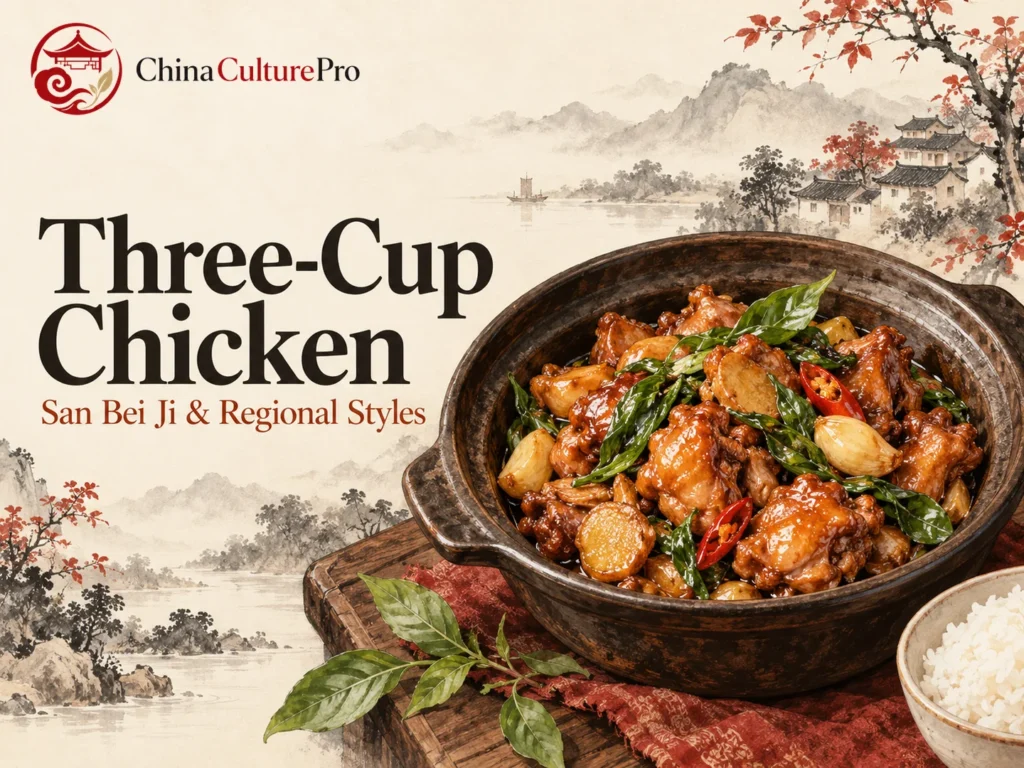

Quick Answer: What Is Three-Cup Chicken?
Three-cup chicken, also called San Bei Ji (三杯鸡, sān bēi jī), is chicken cooked with soy sauce, rice wine and oil until coated in a concentrated sauce.
- Chicken: Often chopped into bone-in pieces, although boneless versions also exist.
- Three seasonings: Soy sauce, rice wine and cooking fat explain the familiar name.
- Aromatics: Ginger and garlic are common; sesame oil and basil characterize many Taiwanese versions.
- Finished dish: Savory, glossy chicken served as a shared dish, often with rice.
The name does not require three full measuring cups or one universal ratio. Jiangxi and Taiwanese versions differ, and neither basil nor a clay pot defines every rendition.
Glossy chicken pieces, softened garlic and fragrant ginger make three-cup chicken easy to recognize among Chinese dishes. In many Taiwanese versions, a handful of basil adds another aroma. The name raises a useful question: what exactly are the three cups?
What Do the Three Cups Mean?
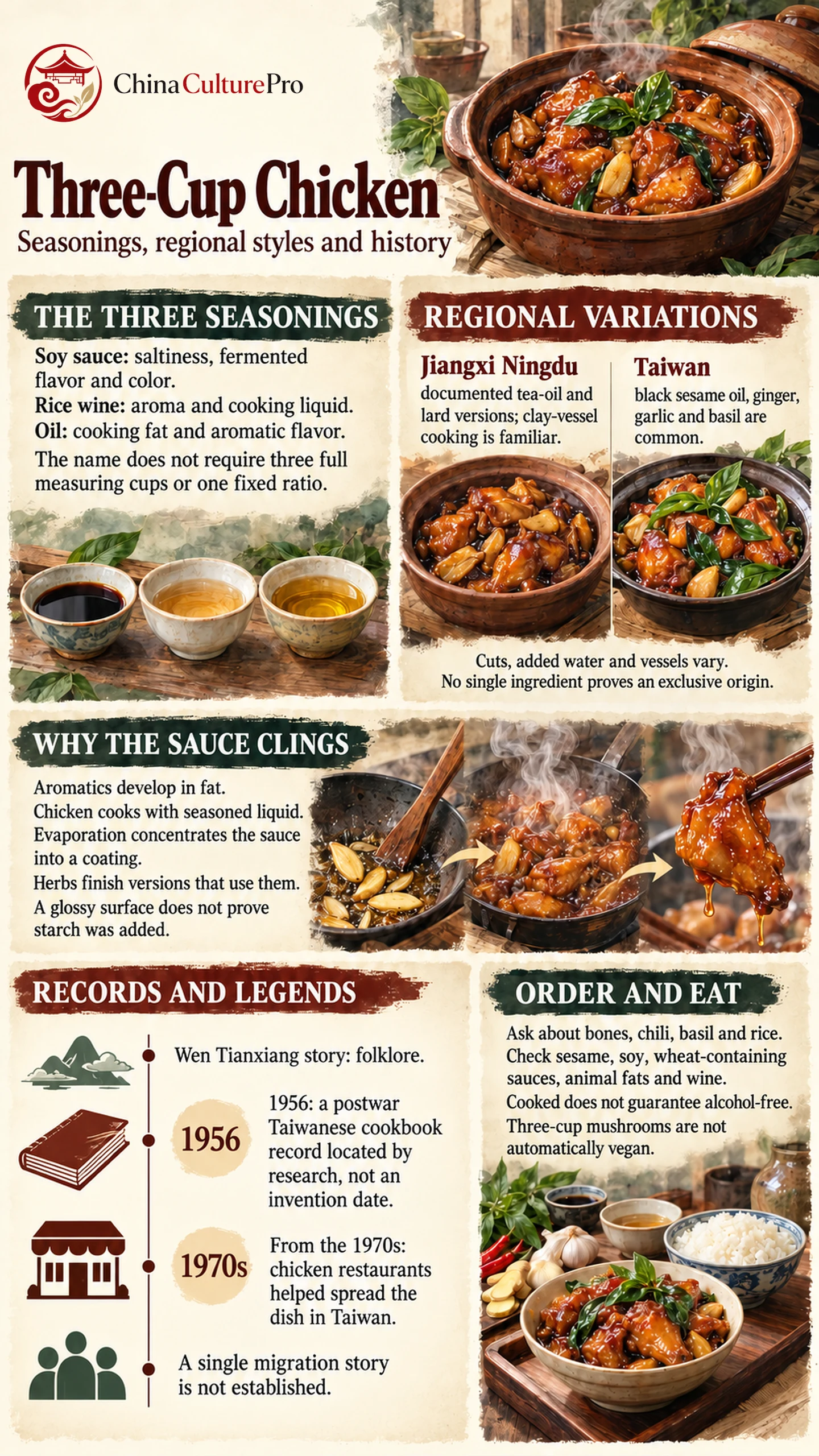
The usual explanation identifies three seasoning categories: soy sauce, rice wine and oil. Their quantities are adjusted to the chicken and the kitchen’s preferred balance. Some recipes use equal measures; others do not. Three full household measuring cups are not a requirement.
- Soy sauce: Supplies saltiness, fermented flavor and brown color. Different soy sauces and prepared sauce blends can change both the taste and appearance.
- Rice wine: Contributes aroma and liquid for cooking. Taiwanese rice wine and the sweet fermented-rice preparations described in some Jiangxi accounts are not interchangeable labels for one identical ingredient.[1][2]
- Oil: Provides cooking fat and carries aromatic flavors. Sesame oil adds a distinctive toasted fragrance; other fats produce a different result. Oil does not seal meat juices inside the chicken.
Ginger, garlic, sugar, chili and herbs are additional ingredients, not extra cups. Jiucengta (九层塔, jiǔcéngtǎ) is a basil used in Taiwanese cooking. It differs in culinary character from pesto-style sweet basil and the holy basil associated with Thai kaphrao dishes. Different basils can be used as adaptations, with a different aroma.[3]
Jiangxi and Taiwan: Regional Variations
Regional names describe recognizable traditions, but they do not produce a single, unchanging recipe. Oil choice, herbs, chicken cuts and cooking vessels all need a more precise local context.
Jiangxi Ningdu: A Local Hakka Tradition
Ningdu three-cup chicken is associated with Jiangxi’s Hakka food tradition. A local account describes a tea-oil version, while another published account describes lard and sweet fermented rice wine. These examples do not justify calling every Jiangxi rendition a sesame-oil dish, or declaring one fat universal.[2][4]
Clay-vessel cooking without additional water is a familiar Ningdu description. Even then, the dish is not literally cooked without liquid: wine and moisture released by the chicken remain involved. A regional cooking standard, DB36/T 1811-2023, documents Ningdu three-cup chicken as a contemporary local specialty; its existence does not establish a medieval invention date.[5]
Taiwanese Versions: Sesame Oil and Basil
Many Taiwanese versions pair rice wine and soy sauce with black sesame oil, ginger, garlic and a basil finish. One published restaurant preparation also includes sugar and chicken that has been fried before being combined with its sauce.[1]
Other documented restaurant versions use boneless chicken, or add water during cooking. Such variations make “always bone-in,” “never add water” and “must use basil” unreliable tests of the whole category.[6] Sesame oil and basil help identify a familiar Taiwanese flavor profile, rather than proving that every local chicken dish follows the same formula. The historical relationship between the regional traditions requires a separate look at the evidence.
How Three-Cup Chicken Is Cooked and Why the Sauce Clings
The finished texture comes from several operations, not simply pouring a ready-made sauce over cooked meat. Ginger and other aromatics develop flavor in cooking fat. Chicken then cooks with the seasoned liquid, combining its juices with soy sauce and wine. Some kitchens blanch, brown or fry the chicken beforehand; those preliminary treatments are version-specific.[1][7]
During the moist cooking stage, the chicken takes on the seasoning. As liquid evaporates, the remaining sauce becomes more concentrated and coats the pieces more closely. Sugar, when used, also affects sweetness and the finished coating. The result is usually a small amount of rich sauce clinging to the chicken, rather than a bowl of thin broth.
A basil finish adds a fresh herbal note in versions that use it. A clay pot may hold and present the dish, but a wok or other cooking vessel can also be involved. The serving pot alone does not reveal the complete kitchen process. Nor does a glossy surface prove that starch was added: reducing the cooking liquid is itself an important part of the dish.
Three-Cup Chicken History: Records, Legends and Local Culture
A well-known origin legend links the dish to Wen Tianxiang (文天祥, Wén Tiānxiáng), the Southern Song statesman. Different tellings describe chicken prepared for him during imprisonment. This is a food legend, not secure evidence that the modern dish was invented for him.[2][8]
A study of the dish’s development located a postwar Taiwanese recipe in Zhongcai Jijin (中菜集锦, Zhōngcài Jíjǐn), published in 1956. That is the earliest such cookbook record identified in the research, not a proven first appearance everywhere or the date someone invented three-cup chicken. Later writing attributed it to Jiangxi, but a written attribution is not the same as evidence of the transmission itself.[8]
Interviews with Taiwanese cooks offer other explanations, including rural cooking practices and an evolution from sesame-oil chicken. The growth of chicken-specialist restaurants helped popularize the dish in Taiwan from the 1970s onward. These oral accounts and restaurant developments matter, but they should not be combined with the Wen Tianxiang story to manufacture one seamless history.[8]
Jiangxi’s contemporary local tradition and Taiwan’s established food culture can both be described clearly. Neither requires claiming that all questions of birthplace, migration and recipe change have been settled.
Ordering and Eating Three-Cup Chicken
Ask about the kitchen’s version before ordering, especially when ingredients or chicken bones affect your choice:
- Chicken and heat: Check whether the pieces are bone-in or boneless, and whether chili is included.
- Herbs and serving: Ask about basil and whether rice is ordered separately. A concentrated sauce makes the dish easy to share alongside plain rice.
- Ingredient restrictions: Check sesame, soy, wheat-containing sauces and any animal fats. Soy is an allergen, but soy itself is not gluten; wheat in a sauce is a separate issue.
- Rice wine: Do not assume cooking makes the meal alcohol-free. If avoiding alcohol, ask specifically about wine and prepared sauces.[9]
Take care with bones as you divide the chicken. In the shared-table setting of Chinese food culture, each diner can take a portion. Menus may also offer three-cup mushrooms or seafood: these use the seasoning idea with another main ingredient. A mushroom version still needs its broth, sauce and fat checked before it can be treated as vegan.
FAQs About Three-Cup Chicken
Does Three-Cup Chicken Use Three Equal Cups?
Not necessarily. The name points to soy sauce, rice wine and oil. Equal proportions occur in some recipes, but other versions adjust the balance. Three full measuring cups are not a universal rule.
Is Three-Cup Chicken Always Spicy?
No. Chili use varies, and some versions omit it. Ginger’s warming aroma is different from chili heat. Ask about the particular preparation rather than judging its heat from the dark sauce.
Does Three-Cup Chicken Always Contain Basil?
No. Jiucengta is characteristic of many Taiwanese versions, but it is not a requirement across all regional and restaurant preparations. A basil-free dish is not automatically outside the three-cup category.
Does Three-Cup Chicken Contain Alcohol?
Rice wine is a common ingredient, so the cooked dish should not automatically be treated as alcohol-free. For an alcohol restriction, confirm the ingredients and preparation with the kitchen.
Sumber
[1] Shin Yeh. Three-Cup Chicken
[2] Zhang Pan. Taiwan’s Chicken-Year Food and Culture
[3] Taiwan Ministry of Agriculture. The Basil Family
[4] Ningdu County Integrated Media Center. The Nostalgia in Three-Cup Chicken
[5] National Standards Information Platform. Local Standards Registration Bulletin
[6] Hsieh Ming Ling. The Many Lives of Three Cup Chicken, a Taiwanese Classic
[7] Taiwan Agriculture Knowledge Portal. Versatile Chicken Dishes, Part Two
[8] Chunghao Kuo. Tracing the Story of Taiwan’s Three-Cup Chicken
[9] Taiwan Health Promotion Administration. Can Pregnant Women Eat Dishes Containing Alcohol?