
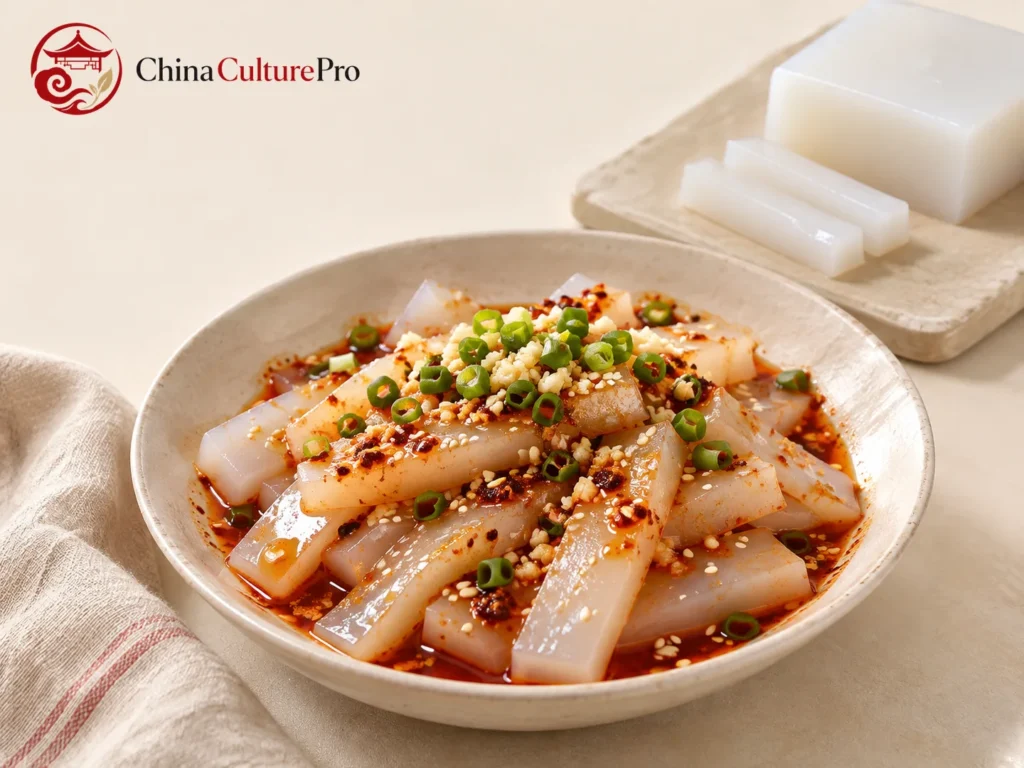

Quick Answer: What Is Sichuan Mung Bean Jelly?
Liangfen (凉粉, liáng fěn) is a cooked starch jelly cut into strips or cubes. In a Sichuan-style mung bean version, the jelly is mild, smooth and slippery, while its dressing supplies the strong flavor.[2][8]
- Ingredient: use mung bean starch for the white jelly described here.
- Texture: soft and slippery, with enough structure to cut.
- Method: cook starch with water, let it set, then shape and season.
- Serving: cold chili-oil dressings and hot stir-fries are both possibilities.[1][2][3]
Liangfen is a broader food family than mung bean jelly alone. Sichuan versions can also use peas and other starches.[3][4]

Make the plain jelly first, then choose how to season and serve it.
What Liangfen Is and How It Differs from Noodles
“Jelly noodles” describes cut or scraped gel, rather than a packet of dried strands.[1][2]
| Istilah | Makna | Kitchen role |
|---|---|---|
| Mung bean liangfen | A cooked mung bean starch jelly that sets into a cuttable block | Slice or scrape it, then dress or cook it |
| Mung bean starch | The powder used to form the jelly | Measure it with water before heating |
| Mung bean thread noodles | Dried starch noodles | Prepare the dried strands according to their package |
Liangfen appears well beyond Sichuan, but local sauces and serving traditions make it part of the province’s food landscape. A bowl can be a street snack or one dish in a meal, especially welcome in warm weather.[8]
Choosing Starch and Measuring the Water
Use clearly labelled mung bean starch. Whole-bean flour and other starches are not automatic substitutes for this method.[1][2]
For the base below, measure ½ cup mung bean starch and 3½ cups water: 1:7 by volume, using the same cup.[3]
Volume and weight ratios are different. Follow one complete formula rather than combining quantities from different methods.
How to Cook and Set the Jelly
Keep all the measured water accounted for between the slurry and the pan.
- Make a slurry: mix the starch with 1 cup of the measured cold water.[3]
- Heat the rest: boil the remaining 2½ cups water, reduce to medium-low and whisk in the slurry.[3]
- Cook while stirring: whisk continuously for about one minute, until thick and slightly translucent.[3]
- Set and cut: pour into a shallow heatproof container and refrigerate promptly. Once firm, unmold and cut.[3][6]
Use a knife for strips or cubes, or a jelly scraper for noodle-like strands.[1]
Building the Sichuan Dressing
The dressing supplies the flavor. For a cold bowl, combine these roles:
- Savory: soy sauce and salt season the mild jelly.
- Sour and aromatic: vinegar and garlic add brightness.
- Fragrant heat: chili oil, scallions and sesame oil provide aroma; Sichuan pepper can add a numbing note.[2]
Adjust the chili to taste and dress the cut jelly before serving. This combination is one route through Sichuan cuisine, rather than a mandatory formula.
Three Ways to Serve Liangfen
- Cold chili-oil jelly: dress the cut jelly. Shangxin liangfen (伤心凉粉, shāng xīn liáng fěn), or “heartbreak” jelly, is known for tear-inducing heat.[3]
- Northern Sichuan style: chuanbei liangfen (川北凉粉, chuān běi liáng fěn) is associated with Nanchong. It is a regional preparation with its own seasoning tradition, not simply another name for every mung bean jelly.[7]
- Hot stir-fried jelly: cook firm cubes with aromatics and savory seasonings; a sturdier block holds together better in a wok.[3]
A Chengdu food guide puts these options alongside other local snacks. Ask about the starch and sauce if you want a particular version. A documented Chengdu tradition, for example, starts with dried peas that are ground, filtered and cooked.[4]
Texture Problems and Storage
For a block too soft to cut, check starch identity, measuring units, cooking and setting. Do not judge its final firmness while it is still hot.[1][2]
During storage, mung bean starch gel can become firmer and lose water through starch retrogradation. Research on its texture explains this quality change; it does not give a household batch a long safe shelf life.[5]
Keep prepared jelly refrigerated at 40°F/4°C or below. Refrigerate within two hours of cooking, or within one hour when the surroundings exceed 90°F/32°C; shallow containers help it cool. Do not leave a batch on the counter overnight to preserve softness. For a purchased block, follow its label.[6]
FAQs About Mung Bean Liangfen
Can I use mung bean flour instead of starch?
Use mung bean starch for this method. A flour label does not guarantee the same ingredient, composition or gelling behavior.[1][2]
Does liangfen contain gelatin?
The plain mung bean base described here sets from starch and water, without animal gelatin. Check the sauce separately if you need a vegetarian dish.[2]
Is every bowl of liangfen very spicy?
No. Heat comes from the seasoning, and sauces vary. The plain starch jelly itself is mild.[2][3]
Why does refrigerated liangfen become firmer?
Starch gel changes during storage, including increasing firmness and releasing water. That is a texture process, not a reason to skip refrigeration.[5][6]
Sumber
[1] Red House Spice. Liang Fen: Mung Bean Jelly Noodles
[2] China Sichuan Food. Mung Bean Jelly — Liangfen
[3] The Mala Market. Sichuan-Style Stir-Fried Mung Bean Jelly
[4] Ministry of Commerce Digital Museum. Zhang Laowu: Liangfen Preparation Tradition
[5] Chinese Academy of Agricultural Sciences. Cooling Rate and Mung Bean Jelly Texture During Storage
[6] US Food and Drug Administration. Refrigerator Thermometers: Cold Facts about Food Safety
[7] Ministry of Commerce Digital Museum. Chuanbei Liangfen Tradition
[8] Yun’s Family Table. Liang Fen: Mung Bean Jelly Noodles