

Quick Answer: What Is Youmian Kaolaolao?
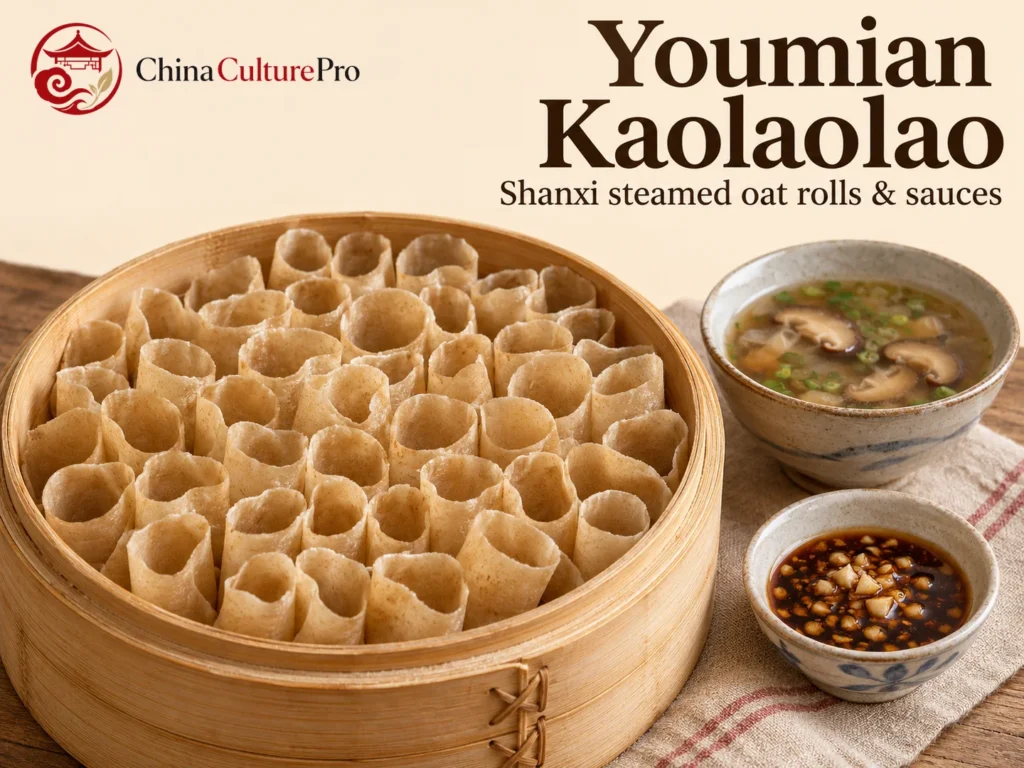
Shanxi youmian kaolaolao (莜面栲栳栳; yóu miàn kǎo lǎo lǎo) is a steamed oat-flour food shaped into thin, open tubes and stood upright together in a steamer. Its basket-like form gives the dish its distinctive name.[1]
- Main ingredient: Prepared oat flour forms the dough rather than ordinary wheat flour.
- Technique: Hot-water dough is pushed into sheets, curled and steamed.
- Serving: Mutton, mushroom or tangy vegetable sauces can accompany the rolls.
The rolls provide the staple; the sauce determines much of the finished meal’s character. Mutton is one option, not a requirement.

A basket of these rolls looks like a cluster of small, open cups. The shape matters as much as the ingredient: this is not a bowl of long noodle strands. The guide below follows the shaping method and sauce choices that give the dish its place in Shanxi cuisine.
Oat Flour and the Basket Shape
The dough uses oat flour. In the traditional preparation described by a Taiyuan pastry cook, the grain is first roasted and then milled. Boiling water cooks the flour again during dough mixing, and steaming supplies the third heating stage. These are separate parts of the preparation, not instructions to steam the shaped rolls three times.[4]
Look for flour intended for this style of oat dough. A recipe that starts with prepared flour is beginning after the grain-processing stage; it is not necessarily asking you to roast raw grain at home. Check the product and recipe together before treating finely ground breakfast oats as an identical ingredient.
The name refers to a woven basket or bucket form traditionally made with bamboo strips or willow. Small tubular pieces stand together rather than lying loose like pasta shells. Their pale color and open tops help identify the dish before any sauce is added.[1]
It belongs within the broad range of Chinese noodles and flour foods, but its oat dough and upright steamed shape distinguish it from wheat noodles cooked in a pot of water.
From Hot-Water Dough to Steamed Tubes
The traditional shaping sequence is a skilled hand process.[2]
- Mix the hot-water dough: Mix boiling water into the prepared oat flour. Knead once safe to handle.
- Push a thin sheet: Push a small dough piece across a smooth board into a thin, even sheet.
- Curl and stand: Curl the sheet around a finger into an open tube. Stand the tubes together in a lightly oiled steamer.
- Steam the formed rolls: Steam until cooked while keeping the tubes upright. Adjust cooking to the recipe, thickness and steamer.
One artisan demonstration uses roughly 3-gram pieces and eight minutes in a steam cabinet; other thicknesses and equipment may require different timing.[2]
The aim is a cooked roll that still stands. Too much steaming can make the tubes slump.[2]
The Chinese cooking methods guide explains the wider distinction between steaming and boiling. Here the formed dough stays above the water rather than being boiled loose in it.
Sauces and Regional Serving Choices
Mutton soup and mushroom soup are familiar partners. Garlic-vinegar dips, poured sauces and stir-fried presentations also appear in local descriptions.[3]
A warm-weather example combines cucumber, radish, garlic, salt, sesame-scallion oil, aged vinegar and cilantro. Mutton broth supplies a contrasting cold-season option.[2]
Tomato and vinegar sauces also appear in a first-person account of a Shanxi family’s cooking. They show how the steamed staple can take a vegetable-based accompaniment without changing its identity.[5]
For a first tasting, choose the sauce by the meal you want: a light, sharp dip, a fuller mushroom accompaniment or a substantial meat broth. Ask about the actual stock and additions if you need a meat-free plate; a mushroom name alone does not describe every ingredient in its sauce.
Choosing Flour and Serving a Basket
When buying, distinguish flour, uncooked shaped rolls and an already cooked product. Each begins at a different point in the process. Follow the package’s directions for storage and heating rather than applying the shaping demonstration’s timing to every form.
When ordering, ask whether the sauce comes alongside, is poured over the rolls or is used in a stir-fried dish. A basket of pale tubes with a separate dip and a plate of sauced pieces represent different serving forms.[3]
The handwork also carries family associations. In one pastry cook’s memory, older relatives improvised a smooth surface when a stone board was unavailable. The memory connects the practiced push-and-curl action with family teaching.[4]
For home preparation, begin with a tested recipe for the flour you can buy and practice a small batch of similarly thin pieces. Keep the dough method, steaming stage and sauce recipe distinct so that changing the accompaniment does not confuse the cooking instructions.
FAQs About Youmian Kaolaolao
Is kaolaolao made from wheat flour?
The traditional dough uses oat flour. Check the actual product or recipe if a commercial version contains a blend.[1]
Are the rolls boiled or steamed?
The shaped tubes are steamed upright. Boiling water is also used earlier to mix the dough.[2]
Is every serving made with mutton?
No. Mushroom soup, garlic-vinegar dips and other sauces are also documented accompaniments.[3]
Sumber
[1] China Daily via China.org.cn. Taiyuan Kaolaolao
[2] Wang Ning, original artisan interview, Yellow River News via China Youth. 莜面栲栳栳:来自1400多年前唐朝的味道
[3] Xinzhou Daily, local food archive. 莜面栲栳栳
[4] Li Kun, Taiyuan pastry cook, original interview in People’s Daily Overseas Edition. 来,尝尝我家乡的美食:家乡的美食 妈妈的味道
[5] Waseda Weekly, first-person Shanxi food essay. Shanxi: Immersed in the world of wheaten food