

Quick Answer: What Is Ruomu?
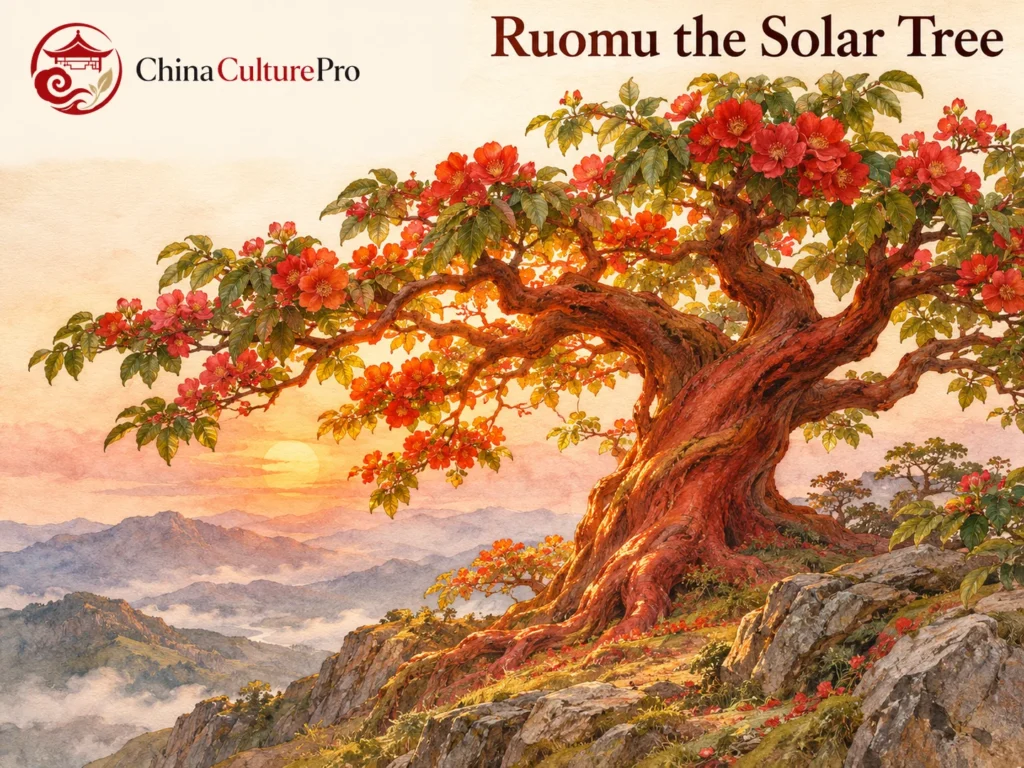
Ruomu (若木, Ruòmù) is a mythic tree in Chinese literature. The Classic of Mountains and Seas describes it as a red tree with green leaves and red blossoms. The Huainanzi places it to the west of Jianmu (建木, Jiànmù) and describes ten suns at its top, whose brightness shines down on the land.[1][3]
- Penampilan: Green leaves and red blossoms distinguish the tree in the northern wilderness account.
- Direction: Commentators associate Ruomu with the far west.
- Poetry: The speaker of the Li Sao breaks a branch in an attempt to affect the sun’s passage.
The colors, the direction and the action come from different parts of the tradition.[1][2][3][4]

Ruomu can appear as a tree on a mountain, a source of brightness or a branch held against the sun. Those images come from a mountain catalogue, a description of the world and a poem.
The Red Tree in the Great Wilderness
The Great Wilderness of the North chapter introduces Ruomu in a group of mountains. It calls it a red tree, gives it green leaves and describes its blossoms as red. The description identifies the tree by color and setting. It does not tell a story about the sun going down there.[1]
A Within the Seas passage, preserved in a later compendium, gives Ruomu another setting between Black Water and Green Water, where the Ruo River rises. The same compendium preserves a commentary that places Ruomu by the far western limit near Kunlun, with red light shining below. The river belongs to the Within the Seas entry. The far-west location comes from the commentary.[2]
Ten Suns in the Huainanzi
In the Huainanzi’s geography, Ruomu is west of Jianmu. The passage gives it ten suns at its tip and says its brightness shines on the land below. The commentary compares their appearance to lotus blossoms and reads the word for brilliance as light. That helps a reader understand why the tree can be described in floral and solar language.[3]
The account locates the tree relative to other features rather than providing a route that can be followed on a map. The count of ten belongs to this passage. The northern mountain description gives the red blossoms without a number.[1][3]
A Branch of Ruomu in the Li Sao
The Li Sao places the speaker on an extraordinary journey. He tells Xihe to slow down and later breaks a Ruomu branch to brush at the sun. The commentary offers more than one reading of the action, including striking the sun to turn it back and shielding it to keep it from passing.[4]
In the poem the branch answers the speaker’s concern with time. The sun’s journey sets a limit. The branch gives him a way to imagine holding that movement back, even while his own search continues.[4]
Ruomu, Fusang and Jianmu
The Huainanzi mentions Fumu, glossed as Fusang (扶桑, Fúsāng), in connection with sunlight in the east. It sets Jianmu at Duguang as a place where divine rulers go up and down. Ruomu appears to its west and is associated with the ten suns.[3]
The names separate three roles in that account. East and west are useful for comparing the solar trees. The passage through the realms is the detail that distinguishes Jianmu.[3]
FAQs About Ruomu
Does Ruomu always stand where the sun sets?
The western setting is traditional, and the Li Sao commentary places Ruomu at the far west. The Great Wilderness of the North passage describes the tree’s appearance without naming it as a sunset station.[1][2][4]
What does Ruomu look like?
One classical account gives it a red body, green leaves and red flowers. The Huainanzi adds a separate image of ten suns at its tip.[1][3]
Is Ruomu the same as Fusang?
They have different positions in the Huainanzi. Fusang is associated with sunlight in the east. Ruomu stands west of Jianmu.[3]
Sumber
[1] Chinese Wikisource. Classic of Mountains and Seas, Great Wilderness of the North
[2] Chinese Wikisource. Imperial Collection of Books, Flora, volume 314
[3] Chinese Text Project. Huainanzi, Treatise on the Forms of the Earth
[4] Chinese Text Project. Commentary on the Songs of Chu, volume one