

Quick Answer: What Do Ren, Li and Yi Mean?
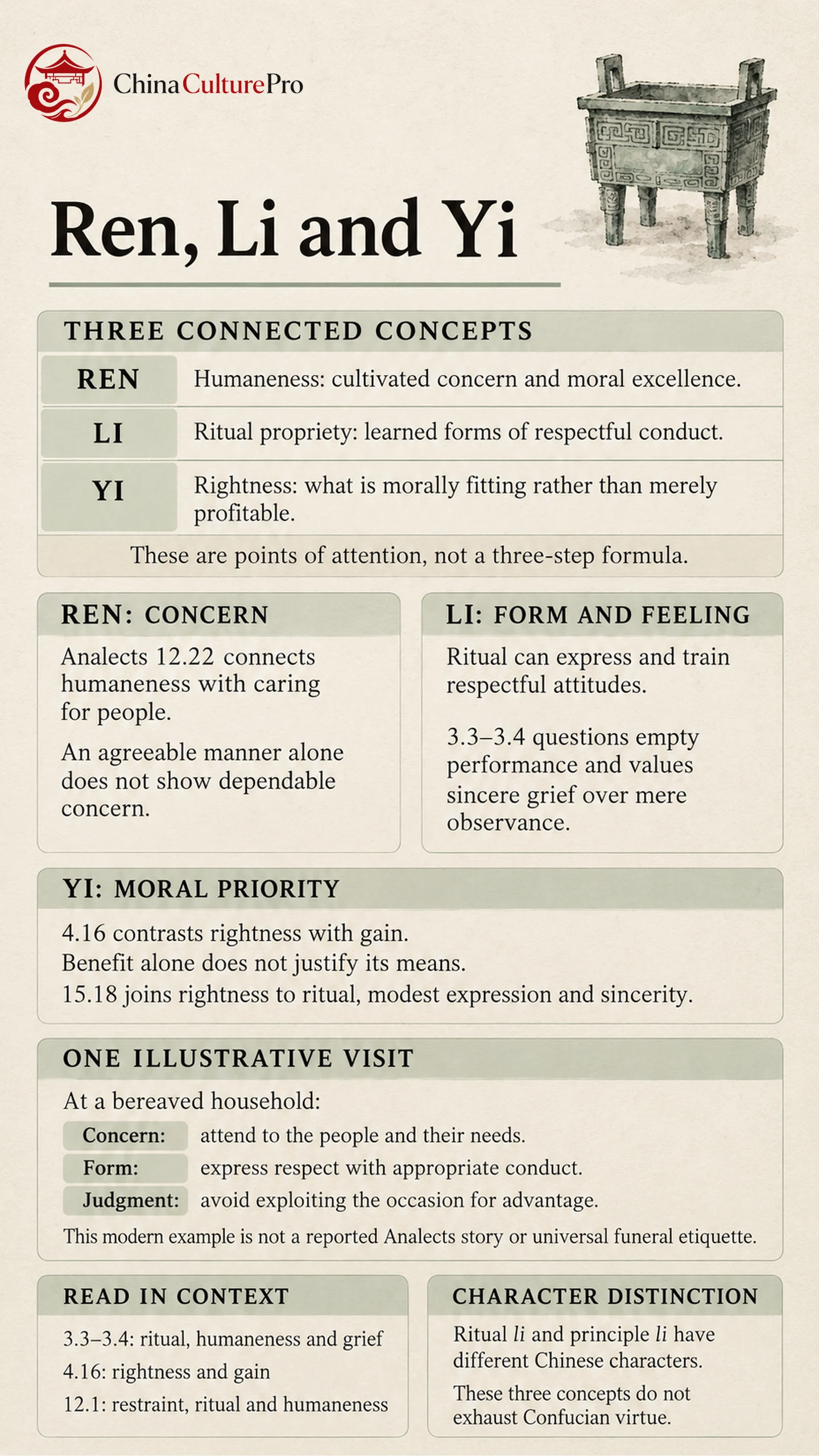
Ren (仁, rén), li (礼, lǐ) and yi (义, yì) are connected concepts in Confucian ethics: humaneness, ritual propriety and rightness. Together, they help explain morally cultivated conduct rather than merely correct appearances.[1]
- Ren: Concern for people and the broader quality of humane character.
- Li: Learned forms of respectful conduct that shape and express relationships.
- Yi: Commitment to what is right, including when personal advantage pulls another way.
- Their relationship: A considerate intention, an appropriate expression and sound judgment need to support one another.
This is a useful introduction to their relationship, not a fixed three-step moral formula. Their meanings vary with the passage, thinker and question being discussed.[1][2]
A courteous gesture can be caring, empty or manipulative. To explain the difference, Confucian ethics asks about the concern behind conduct, its learned form and whether the act is right in the circumstances.
Three Concepts, Three Points of Attention
The teaching associated with Confucius (孔子, Kǒngzǐ) places these concepts in lived relationships and particular situations. The Analects (论语, Lúnyǔ) preserves short conversations and sayings, so a definition needs to be read beside its setting.[1]
| Konsep | Working definition | Point of attention |
|---|---|---|
| Ren | Humaneness: cultivated concern for others and, in some passages, broader moral excellence. | How are other people being regarded? |
| Li | Ritual propriety: learned forms of respectful conduct that express and shape relationships. | How is regard embodied in conduct? |
| Yi | Rightness: commitment to what is morally fitting rather than merely advantageous. | Is this act right in the circumstances? |
These distinctions make the concepts easier to compare. They do not assign each virtue to a sealed compartment: the same act can disclose a person’s concern, training and priorities at once.
For the wider tradition, see Confucianism; for the teacher’s historical setting, see Confucius.
Ren: Humaneness Beyond a Pleasant Manner
In Analects 12.22, humaneness is explained through caring for people. Elsewhere, responses emphasize respectful dealings, restraint in speech or the way one treats those under one’s authority. The answer is responsive to a concrete question rather than always repeating one dictionary sentence.[1][3]
This range matters because an agreeable manner need not reveal humane concern. Someone can speak softly while disregarding the person affected by a decision. Conversely, concern can require a difficult conversation rather than immediate agreement.
Ren is therefore broader than being pleasant. It involves the development of a reliable disposition expressed in relationships, and sometimes functions in the text as a name for moral excellence more generally.[1]
Conduct reveals the quality of concern when attention, effort or restraint is required.
Li: Ritual Forms That Educate Feeling
Li includes ceremonial rites and more ordinary patterns of respectful interaction. Such forms can make regard visible, organize relationships and train responses over time. They are more substantial than a set of optional flourishes added after the “real” ethical work is finished.[2]
Yet outward correctness is not sufficient. Analects 3.3 questions rites performed without humaneness. In 3.4, sincere grief matters more in mourning than punctilious observance alone; restraint is preferred to extravagance in ritual expenditure.[4]
The two points should be held together. Shared forms matter, and their purpose cannot be fulfilled by empty performance. A gesture of respect loses something if the person using it treats the recipient with contempt.
This leaves a serious interpretive question: does ritual cultivate humaneness, partly constitute it, or relate to it differently in different passages? Readers and scholars have offered more than one answer.[2]
Yi: Rightness When Advantage Tempts
Analects 4.16 contrasts the exemplary person’s attention to rightness with the lesser person’s attention to gain. Yi concerns a moral priority that is not displaced simply because an act would be profitable.[4]
That is not the same as declaring every benefit or comfortable life wrong. The contrast asks what governs a choice when advantage and appropriate conduct diverge. An attractive reward does not by itself make its means acceptable.
Nor does “fitting” mean whatever is expedient. In this ethical context, it concerns what one has good moral reason to do, including responsibilities that cannot be discarded for convenience.
Analects 15.18 places rightness alongside ritual in its account of the junzi (君子, jūnzǐ), the exemplary person: rightness is fundamental, while ritual, modest expression and sincerity belong to its realization.[5]
The junzi ideal thus helps explain why these concepts belong to character formation rather than separate tricks for appearing respectable.
How Concern, Form and Judgment Work Together
Consider an illustrative situation: visiting a household after a death. This is a modern example for comparison, not a reported episode from the Analects.
Ren directs attention toward the bereaved people and their needs. Li concerns the forms through which respect and sympathy are expressed, including when to speak, remain quiet or accept the household’s arrangements. Yi asks whether one’s conduct is right, rather than a way to secure attention or a favor.
A visitor might follow every expected gesture yet turn the occasion into self-promotion. Another might feel concern but act so carelessly that the visit increases the family’s burden. These points of attention identify different shortcomings; they are not successive steps that settle every difficult case.
The appropriate form of mourning also depends on community and historical setting. These observations explain an ethical relationship; they do not prescribe one modern funeral etiquette for every Chinese family.
Reading the Terms in Their Textual Setting
Start with a few passages rather than collecting isolated inspirational definitions:
- Analects 3.3–3.4: Read ritual alongside humaneness, sincerity and grief.
- Analects 4.16: Compare concern for rightness with concern for gain.
- Analects 12.1: Consider how self-restraint and ritual relate to humaneness.
These passages support different parts of the explanation above.[4][5]
In particular, 12.1 closely links restraint, ritual and humaneness. How strong that link is remains debated: a translation can suggest a means of achieving humaneness or a more constitutive relationship. One English equivalent should not silently settle that philosophical issue.[2]
A reading guide to the Analects provides the larger textual setting. Later Neo-Confucian interpretations develop the concepts further, so distinctions drawn from one period should not automatically be assigned to every Confucian writer.
FAQs About Ren, Li and Yi
Are ren, li and yi three names for the same thing?
No. Humaneness, ritual propriety and rightness have different emphases, even though they support one another in an account of cultivated character. Their precise relationship depends on the passage and interpretation.
Is ritual li the same as Neo-Confucian principle li?
No. Ritual propriety is written 礼, while principle or pattern is written 理. Both are pronounced lǐ, but the characters and meanings differ.
Are these the only Confucian virtues?
No. Wisdom, trustworthiness and other qualities also matter. These three concepts provide an entry into Confucian ethics, rather than a complete inventory of its virtues or historical developments.
Sumber
[1] Mark Csikszentmihalyi. Confucius
[2] David Wong. Chinese Ethics
[3] Asia for Educators. Selections from the Confucian Analects: On Humaneness
[4] James Legge, translator. The Analects, Books 1–6
[5] James Legge, translator. The Analects, Books 12–15