
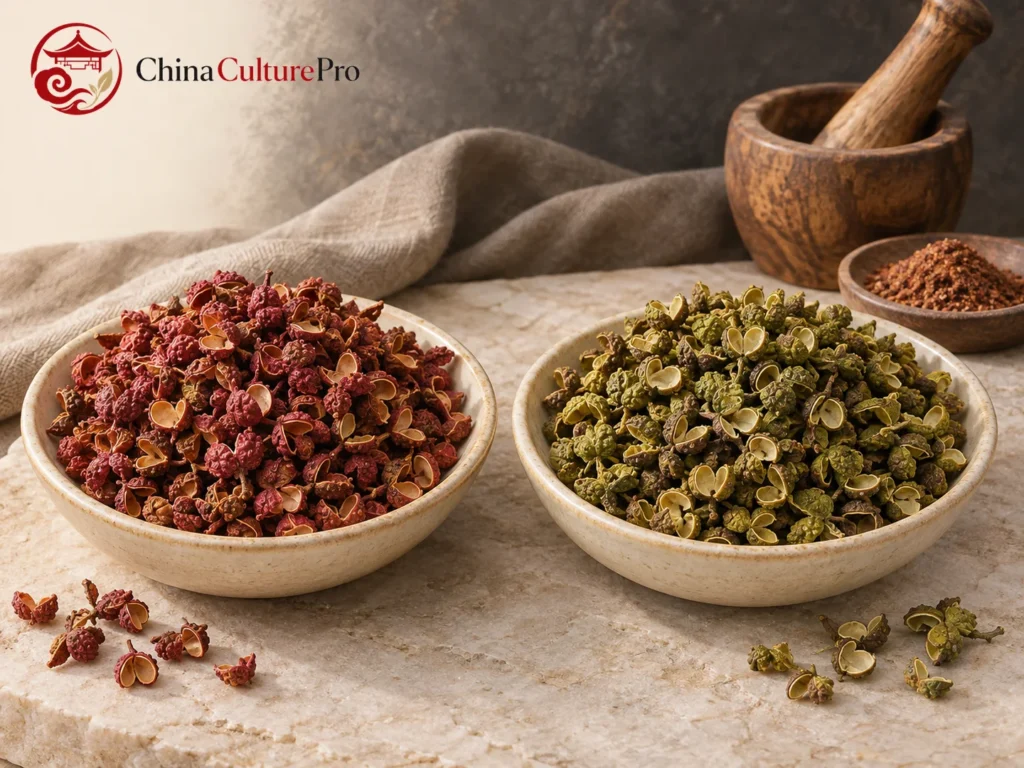

Quick Answer: How Do Red and Green Sichuan Peppercorns Differ?
Sichuan pepper, Hua Jiao (花椒, huā jiāo), is an aromatic fruit husk that produces a tingling, numbing sensation. Red and green types differ most usefully in their fragrance and the character they bring to a dish.[1][2]
- Red Sichuan peppercorns, Hong Hua Jiao (红花椒, hóng huā jiāo), typically offer warm citrus, floral and woody notes.[2][4]
- Green Sichuan peppercorns, Qing Hua Jiao (青花椒, qīng huā jiāo), tend toward a brighter citrus and herbal perfume.[3][4]
- Choose the flavorful husks; remove hard black seeds before making fine powder.[6]
- Either color can work in cooked dishes, but changing it changes the aroma.[4][5]
Green is not simply an unripe red peppercorn, and color alone does not establish which bag will be more numbing.[1]
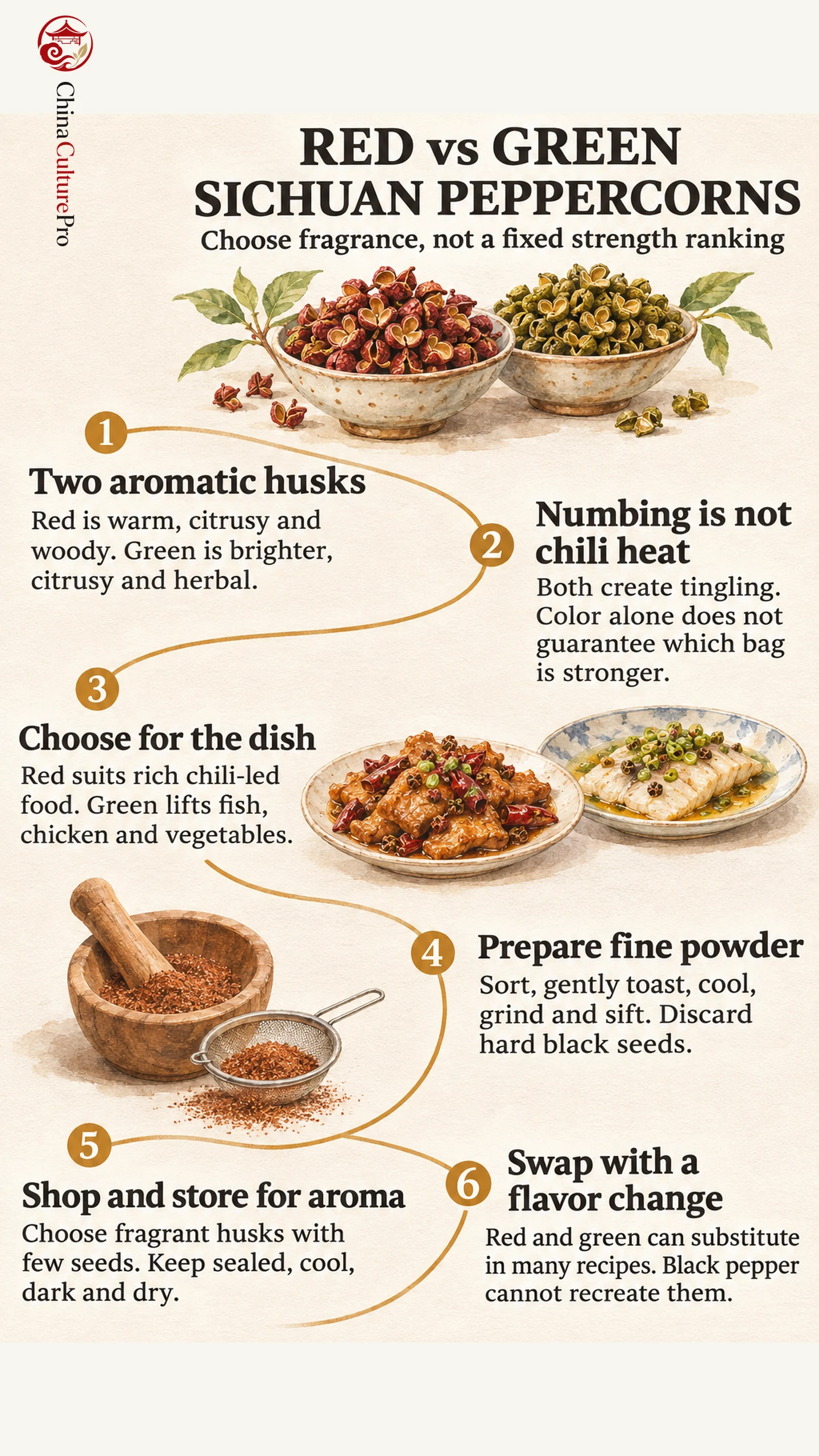
If a recipe says only “Sichuan peppercorns,” the red type is a practical starting point for a general Chinese pantry. Green adds another aromatic direction rather than replacing red throughout the cupboard.[4]
Compare the Two Sichuan Peppercorn Types
Both belong to the Zanthoxylum genus. Cultivated red types commonly include Zanthoxylum bungeanum; green types include Zanthoxylum armatum. These are distinct plants, not a single fruit picked at successive colors.[1]
| Jenis | Definisi | Typical aroma | Useful starting point |
|---|---|---|---|
| Red Sichuan peppercorn | An aromatic red fruit husk used for numbing seasoning | Warm citrus, floral and woody | Chili-rich sauces, pork and robust savory dishes |
| Green Sichuan peppercorn | An aromatic green fruit husk used for numbing seasoning | Bright citrus, herbal and sometimes mint-like | Fish, chicken and vegetables |
These are aroma tendencies: red peppercorns can be distinctly lemony too.[2][3][4][5]
Why Color Does Not Guarantee Numbing Strength
Ma La (麻辣, má là) combines the numbing character of Sichuan pepper with the heat of chilies. Peppercorns supply the tingling component; adding more of them is not the same adjustment as adding more chili.[2][3]
Do not treat “green is always stronger” as a dependable dosing rule. Culinary descriptions often emphasize green peppercorns’ powerful buzz, while cultivar research has found red samples with stronger numbing-related characteristics. Species, cultivar and the condition of the spice matter.[1][3] Green peppercorn aroma also varies among growing areas and samples.[7]
With a new bag, use a modest amount first and adjust after tasting. A fixed spoonful cannot guarantee the same result across purchases.
Choose a Peppercorn for the Dish
These are flavor pairings, not regional prohibitions. Either color can cross into the other’s usual territory.[5]
- Red for rich, chili-led food: its warmer profile suits pork, chili-bean-paste dishes and the broth of a spicy hotpot.[4][5]
- Green for a lifted citrus aroma: try the type specified in a fish, chicken or vegetable recipe when you want its brighter fragrance.[3]
- Ground pepper for an even finish: fine powder seasons Mapo Tofu (麻婆豆腐, má pó dòu fu) and sauces for Chinese noodles without leaving whole husks to bite.[6]
Whole husks can instead perfume cooking oil, which carries their flavor through a stir-fry. This choice of whole, powdered or infused seasoning is part of the broader flavor vocabulary of Sichuan cuisine, beyond making every dish intensely numbing.[2]
How to Prepare Whole Husks for Fine Powder
For dried whole peppercorns, make a small batch rather than filling a large jar that will sit for months.[6]
- Sort the husks: discard black seeds and stems.
- Toast gently: stir in a dry pan over medium-low heat until fragrant. Remove promptly to prevent bitterness.
- Cool and grind: cool completely, then crush with a mortar or spice grinder.
- Sift: remove coarse fragments with a fine sieve.[6]
This produces a fine seasoning for finishing food. It is a different route from frying whole husks in oil at the beginning of a recipe.[4]
Buying, Storing and Substituting
Look for a clear red or green identity, a lively fragrance when opened, and a bag with relatively few seeds and stems. Do not confuse green Sichuan pepper with ordinary green peppercorns sold for pepper sauces.[2][3]
Keep dried husks sealed in a cool, dark, dry place. Grind small quantities as needed because the powder loses fragrance faster. An old, weak-smelling bag is a quality problem even if its color still looks convincing.[3][4][6]
Red and green can substitute for one another, with a change in fragrance; start conservatively with an unfamiliar bag.[3][5] Black or white pepper will not recreate the same flavor or numbing sensation.[4]
FAQs About Red and Green Sichuan Peppercorns
Is green Sichuan pepper just unripe red pepper?
No. Mature green cultivars exist alongside red cultivars; the usual cooking distinction involves different plants, not simply harvest timing.[1]
Which Sichuan peppercorn is hotter?
Neither supplies chili-style heat. Both create tingling numbness, and color is not a reliable universal ranking of its intensity.[1][2][3]
Can I use red instead of green Sichuan peppercorns?
Yes, for many savory recipes. Expect the aroma to shift toward warmer, woodier notes rather than matching green exactly.[4][5]
Should I eat the black seeds?
Remove them when preparing powder. The husk is the desired seasoning; hard seeds and coarse fragments make the result gritty.[6]
Sumber
[1] Xiang et al. The Chemical and Genetic Characteristics of Szechuan Pepper Cultivars and Their Suitable Habitat
[2] The Woks of Life. Sichuan Peppercorns
[3] The Woks of Life. Green Sichuan Peppercorns
[4] Omnivore’s Cookbook. Sichuan Peppercorn
[5] The Mala Market. Sourcing Huajiao
[6] Red House Spice. Sichuan Pepper, How to Grind It Correctly?
[7] Gao et al. Aroma Characteristics of Green Huajiao in Sichuan and Chongqing Area