

Quick Answer: Who Was Qu Yuan?
Qu Yuan (屈原, Qū Yuán) is remembered as a poet and loyal official of Chu (楚, Chǔ), a major state before imperial unification. He is closely associated with the Chuci (楚辞, Chǔcí) anthology and with Dragon Boat Festival remembrance. His traditional biography, the poems and later commemoration are related kinds of evidence, but they are not interchangeable.[1][2][6][7]
- For the life story: Read the early historical account with its distance from the events in mind.
- For the poetry: Compare a long first-person poem, a sequence of questions and songs with ritual settings.
- For the festival: Recognize Qu Yuan’s importance without making every regional custom originate in one story.
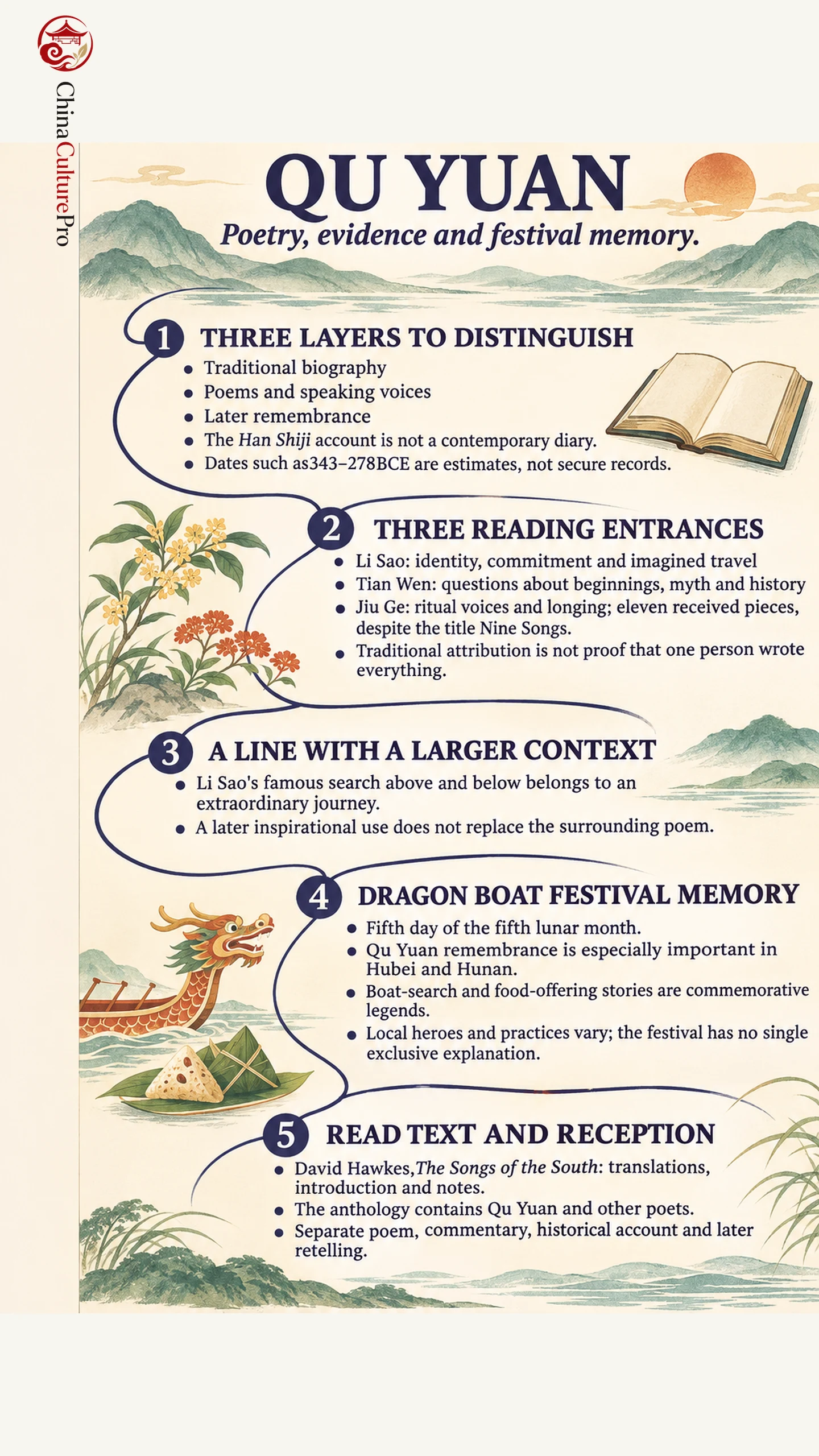
Dates such as 343–278 BCE are traditional estimates, rather than securely documented birth and death records.[2]
Qu Yuan’s cultural presence joins questions of integrity, frustrated service, imaginative poetry and remembrance. A useful introduction begins with those connections while asking what each source can establish. The Chinese poetry guide supplies the wider setting; the Songs of Chu guide explains the anthology beyond a single author.
The Traditional Life and Its Historical Limits
The central early biography appears in the Shiji (史记, Shǐjì), or Records of the Grand Historian, by Sima Qian (司马迁, Sīmǎ Qiān). It presents Qu Yuan as a member of Chu’s royal clan, a capable adviser and a writer whose loyalty meets slander and exclusion.[1]
In that account, he serves a ruler, argues over affairs of state and suffers estrangement from political power. The narrative connects his poetic expression with distress at injustice. It ends his life with drowning in the Miluo (汨罗, Mìluó) River. These details explain the traditional image of an upright but rejected minister; they should be identified as the account’s narrative, not presented as a recovered contemporary diary.[1]
The biography was written in the Han period, after the world it describes. Modern scholarship examines its sources, chronology and relationship with poems attributed to Qu Yuan. Martin Kern argues that the familiar life and poetic persona depend heavily on Han accounts and later interpretive material. This cautions against treating a first-person poem as an independent verification of every biographical detail.[2]
Historical uncertainty does not make the later cultural tradition meaningless. It changes the questions: what does the early narrative say, how does the poem work, and how have subsequent readers connected them? The Shiji guide and Chinese history overview help distinguish a source’s own period from the period it portrays.
Three Ways Into the Poetry
| Work or sequence | A reading entrance |
|---|---|
| Li Sao (离骚, Lí Sāo), conventionally translated as Encountering Sorrow | Follow an elaborate first-person voice through self-description, disappointment, moral commitment and imagined travel.[3] |
| Tian Wen (天问, Tiān Wèn), or Heavenly Questions | Read the succession of questions about beginnings, the cosmos, myths and historical figures.[4] |
| Jiu Ge (九歌, Jiǔ Gē), or Nine Songs | Notice ritual language, different speaking positions, longing and encounters with divine figures; the received sequence contains eleven pieces.[5] |
These texts are traditionally associated with Qu Yuan, but traditional attribution should not be confused with settled proof of individual authorship. Nor does his prominence make the entire anthology the work of one person.[2][7]
In the long first-person poem, fragrant plants and carefully arranged adornments help present a cultivated identity. Political and personal language mingle, while journeys extend into a mythic world. A reader can follow those movements without assigning every plant, encounter or destination a single literal counterpart in the author’s life.[3]
One familiar passage reads, in simplified characters: 路曼曼其修远兮,吾将上下而求索. Modern Mandarin pronunciation is Lù màn màn qí xiū yuǎn xī, wú jiāng shàng xià ér qiú suǒ. An English sense-gloss written for this guide is: The road extends far ahead; I will seek above and below. In its surrounding passage, the speaker’s search belongs to an extraordinary journey involving celestial places and figures. The line’s later use as encouragement is one part of its reception, rather than the whole original context.[3]
The questioning poem offers a different experience. Its opening asks who transmitted knowledge of the remote beginning and how matters before the formation of heaven and earth could be investigated. Questions then move through cosmology, myth and human history. It is not simply a modern science textbook in verse or a list of answers endorsed by its speaker. Its interrogative form is part of the interest.[4]
The song sequence differs again. Its received pieces include addresses to divine powers, anticipated meetings, distance and disappointment, as well as commemoration of fallen warriors and a closing ritual piece. The title’s “nine” does not mean that the surviving collection has exactly nine poems. Reading the eleven pieces as a sequence reveals a range obscured by treating every voice as Qu Yuan speaking directly about his own exile.[5]
The Chinese mythology guide provides background for divine figures; literary allusions explains how later writing can reuse earlier phrases and scenes.
Qu Yuan in Dragon Boat Festival Memory
Duanwu (端午, Duānwǔ), commonly called the Dragon Boat Festival in English, falls on the fifth day of the fifth lunar month. Qu Yuan is a major figure in its commemorative traditions, especially in Hubei and Hunan. Festival activities include boat events, community observances and foods such as zongzi (粽子, zòngzi), rice dumplings wrapped in leaves.[6]
A familiar legend describes people searching the river by boat and offering food to keep fish away from the poet. It explains remembrance within the tradition, rather than documenting the origin of every boat race or food custom.[8] UNESCO’s description emphasizes that celebrated heroes and practices vary by region.[6]
That regional variety matters. Qu Yuan’s prominence can coexist with other local figures and histories. Remembrance, seasonal customs, food and competition can coexist without one exclusive cause. The Dragon Boat Festival guide develops the wider customs without reducing them to a single biography.[6]
Reading the Texts and Their Reception
David Hawkes’s The Songs of the South offers English translations with an introduction and notes. Its full framing identifies Qu Yuan and other poets, an important reminder that an anthology is not the same thing as one author’s collected works. Use the notes for speakers, mythical references and questions of attribution.[7]
Begin with one complete piece or a substantial annotated passage. Distinguish the wording of the poem from a commentator’s explanation and a later popular retelling. Then compare genres: the long poem’s journey, the questioning poem’s repeated interrogatives and the songs’ shifting voices create different reading experiences.
A biography can make those experiences richer while still requiring scrutiny. Likewise, a modern commemoration shows what later communities value without automatically resolving an ancient historical question. The classical books guide helps with choosing texts and translations that keep those layers visible.
FAQs About Qu Yuan
Are Qu Yuan’s birth and death dates certain?
No. Traditional dates such as 343–278 BCE should not be treated as secure birth and death records. Historical reconstructions depend on later evidence and interpretation.[2]
Did Qu Yuan write the whole Chuci anthology?
No. The anthology includes works associated with different writers and periods. Traditional attribution of particular texts also raises questions that a scholarly edition should discuss.[2][7]
Does Nine Songs contain exactly nine poems?
The received sequence contains eleven pieces. Its traditional title should not be used as a count of the surviving individual works.[5]
Is the Dragon Boat Festival only about Qu Yuan?
No. His remembrance is especially important in some regions, but local commemorative figures and practices vary. The festival combines several social and seasonal activities.[6]
Sumber
[1] Sima Qian, Chinese primary text via Wikisource. Shiji, chapter 84: Qu Yuan and Jia Yi
[2] Martin Kern, Princeton University. Reconstructing Qu Yuan
[3] Chinese primary text via Wikisource. Li Sao
[4] Chinese primary text via Wikisource. Tian Wen
[5] Chinese primary text via Wikisource. Jiu Ge
[6] UNESCO Multimedia Archives. The Dragon Boat Festival
[7] Penguin Classics, David Hawkes. The Songs of the South
[8] Beijing Municipal Government. Dragon Boat Festival: commemorative legends