

Quick Answer: What Is Plum Blossoms and Rocks?
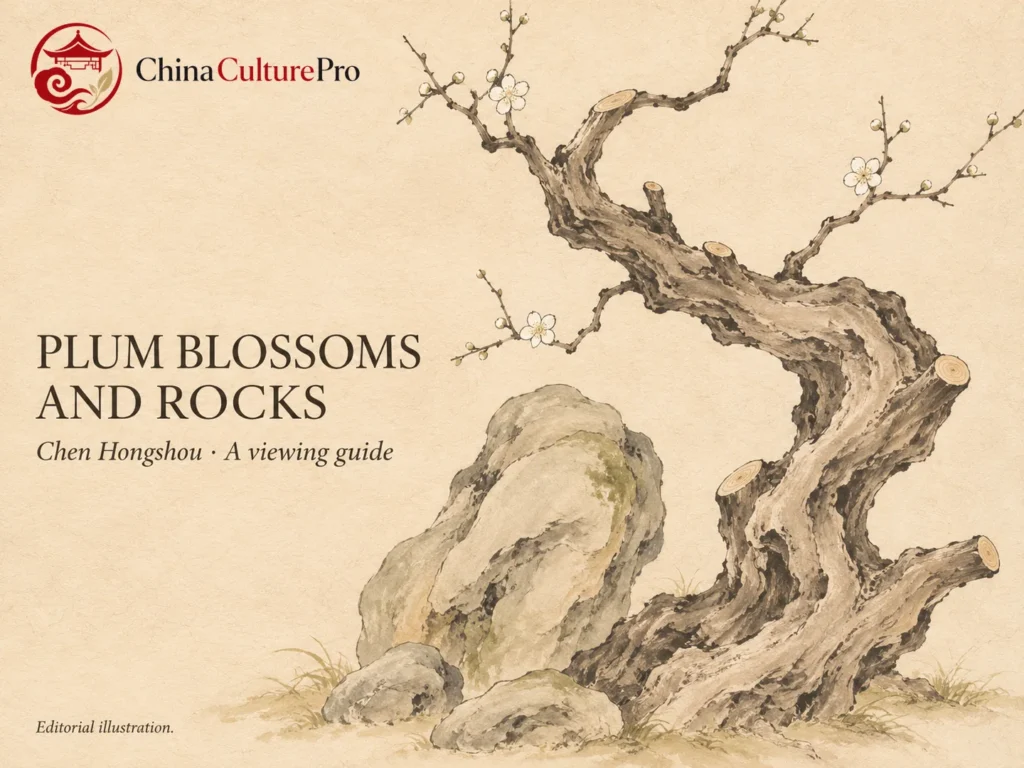
Plum Blossoms and Rocks (梅石图, Méishí Tú) is a Ming-dynasty hanging scroll by Chen Hongshou (陈洪绶, Chén Hóngshòu), held by the Palace Museum in Beijing. The paper painting measures 115.2 × 56 cm. Its defining contrast is between an angular old plum tree, with conspicuous cut branch stubs, and softly rounded rocks. Sparse flowers give the weathered wood a sign of renewed growth.[1]

The first surprise in this painting is how little blossom it needs. A few pale flowers appear above a heavy, scarred trunk, while rounded stones occupy much of the lower picture. Look at the meeting of these forms before searching for a hidden story.
The Beijing Palace Museum Scroll at a Glance
| Kolom | Identification |
|---|---|
| Seniman | Chen Hongshou |
| Periode | Ming dynasty; exact year unspecified |
| Format and support | Hanging scroll on paper |
| Dimensions | 115.2 cm high × 56 cm wide |
| Collection | Palace Museum, Beijing |
| Museum number | 故00005562 |
These details identify the specific scroll discussed here.[1] Its ink-dominated appearance rewards attention to line and wash; the exhibition description also records light ochre tinting.[2] The narrow vertical format lets the trunk rise well above the rock group. For the difference between this wall-oriented arrangement and a horizontally unrolled picture, see Chinese scroll painting formats.
Angular Wood Meets Rounded Stone
Start near the foot of the tree, on the right. Its broad trunk climbs past several blunt, oval-ended stubs, then divides into branches that turn abruptly. The cut ends interrupt the upward movement: instead of a smooth, elegant stem, you follow a sequence of scars, bends and new shoots.
Now shift left to the large upright stone. Its outer contour swells and contracts in broad curves. Pale washes make folds within the mass, while darker marks gather along selected ridges. It seems weighty without being filled uniformly with black. The tree, by comparison, has sharper interruptions and a more insistent linear rhythm.
At the bottom, smaller rocks keep the composition from becoming two isolated columns. They spread the visual weight sideways and bring your eye back toward the trunk’s base. The contrast is therefore also a connection: the stones provide a broad footing for the tree’s upward movement. A guide to Chinese painting techniques explains how outline and wash can perform these different jobs.
A Few Flowers Change the Meaning of the Old Trunk
The flowering plum (梅花, méihuā) carries a familiar cultural association with endurance and renewal because it flowers around the transition from winter to spring. That association belongs to a broad Chinese artistic tradition; it does not establish a single personal message for every plum painting.[3]
Here, the small blossoms matter because the wood below them looks so battered. They are neither a dense canopy nor a spectacular floral display. Their slightness makes the surviving shoots easier to notice. You can read the contrast as persistence, while still distinguishing your interpretation from a documented statement by the artist.
For the wider range of associations, the separate guide to plum blossom meaning supplies cultural context.
Empty Space Makes the Branches Easier to Read
Much of the upper paper remains open. Against that pale ground, even a thin twig has a clear silhouette. Follow the upper fork toward the left, then compare the shorter branch reaching toward the right edge. Their unequal lengths keep the tree from settling into a symmetrical emblem.
The open area also changes the pace of looking. Dense ink around the trunk and rock creases slows your eye; the spaces between the twigs let it move more freely. The pale ground gives the painted forms room to separate without a detailed landscape background.
The Signature and Later Copies Have Different Jobs
The short inscription at the left uses the name Laolian (老莲, Lǎolián) and identifies the place of painting as Liuzhuang. The scroll was also recorded in the first compilation of Shiqu Baoji (石渠宝笈, Shíqú Bǎojí), the Qing imperial painting and calligraphy catalogue.[1][2] For broader context about the painter’s distinctive forms, see Chen Hongshou’s works and style.
Later artists studied this kind of composition. A 1930s ink drawing by Xie Zhiliu, titled Blossoming Plum and Large Rock, after Chen Hongshou, concentrates on the model’s arrangement through simplified angular lines. It is a separate twentieth-century work, not the Beijing scroll.[4] A shared subject or an “after Chen Hongshou” label therefore needs a second look at artist, date and collection.
How to Look at the Tree and Rocks Together
- Find the base: Notice how the low stones spread beneath the upright forms.
- Follow the trunk: Trace the cut stubs and sharp changes of direction before moving to the thinner shoots.
- Compare surfaces: Set the tree’s broken rhythm against the larger stone’s rounded contour and pale interior washes.
- Step back: Let the small blossoms and broad open paper change how you see the heavier forms below.
FAQs About Plum Blossoms and Rocks by Chen Hongshou
When did Chen Hongshou paint this scroll?
It is catalogued as a Ming work, but the collection entry gives no exact creation year. The signature’s place name does not supply one.[1]
Are these plum blossoms or cherry blossoms?
They are plum blossoms: both the title and the identified tree refer to plum. This is not a cherry-blossom scene.[1]
Is this the painting with a wild bird?
No. The work discussed here centers on a tree and rocks. Plum Blossoms and Wild Bird is a separate work and deserves its own comparison.
Sumber
[1] Palace Museum. Chen Hongshou: Plum and Rock Hanging Scroll
[2] Palace Museum. Plum and Rock: Shiqu Baoji Exhibition Record
[3] Smithsonian National Museum of Asian Art. Birds, Plum Blossoms, and Bamboo in Winter: Collection Label and Plum Symbolism
[4] Metropolitan Museum of Art. Xie Zhiliu: Blossoming Plum and Large Rock, after Chen Hongshou