


Quick Answer: Who Was Nalan Xingde?
Nalan Xingde (纳兰性德, Nàlán Xìngdé; 1655–1685) was a Manchu writer of the Qing dynasty, especially known for song lyrics (词, cí). His work connects courtly travel, attachment and remembrance, but a lyric speaker should not automatically be equated with the author.[1]
- Start with a complete lyric: follow its change of scene or time rather than stopping at a famous opening.
- Keep identifying details: record the tune title and first line together.
- Choose a verified translation: check the translator, collection and page range.
This guide introduces representative lyrics and ways to read them without inventing a private story behind every voice.
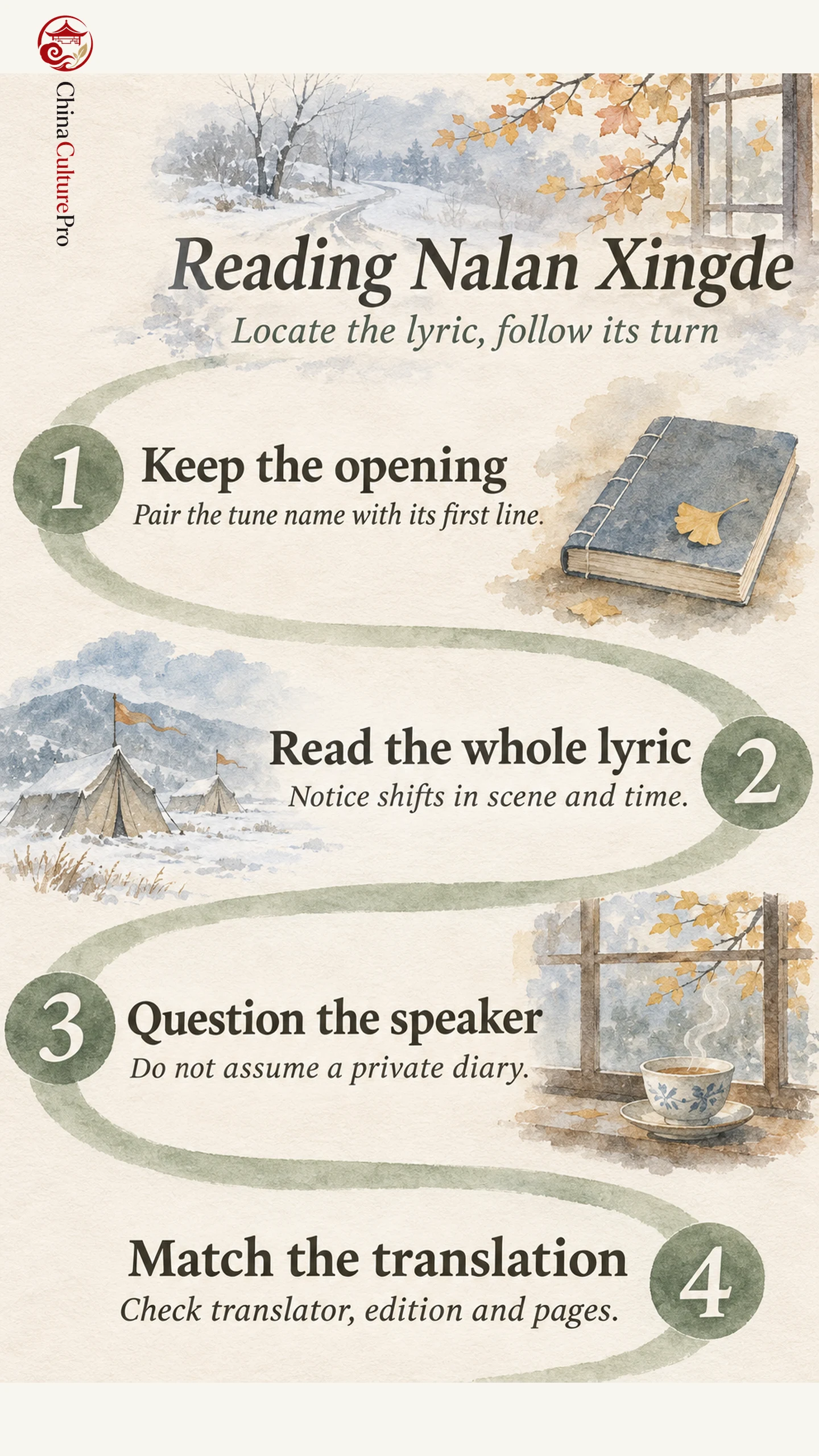
An isolated line can sound like a universal statement about love. A complete poem may complicate it with an imagined speaker, inherited language or a movement into memory. The reading task is to notice those changes before turning a lyric into a quotation for every occasion.
Court Service, Literary Life and Collections
Known also by the courtesy name Rongruo (容若, Róngruò), Nalan belonged to the cultural world of the Qing dynasty. The Palace Museum gives his Gregorian birth year as 1655.[2]
CUHK records his elite family background, examination success and service in the imperial bodyguard, which took him on distant journeys. It also emphasizes scholarly interests and literary gatherings. His poetry and prose appear in Collected Writings of Tongzhi Hall (通志堂集, Tōngzhìtáng Jí).[1]
The last lyric below is included in Drinking-Water Lyrics (饮水词, Yǐnshuǐ Cí).[5]
These contexts help frame a reading, but they should not substitute for it. Separate a documented office, a collected-text title and an interpretation of a particular speaker: they are different kinds of information.
Three Lyrics to Read Whole
The English labels below identify the works rather than prescribe a translator’s wording. The extended Chinese titles prevent a tune name shared by many poems from becoming an ambiguous search term.
| Identified lyric | First question |
|---|---|
| Endless Longing, beginning Mountains, one stage (长相思·山一程, Cháng Xiāngsī · Shān Yī Chéng) | How does a journey’s repetition become an unwelcome night sound?[3] |
| Magnolia Lyric: Imitating an Old Song of Parting (木兰花令·拟古决绝词, Mùlán Huā Lìng · Nǐ Gǔ Juéjué Cí) | How does remembered first attachment become an accusation of change?[4] |
| Sands of the Washing Stream, beginning Who remembers (浣溪沙·谁念西风独自凉, Huàn Xī Shā · Shéi Niàn Xīfēng Dúzì Liáng) | What does the final judgment change about remembered ordinary life?[5] |
How Memory Works Beyond a Quoted Line
The last lyric moves from cold solitude to remembered books and spilled tea, then revalues what once seemed ordinary.[5]
Try marking the words that belong to the present and those that turn toward the past. Then reread without pausing after the line you already know. Does the final statement confirm your first impression, or alter it? This exercise keeps an account of grief attached to the poem’s structure rather than to an invented anecdote.
For the inherited form, the Song ci guide offers background. The name of that tradition does not restrict later writers to the Song period.
Locating English Translations
- For one short entrance: the Renditions index lists John Turner’s Love-longing in A Golden Treasury of Chinese Poetry, pages 300–301 in the Books edition and page 125 in the paperback.[6]
- For a broader selection: the same index lists Eleven Ci translated by John C. H. Wu in Renditions, numbers 11 and 12, pages 252–264.[6]
Use those references as finding aids. The two page systems for the Turner volume belong to different formats, not contradictory citations. Once you have a translation, match its opening with the Chinese text before comparing choices. The wider Chinese poetry guide helps place this lyric tradition among other forms.
FAQs About Nalan Xingde
Was Nalan Xingde a Song-dynasty poet?
No. He lived in the Qing dynasty. Ci is a literary form with a longer history, not a date attached to every poem written in it.[1]
Do all his love lyrics describe his own marriage?
The Magnolia subtitle announces imitation of an older parting-song mode. Its speaker needs interpretation, not automatic identification.[4]
Why can the same English tune title lead to different poems?
A tune name is not necessarily a unique work title. Keep the author and opening words in your search and notes; a translation’s wording can vary as well.
Sumber
[1] Chinese University of Hong Kong. Nalan Xingde
[2] Wu Boya, Palace Museum. Nalan Xingde: historical context
[3] Nalan Xingde, Wikisource text. Endless Longing
[4] Nalan Xingde, Wikisource text. Magnolia Lyric: Imitating an Old Song of Parting
[5] Nalan Xingde, Wikisource text. Sands of the Washing Stream
[6] Chinese University of Hong Kong. Renditions Authors/Translators Index