
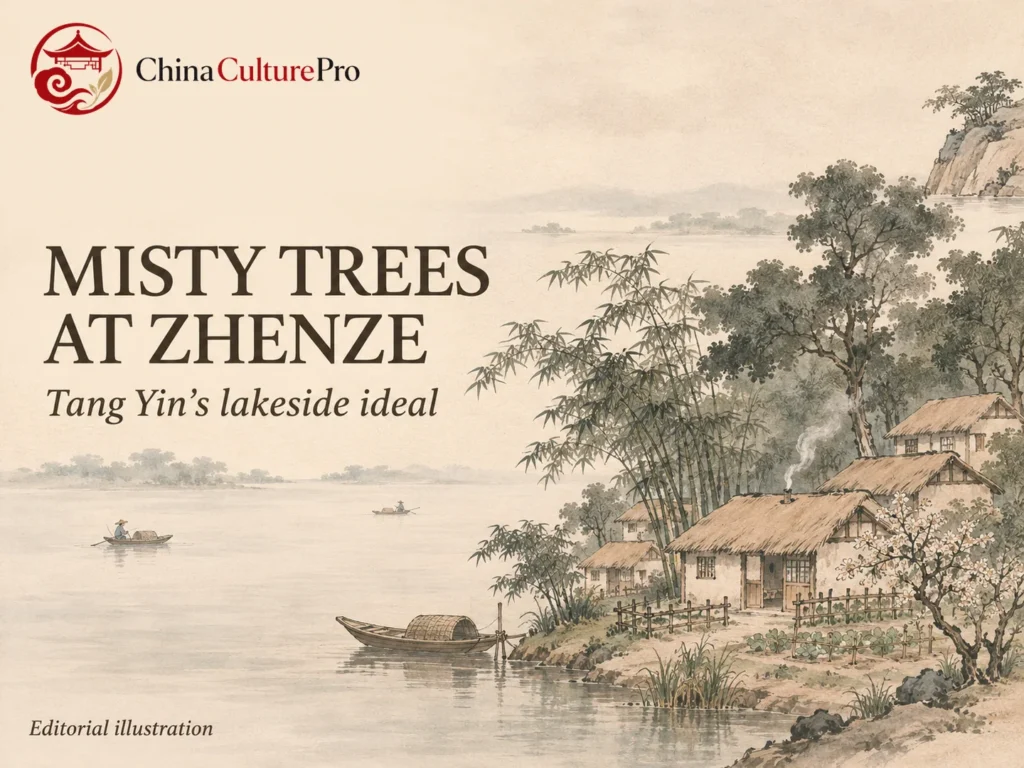

Quick Answer: What Is Misty Trees at Zhenze?
Misty Trees at Zhenze (震泽烟树图, Zhèn Zé Yān Shù Tú) is a Ming-dynasty hanging scroll by Tang Yin (唐寅, Táng Yín), held by the National Palace Museum, Taipei. The ink-and-light-color picture on paper measures 47 × 37.8 cm. Its title uses Zhenze (震泽, Zhènzé), an older name for Lake Tai (太湖, Tài Hú). Thatched houses, bamboo, boats and misty water accompany a poem expressing the painter’s wish to grow old beside the lake with a friend.[1][2][3]
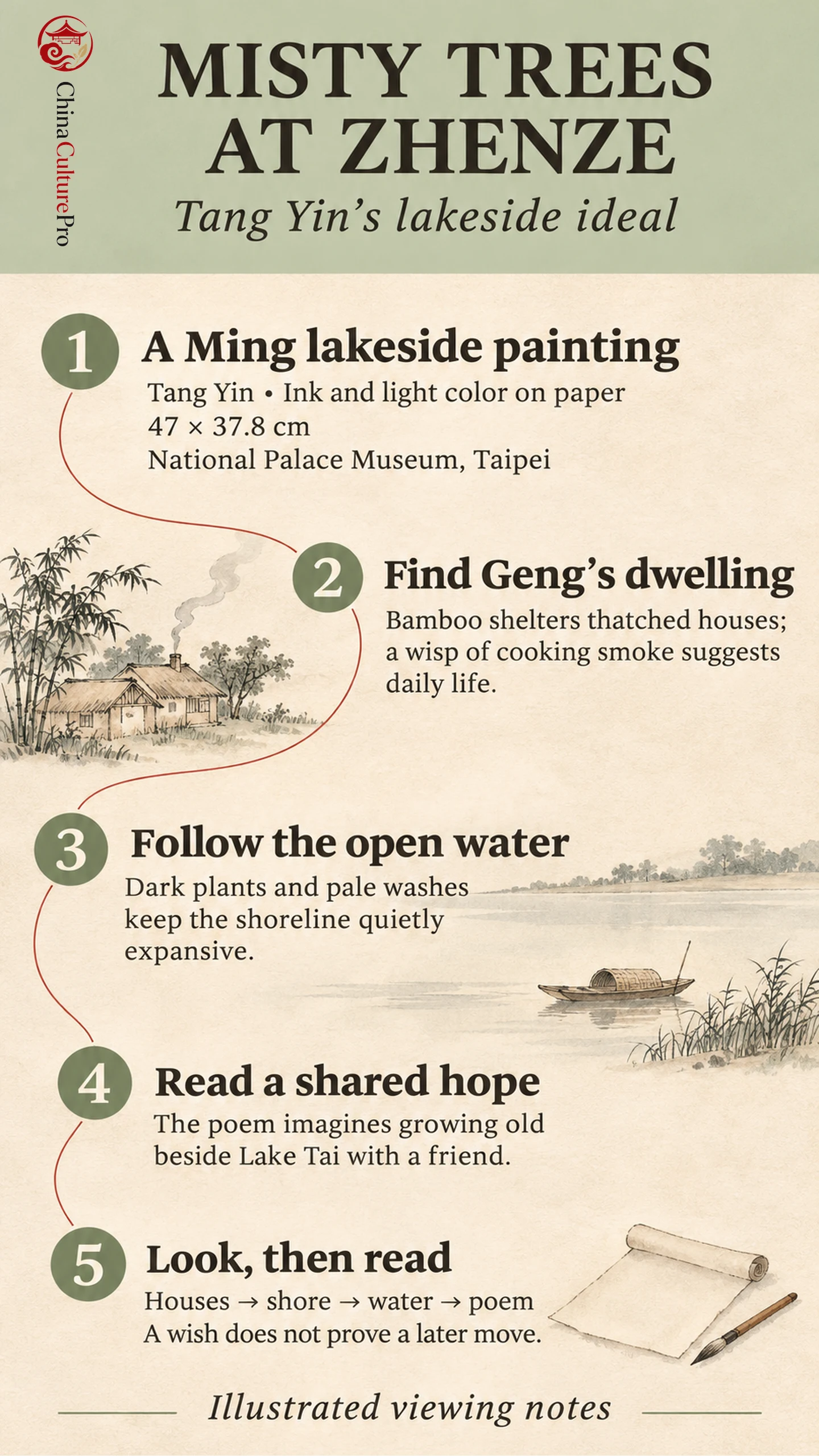
The modest scene offers a place to imagine living. Look from the houses toward the open water, then read the writing: the landscape becomes more personal when its intended companion and hoped-for future come into view.
The Painting at a Glance
| Kolom | Identification |
|---|---|
| Seniman | Tang Yin |
| Periode | Ming dynasty; associated with his late career |
| Exact creation year | Not established in the cited records |
| Format | Hanging scroll |
| Media | Ink and light color on paper |
| Picture size | 47 cm high × 37.8 cm wide |
| Collection | National Palace Museum, Taipei |
The picture and the upper poetry panel are measured separately. The later panel is 29.3 × 37.8 cm, so a reproduction showing the full mounted work includes more than the original painted area.[1]
The guide to Chinese hanging scrolls and handscrolls explains that distinction between a picture and the larger object that presents it.
A Friend’s Dwelling in the Lake Tai Landscape
Tang made the work for his friend Geng Jingzhai (耿敬斋, Gěng Jìngzhāi), depicting the setting of Geng’s residence. Bamboo surrounds a group of thatched houses, and a thin wisp of cooking smoke rises from one of them.[3]
That domestic detail makes the dwelling feel inhabited. The house is more than a marker of scale: someone has a reason to remain there, prepare food and pass an ordinary day. The bamboo partly shelters this place while the water opens the view outward.
Boats connect the inhabited shore with the lake. Their small forms give the water a human measure without filling its expanse. Compare the nearer vessel with the distant marks before focusing on the houses alone.[2]
For the broader visual tradition, see Chinese landscape painting. Here, a residence, boats and open water combine to make a specific friend’s surroundings carry an ideal of life.
Light Washes Make the Shoreline Feel Open
The composition uses concise marks and substantial ink washes, with varied tones across rocks, banks, trees and bamboo. The handling is freer and less minutely descriptive than a densely articulated mountain scene.[2]
Compare a dark patch of foliage with the adjacent pale water. The contrast makes the plants register strongly even when their individual leaves are only briefly indicated. Now look at the shore: a soft transition can suggest damp ground without requiring a hard boundary around every inlet.
A rocky corner enters from the upper left, while the inhabited bank occupies the lower right. Between them, the relatively open water keeps the two areas apart and gives their relationship room to develop.
Try shifting your attention between those positions. Beginning with the darker shore emphasizes shelter and habitation; beginning with the water makes the same houses feel small and withdrawn. The change in attention alters which part of the scene seems to lead the experience.
Chinese ink painting provides context for the expressive work done by wash, tone and selective line. In this painting, their differences help maintain a quiet openness around the dwelling.
The Poem Turns a Residence into a Shared Hope
Tang’s inscription introduces Geng as an old acquaintance who farms by day and reads at night. It says that Geng asked him to depict his surroundings. The painter then reflects on his own pursuit of worldly advancement and imagines a quieter future beside the lake.[1]
The closing hope concerns growing old together, with plain rice and fish soup. These ordinary comforts make the wish concrete. A landscape of retreat becomes an imagined shared routine, rather than an abstract statement about withdrawing from society.
Read that future as an aspiration expressed through poem and picture. The inscription establishes the relationship and the wish; it does not document that Tang later moved into the painted residence.
The guide to Chinese painting inscriptions and seals helps distinguish what a text records from what it hopes or praises. This is also a useful example of Chinese literati painting bringing friendship, writing and landscape into the same object.
For more of the artist’s range, see Tang Yin’s works and style. The restraint here is one choice within that wider practice.
How to Look from the Houses to the Poem
- Locate habitation. Find the thatched houses and surrounding bamboo. Notice the small cooking-smoke detail that suggests daily life.
- Compare the shores. Move between the rocky upper-left corner, the inhabited lower-right bank and the open water between them.
- Follow the ink tones. Compare a dark plant cluster with a pale bank or lake passage. Ask how much description each area receives.
- Read the wish precisely. Identify Geng, the requested residence picture and Tang’s imagined lakeside future. Keep aspiration distinct from a verified later move.
FAQs About Misty Trees at Zhenze by Tang Yin
Does the 1784 inscription date the painting?
No. The Qianlong emperor (乾隆, Qiánlóng) added that poem centuries later on the separate upper panel. It is part of the work’s later reception.[1]
Did Tang Yin actually retire to this house?
The poem expresses a hope of growing old by the lake with his friend. The cited evidence does not establish that the imagined arrangement was fulfilled.[1][3]
Is Trees Shrouded in Mist a different painting?
That English title appears in an older catalogue entry for the same 47 × 37.8 cm work. The current collection record uses Misty Trees at Zhenze.[1][3]
Sumber
[1] National Palace Museum. Misty Trees at Zhenze: collection record, measurements and inscriptions
[2] Bureau of Cultural Heritage, Ministry of Culture. Tang Yin’s Misty Trees at Zhenze: designated-object description
[3] National Palace Museum, via Digital Archives Union Catalog. Trees Shrouded in Mist: residence and friendship context