


Quick Answer: What Is Minnan Culture?
Minnan (闽南, Mǐnnán) means southern Fujian. Minnan culture is associated especially with Quanzhou, Zhangzhou and Xiamen, together with communities connected to the region through migration and maritime networks. [1][2]
- Language: Related forms of southern Fujian speech carry stories, songs and everyday relationships across communities.
- Belief: Temples and local ceremonies connect religious practice with the histories of ports, neighborhoods and families.
- Performance: Music, sung drama and puppetry preserve distinctive repertoires and skills.
Minnan is a regional cultural identity. People with connections to it can differ in language use, religious affiliation and ways of taking part in community life.
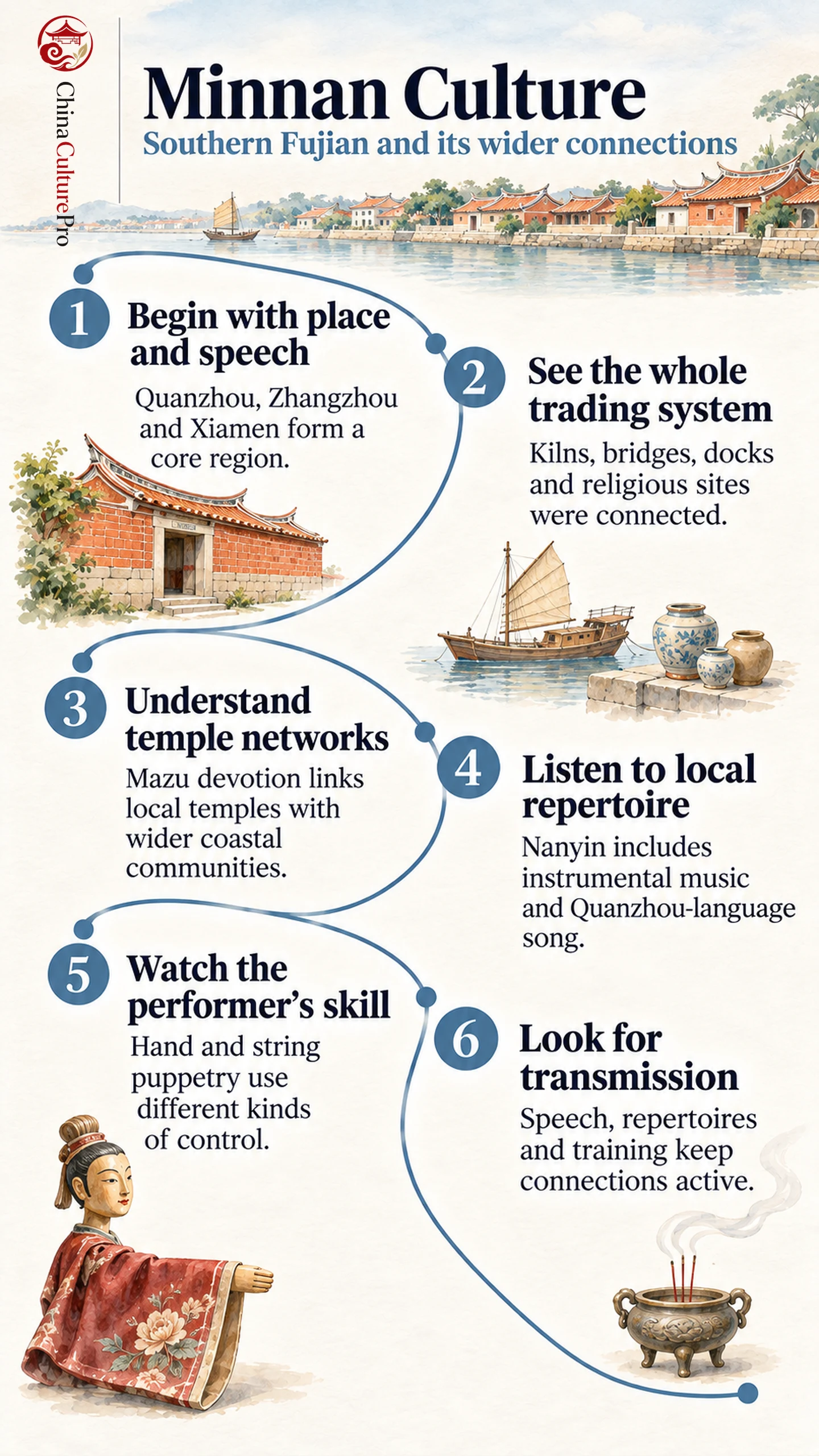
A song performed in Quanzhou speech and a temple beside an old trading route offer two ways into Minnan culture. One carries a local repertoire through sound. The other records the institutions and beliefs of a maritime community. Following both gives a fuller picture than treating southern Fujian simply as a collection of port cities.
Minnan, Hokkien and the Geography of Speech
The core region includes Quanzhou, Zhangzhou and Xiamen in southern Fujian. Southern Min (闽南语, Mǐnnányǔ) names a related linguistic category. Hokkien is a familiar name for varieties associated with this area and its overseas communities. Fujian also has other Min branches and Hakka-speaking areas, so neither the regional label nor Hokkien describes all the province’s speech. [1][2]
Quanzhou and Zhangzhou varieties helped shape the development of Southern Min in Taiwan. Migration also carried related speech to communities in Singapore, Malaysia, Indonesia and the Philippines. Those varieties developed in their new surroundings and can differ from one another in pronunciation, vocabulary and use. A shared connection does not imply that everyone speaks in exactly the same way. [2]
The Fujian culture guide provides the wider provincial frame. For a particular recording or spoken phrase, a place label such as Quanzhou or Zhangzhou is often more informative than the word Fujian alone.
Quanzhou’s Port Was More Than a Waterfront
During the Song and Yuan periods, from the tenth to fourteenth centuries, Quanzhou linked maritime commerce with production and transport inland. The surviving heritage includes kilns, iron-production sites, bridges, docks and administrative structures. Ships were one part of a wider system that moved products from their places of manufacture to overseas markets. [3]
Religious buildings also belonged to that trading city. The Qingjing Mosque and Islamic tombs preserve evidence of Muslim communities and overseas connections. Pagodas, inscriptions and other monuments contribute different parts of the record. A stone dock can show where goods moved, while a religious building can reveal something about the people who lived and worshipped around those routes. [3]
This evidence explains the relationship between maritime trade and cultural diversity in concrete terms. Commerce brought people together through work, residence and institutions, as well as through the exchange of objects.
Temples, Mazu and Community Belonging
Mazu (妈祖, Māzǔ) is a sea goddess venerated in coastal communities and beyond. Accounts of her protection at sea belong to religious belief and tradition. The Mazu guide follows the deity’s titles, stories and wider devotional networks. [5]
Quanzhou’s Tianhou Temple provides a specific local example. First established in 1196, it stands near the southern end of the old city, oriented toward the river and ports. Its history links Mazu devotion with a place whose economy depended on maritime connections. Worship also had social settings in temple courtyards, festivals and neighborhood activity. [4][5]
Mazu devotion is one strand of the region’s religious life. Buddhism, Daoist and local practices, Islam and Christianity all have institutions or communities in the broader area. The guides to Chinese Buddhism and religion in China help distinguish those traditions. An individual’s hometown alone does not establish their religious affiliation. [1]
Nanyin and Puppetry in Social Life
Nanyin (南音, nányīn) combines instrumental and vocal repertoires associated with Minnan communities. It includes ballads sung in Quanzhou speech, with accompaniment that can feature a horizontally held lute, a bamboo flute and clappers. Listen for the measured pace and the space between a sung line and an instrumental response. [6]
Its social settings include ceremonies, weddings, funerals and festive gatherings. For a community overseas, the sound of local-language repertoire can also maintain a connection with an ancestral hometown. The overview of Chinese traditional music explains how to listen for voice, instruments and occasion separately. [6]
Fujian puppetry includes both string and hand forms. Their manipulation techniques differ, and a performance also requires speech or singing, musical timing and the craft of making puppets. The overview of Chinese performing arts places those skills beside other theatrical traditions. A puppet’s movements carry meaning through the performer’s control, so the object and the performance need to be understood together. [7]
Overseas Networks and Cultural Transmission
A migration route helps explain how a language or performance traveled. Continuing practice explains how it survives. Family use of speech, learning a repertoire and supporting a performing group each provide a different means of transmission. Nanyin’s communities in southern Fujian and Southeast Asia demonstrate how a regional tradition can have more than one home. [2][6]
Puppetry also illustrates the work required to pass on specialized skills. A Fujian safeguarding program developed professional training, teaching materials and performance settings to support new practitioners. The strategy was selected for the international Register of Good Safeguarding Practices in 2012. That designation recognizes an approach to transmission, distinct from the recognition of a specific performance tradition on another heritage list. [7]
Regional identity therefore depends on people making choices about what to learn, use and reinterpret. To understand a contemporary Minnan practice, identify the community and setting as well as its historical connection with southern Fujian.
FAQs About Minnan Culture
Is Minnan the Same as All of Fujian?
Minnan refers to the southern Fujian cultural region. Fujian as a province includes additional cultural and linguistic traditions beyond that region. [1][2]
Are Hokkien and Minnan Related?
Hokkien commonly names Southern Min varieties associated with southern Fujian and connected communities overseas. Their local forms differ, so the place and community remain useful identifiers. [2]
Is Mazu Worship Exclusive to Minnan?
Mazu is venerated across many coastal Chinese and overseas communities. Minnan temples are part of a much wider devotional network. [4][5]
Sumber
[1] Xiamen Municipal Investment Promotion Centre. Culture
[2] Yuchau E. Hsiao. The Sound Patterns of Taiwanese Southern Min: Introduction
[3] UNESCO World Heritage Centre. Quanzhou: Emporium of the World in Song–Yuan China
[4] Quanzhou Municipal Government. Tianhou Temple
[5] UNESCO. Mazu belief and customs
[6] UNESCO. Nanyin
[7] UNESCO. Strategy for training coming generations of Fujian puppetry practitioners