

Quick Answer: What Is the Manas Epic in China?
Manas(玛纳斯,Mǎnàsī)is a heroic epic tradition of the Kyrgyz(柯尔克孜族,Kē’ěrkèzīzú)people. In China, it is associated particularly with communities in Xinjiang, while its cultural world also extends across Central Asian borders.[1]
- Story: The hero and his descendants form a narrative cycle.
- Performance: Voice and gesture bring individual episodes to life.
- Community: Gatherings and celebrations provide settings for telling.
A recording or printed edition represents a particular telling; it is not the sole original from which all others descend.

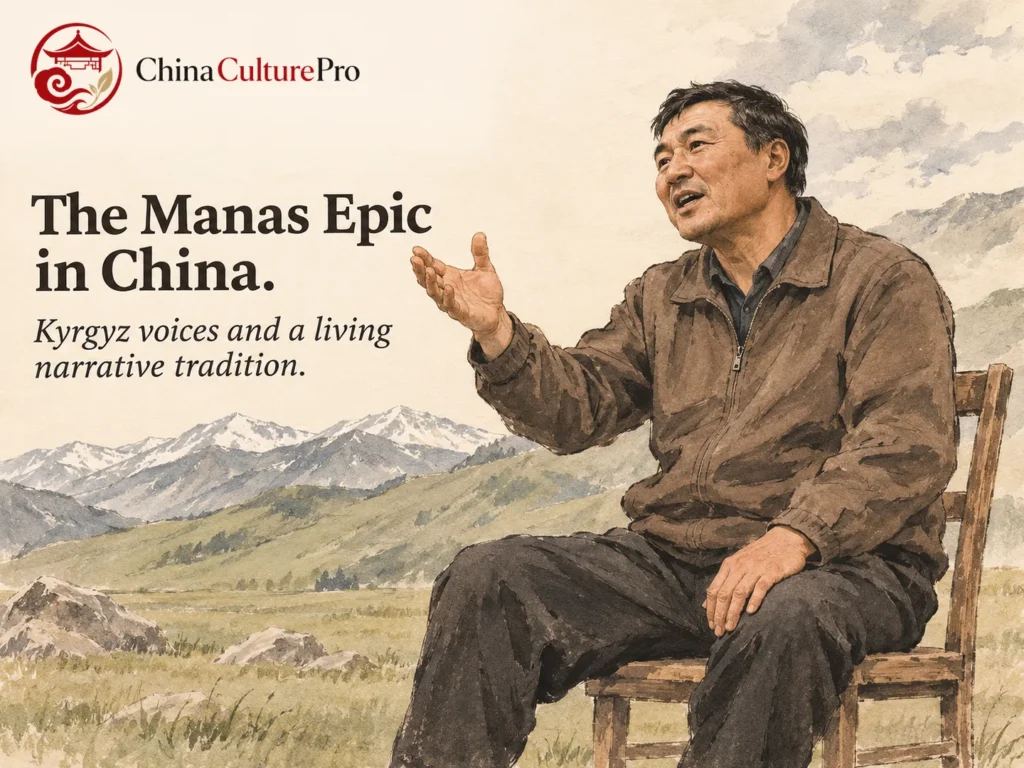
A storyteller’s voice gathers speed, and a change in gesture marks a new character. The listener encounters a performance, not simply a long poem being read aloud. This guide introduces the epic’s stories, a major version recorded in China, and the different roles of community transmission, publication and heritage recognition.
A Heroic Story across Generations
In China, the epic is especially associated with Kizilsu(克孜勒苏,Kèzīlèsū)in southern Xinjiang and with Kyrgyz communities in the Ili region farther north. Its narratives combine heroic conflict with mythology, customs, sayings and accounts of community life.[2]
One nineteenth-century recorded version begins with a long-childless couple finally having a son. Manas grows into a warrior who fights enemies, forms alliances and campaigns with forty companions. His marriage, friendships, battles and death belong to a heroic narrative whose action continues beyond his lifetime.[3]
The familiar trilogy follows Manas, his son Semetey(赛麦台,Sàimàitái)and his grandson Seytek(赛依台克,Sàiyītáikè). Other versions extend the family cycle farther. Three named generations and an eight-generation telling are therefore different shapes of the tradition, rather than contradictory counts for one fixed book.[3]
Historical experiences inform the epic, but its supernatural episodes and shifting versions cannot be read as a literal chronicle. Its formation remains debated; a dated manuscript records an existing telling, not necessarily the tradition’s beginning.[3]
How a Manaschi Brings the Epic to Life
A specialist performer is called a manaschi(玛纳斯奇,Mǎnàsīqí). The annotation is a Mandarin rendering, not its Kyrgyz pronunciation. Traditional performance is unaccompanied, with melodic delivery adjusted to story and character.[1]
Changes in pace and emphasis distinguish situations and characters. Gesture adds another layer that a transcript cannot reproduce.[1]
For a recording, identify the performer and episode before trying to judge whether it represents the entire epic. As in other Chinese storytelling traditions, an excerpt can be a complete performance event while remaining only part of a much larger narrative cycle.
Jusup Mamay and the Making of a Version
Jusup Mamay(居素甫·玛玛依,Jūsùfǔ Mǎmǎyī), a celebrated performer from Akqi(阿合奇,Āhéqí), lived from 1918 to 2014. His eight-part version became important to documentation and publication in China. He was a creative performer within an inherited tradition, not its single author.[3][4]
His learning joined oral instruction with written materials. His elder brother collected and edited performances, and these records formed part of his training. Training included changes of tone, gestures and expressions suited to different situations. A manuscript supported performance rather than replacing it.[4]
Comparison of his recorded tellings also reveals changes in elaboration and in some narrative details. Audience comments and exchanges with other performers contributed to his practice. The account of his learning includes dream experiences, understood within the tradition as a calling; that belief should be distinguished from the documented work of studying and performing.[4]
Writing and oral creativity can interact: notes support learning, while performance retains its responsiveness to listeners and its capacity for variation.
Community Heritage across Borders
Three records are useful to keep separate when discussing Chinese intangible cultural heritage:
| Catatan | Date and scope |
|---|---|
| China’s national list: Manas | Listed in 2006, in the first batch, as folk literature under project I-25.[2] |
| UNESCO: Manas | China’s element entered the Representative List in 2009.[1] |
| UNESCO: Kyrgyz epic trilogy: Manas, Semetey, Seytek | Kyrgyzstan’s distinct element entered the Representative List in 2013.[5] |
These entries identify different safeguarding records within a shared cultural tradition. They are not a single joint nomination, and their dates do not establish when the epic originated.
Cross-border discussion has included disagreement over which versions should represent the tradition and how authenticity should be assessed. Heritage recognition can strengthen visibility while also encouraging claims framed around national boundaries. The presence of an inscription should not be treated as proof that a living epic belongs exclusively to one modern state.[6]
For understanding Kyrgyz culture in China, retain both scales: the specific communities and performers in Xinjiang, and the wider network of related Kyrgyz storytelling traditions.
Recordings, Translations and New Stages
Documentation changes how audiences encounter the epic. A complete Chinese translation based on Jusup Mamay’s performances appeared in April 2022. Its completeness concerns that recorded version; it does not make other performers’ repertoires redundant or turn the original Kyrgyz tradition into a Mandarin-language composition.[7]
A 2025 profile follows performer Tuohenali Tuxunnali(托合那力·吐逊那力,Tuōhénàlì Tǔxùnnàlì), Mamay’s great-grandson, from Akqi to a September performance in Bishkek. The account describes an excerpt presented through changing vocal delivery and gesture. It offers one concrete example of inheritance crossing a family line, an international stage and a new audience.[7]
When choosing a translation or recording, check:
- Version: Whose repertoire is represented?
- Language: Is this the Kyrgyz performance, a translation or an adaptation?
- Extent: Does it present one episode, an abridgment or a longer cycle?
- Presentation: Does it preserve a recitation, or reshape the material for theatre or another medium?
These distinctions also help when approaching the separate Gesar epic tradition. They make the performer and edition visible instead of treating every epic as one anonymous, unchanging text.
FAQs About the Manas Epic in China
Is Manas a Chinese-language epic?
The tradition discussed here is Kyrgyz-language storytelling in China. Chinese translations and stage adaptations are different forms of access.
Is Jusup Mamay the author of Manas?
No. He developed an important version within an inherited tradition involving earlier performers, family teaching and creative retelling.
Is the epic always a trilogy?
No. Longer versions continue beyond the three-generation cycle.
Was Manas a real historical person?
Its historical basis is debated; the narrative does not establish a single verified biography.
Sumber
[1] UNESCO. Manas
[2] China Intangible Cultural Heritage. Manas, National Project I-25
[3] Karl Reichl. Oral Epics into the Twenty-First Century: The Case of the Kyrgyz Epic Manas
[4] Lang Ying. The Bard Jusup Mamay
[5] UNESCO. Kyrgyz Epic Trilogy: Manas, Semetey, Seytek
[6] Svetlana Jacquesson. Claiming Heritage: The Manas Epic between China and Kyrgyzstan
[7] Yang Feiyue. Carrying an Epic Spirit over Centuries