

Quick Answer: What Is Liangcha?
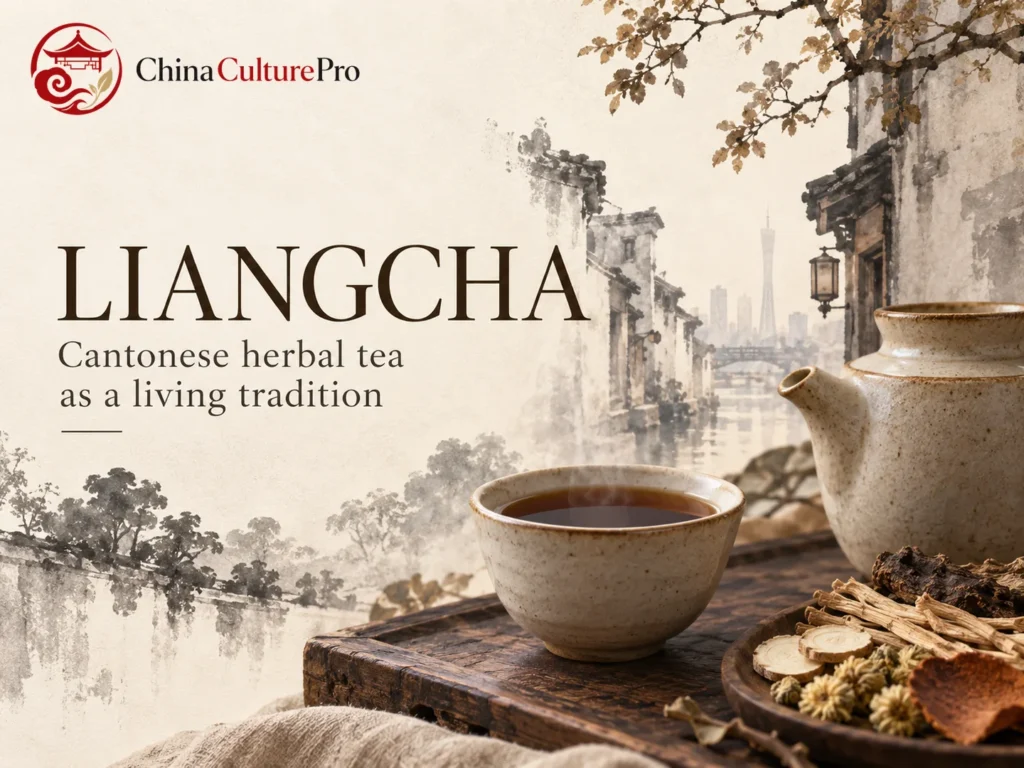
Liangcha (凉茶, liángchá) is a southern Chinese herbal-drink tradition strongly associated with Guangdong, Hong Kong and Macao. In Cantonese contexts it is often written leung cha in English. Its recipes and vocabulary draw on Chinese medical ideas and everyday regional food culture.[1][2]
- Cooling: The name belongs to a traditional conceptual framework, not simply a requirement to serve the drink cold.
- Herbal preparation: It is not necessarily an infusion of ordinary tea leaves.
- Variation: Different formulas, shops and commercial products can taste quite different.
Understanding the tradition does not require accepting a treatment claim. Identify the actual drink, ingredients and serving style before deciding what to order.

A bitter herbal cup from a specialist shop and a sweet packaged drink can create very different expectations. Liangcha is best approached through its regional setting, inherited knowledge and particular recipe rather than one imagined universal flavor. The wider Chinese drinks guide places it beside leaf tea, fruit-based drinks and other everyday choices.
What Cooling Means in the Name
The cooling vocabulary comes from traditional Chinese medical interpretations of the body, climate and food. Hong Kong’s heritage account describes the region through ideas of heat and dampness and explains the herbal decoction within that framework.[2] These are cultural concepts that help explain why the drink is chosen and how it is discussed.
They are different from measuring the liquid’s temperature. A preparation can belong to a cooling tradition without arriving full of ice. When ordering, ask whether it is served warm, at room temperature or chilled instead of assuming the translated name supplies that information.
The word tea also needs context. Chinese leaf tea involves the processing and brewing of tea leaves, while herbal decoctions use a different ingredient basis.[2][3] An English tea label can describe either, so check what has actually gone into the cup.
A Lingnan Tradition and the Neighborhood Shop
Lingnan (岭南, lǐngnán) names the southern cultural-geographical setting closely associated with this tradition. The national heritage account connects liangcha with Guangdong, Hong Kong and Macao and describes formulas and related terminology transmitted over generations.[1]
The shop is part of that story. Hong Kong’s heritage account describes a local history extending over a century and notes that herbal-tea shops once also functioned as neighborhood entertainment centers.[2] This makes the tradition more than a collection of dried ingredients: it belongs to familiar places, repeated visits and everyday social life.
Liangcha entered China’s first national intangible-cultural-heritage list in 2006.[1][2] The designation recognizes a cultural practice and its transmission. It should not be interpreted as a medical trial, a guarantee about every branded product or a claim that every shop uses the same recipe.
The wider Chinese teahouse culture guide offers another view of drinks and social space. A herbal-tea shop and a leaf-tea gathering have different preparations, but both can make the place of drinking part of the experience.
Different Ways to Encounter Herbal Tea
Use the form in front of you to guide your questions. These are practical distinctions for reading a menu or package, rather than three fixed traditional formula classes.
| Bentuk | What to ask or check |
|---|---|
| A prepared cup from a shop | Which preparation is it, how bitter or sweet is it, and what temperature is available? |
| A bottled or canned drink | Read the ingredients, sweetening information and serving instructions for that exact product. |
| A dried ingredient mixture | Check its stated ingredients and intended preparation; use the supplier’s complete directions rather than guessing a formula. |
Do not use bitterness as an authenticity test. A strong botanical flavor and a sweetened formulation answer different taste preferences, and neither alone identifies the full recipe. Similarly, a flower illustrated on the label need not be the only ingredient.
A useful first order is one that names the preparation and asks about taste before buying. If you want something mild or unsweetened, say so directly rather than relying on a generic request for herbal tea.
Recipes, Preparation and Transmission
The core idea is a decoction of selected botanical ingredients, prepared within a tradition of formula knowledge. National and Hong Kong heritage descriptions emphasize inherited recipes and folk knowledge rather than one ingredient list shared by all producers.[1][2]
Preparation can involve selecting and combining ingredients and extracting them in water. The exact quantities, sequence and timing belong to the particular mixture. Use the particular mixture’s complete directions rather than improvising from a familiar name.
That variation also matters when reading names that seem to contain a number or a list of plants. Ask for the actual ingredients instead of assuming the name proves an exact count or an identical combination across shops. For a packaged mixture, keep its directions with the ingredients so that preparation follows the specified product.
People maintain and adapt the knowledge through practice; the appearance of a jar cannot establish that transmission. Changes in packaging or sales format do not tell you, by themselves, whether a particular product preserves a specific inherited formula.
Reading a Menu or Label Clearly
Separate three questions: what is in the drink, what does it taste like and what claims are being made about it? Ingredient information answers the first; a shop’s description can help with the second. A traditional claim does not automatically answer a modern question about treatment effectiveness.
Ask about added sugar, the complete botanical mixture and any tea-leaf component when those affect your choice. Avoid inferring caffeine content from the word herbal alone if the actual formulation is unknown. Use the product’s ingredient information to resolve those questions.
Other drinks can share some botanical ingredients without belonging to the same tradition. Suanmeitang centers on prepared plum, while Chinese flower teas cover several different infusions and scented teas. Knowing the preparation and regional context gives you a clearer distinction than calling every non-coffee infusion liangcha.
FAQs About Liangcha
Is liangcha always served cold?
No. Cooling belongs to its traditional conceptual language. Ask about the actual serving temperature, which is a separate choice.
Does liangcha necessarily contain tea leaves?
No. The tradition centers on herbal preparations, but individual formulations need checking. An English tea label does not establish a tea-leaf ingredient.
Does a bitter taste prove a health benefit?
No. Bitterness describes taste. It does not prove a treatment effect, identify the whole formula or establish that a particular drink suits everyone.
Sumber
[1] China Intangible Cultural Heritage Museum. Liangcha
[2] Hong Kong Intangible Cultural Heritage Office. Herbal Tea
[3] UNESCO. Traditional Tea Processing Techniques and Associated Social Practices in China