


Quick Answer: Who Was Lan Ying?
Lan Ying (蓝瑛, Lán Yīng) was a professional painter from Hangzhou whose career crossed the late Ming and early Qing periods. He combined large-scale landscape design with close study of earlier paintings.[1]
- His subjects include mountains, rivers, secluded dwellings and seasonal scenery.[2][4]
- His surviving works range from restrained album leaves to richly colored hanging scrolls.[3][5]
- His family and pupils carried forward the style associated with Hangzhou.[1]
One school label or brightly colored image cannot represent his full range.
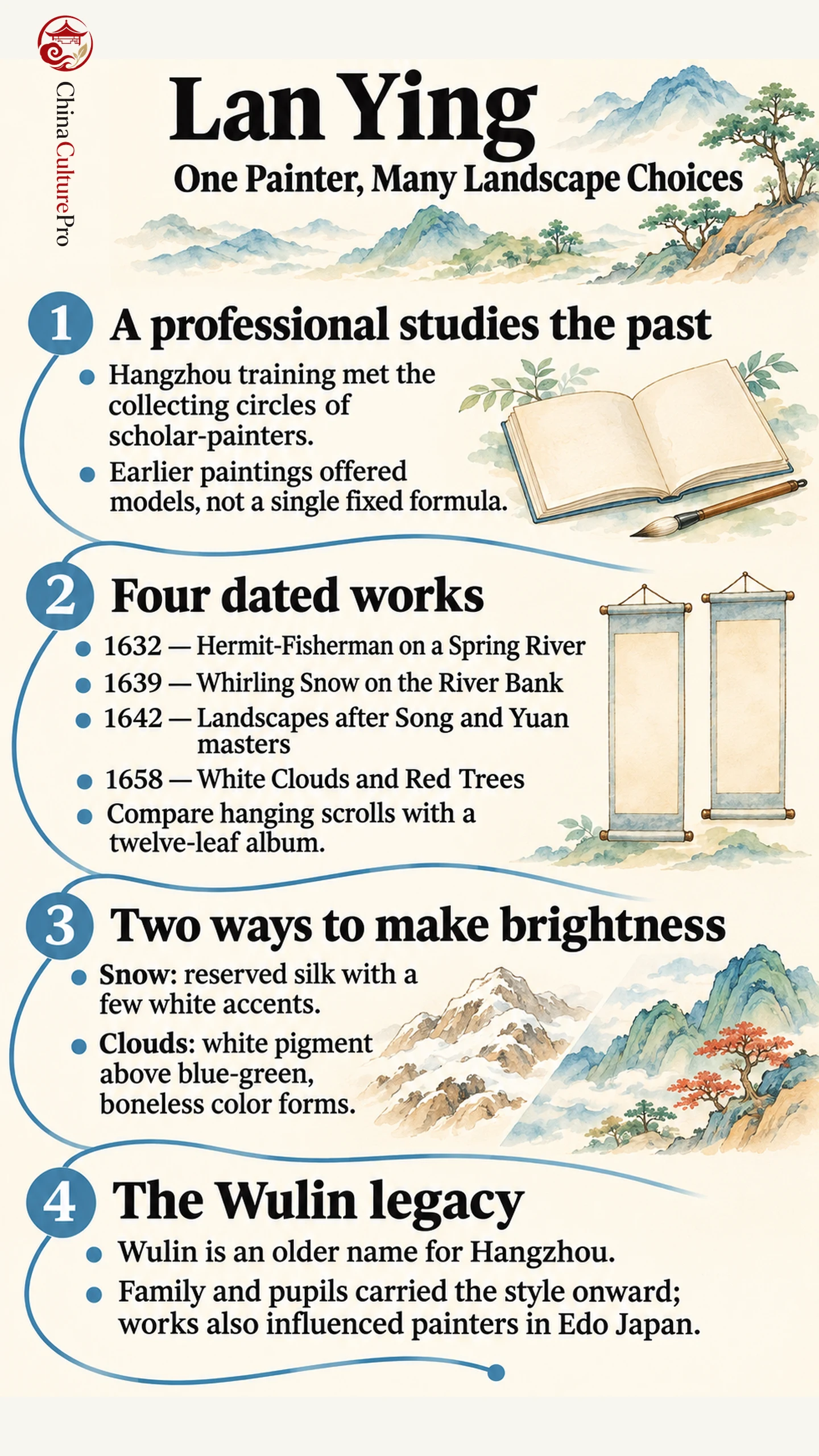
A small album leaf and a tall silk scroll ask for different kinds of attention. Lan’s work shows how historical models could be adapted to both intimate study and striking display.
A Hangzhou Professional among Scholar-Painters
Born in 1585, Lan trained within the Zhe school (浙派, Zhè pài), a tradition associated with professional painters and Southern Song academy models. Contacts with collectors and painters around Dong Qichang gave him access to old paintings and ideas about literati painting.[1][4]
He studied Huang Gongwang and Shen Zhou closely. Their examples expanded his repertoire rather than replacing professional craftsmanship.[5]
Four Dated Paintings to Compare
| Work | Tanggal | Format and medium | Collection |
|---|---|---|---|
| Hermit-Fisherman on a Spring River | 1632 | Hanging scroll; ink and color on silk. | Metropolitan Museum of Art.[2] |
| Whirling Snow on the River Bank | 1639 | Hanging scroll; cataloged as ink on silk. | Asian Art Museum, San Francisco.[4] |
| Landscapes after Song and Yuan masters | 1642 | Album of twelve leaves; ink and color on paper. | Metropolitan Museum of Art.[3] |
| White Clouds and Red Trees (白云红树图) | 1658 | Hanging scroll; color on silk. | Palace Museum, Beijing.[5] |
The 1642 album is a useful contrast to his more dramatic work: its brushwork is comparatively restrained.[3] The 1658 scroll, measuring 189.4 × 48 cm, belongs to the Qing period despite Lan’s frequent identification with late Ming painting.[5]
How Color and Unpainted Silk Shape His Landscapes
In Whirling Snow on the River Bank, washes darken the terrain around areas of exposed silk, making those reserved areas read as snow. A few white accents reinforce the effect. Broken lines and dots keep the mountains’ surfaces lively.[4]
White Clouds and Red Trees uses a different approach. Its boneless painting (没骨, mògǔ) forms rely on color rather than preliminary ink outlines. Blue and green mineral pigments build the rocks, red and other colors enliven vegetation, and white pigment renders clouds. The inscription invokes Zhang Sengyou’s historical method, while the work develops a distinctive personal color language.[5]
Look first at how a pale area is made: exposed support and applied white pigment can produce similar brightness through different material choices. This comparison makes Chinese landscape painting more tangible than a school label alone.
The Wulin School and His Wider Legacy
The Wulin school (武林画派, Wǔlín huàpài) takes its name from an older name for Hangzhou. It describes the style transmitted through Lan’s family and pupils, including his son Lan Meng. Works brought to Japan during the Edo period also influenced painters such as Tani Buncho.[1]
Lan’s legacy therefore involves both making paintings and transmitting a flexible repertoire of historical models. Workshop continuity helps explain why his influence extends beyond pictures bearing his own name.
FAQs About Lan Ying
When did Lan Ying live?
He was born in 1585. Museum references differ over his death, giving 1664 tentatively or around 1666, so the endpoint should be treated as approximate.[1][5]
Was Lan Ying a court painter?
He is described as a professional painter associated with Hangzhou. The Zhe school’s relationship to academy traditions does not itself establish employment at the imperial court.[1][4]
Are all his landscapes painted in bright colors?
No. The restrained 1642 album offers a useful contrast to the more saturated late painting White Clouds and Red Trees.[3][5]
Sumber
[1] Tokyo National Museum. Lan Ying—Family and Atelier
[2] Metropolitan Museum of Art. Hermit-Fisherman on a Spring River
[3] Metropolitan Museum of Art. Landscapes after Song and Yuan masters
[4] Asian Art Museum. Whirling Snow on the River Bank
[5] Palace Museum. White Clouds and Red Trees