
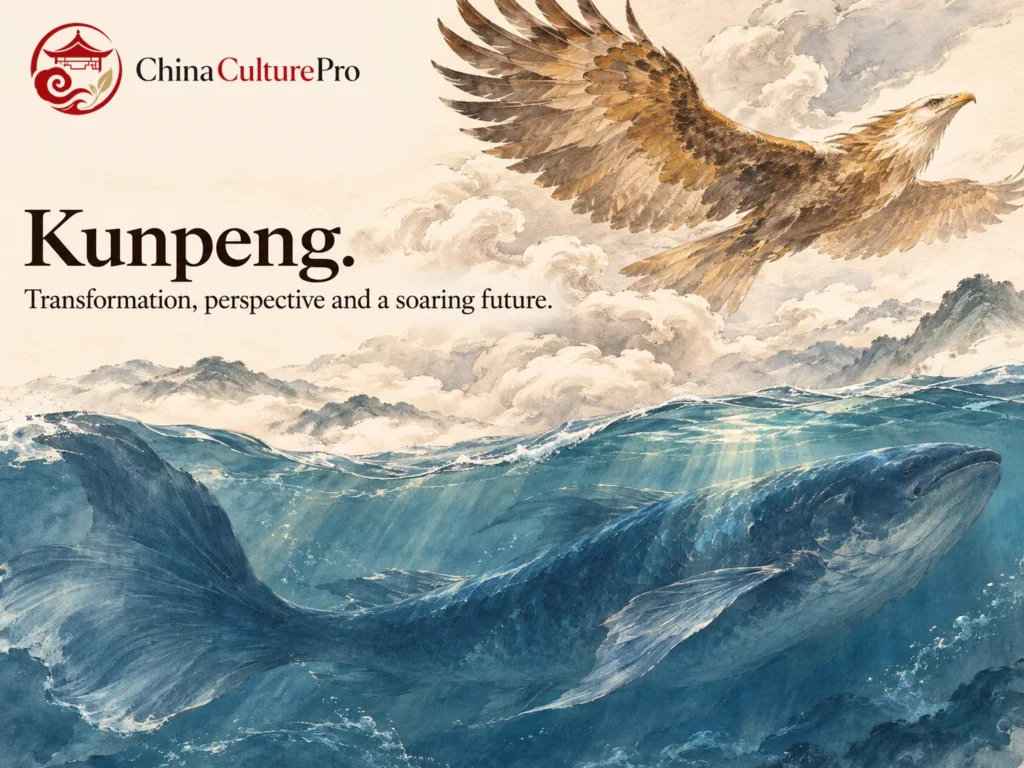

Quick Answer: What Is Kunpeng?
Kunpeng(鲲鹏,Kūnpéng)brings together the fish and bird forms in the opening story of a famous Chinese philosophical text.
- Transformation: An immense fish changes into an immense bird.
- Literary setting: The episode introduces questions about scale, knowledge and freedom.
- Later associations: The soaring bird also appears in poetry and expressions wishing someone a promising future.
It is a mythic literary image, not an identified animal or a single fixed hybrid species. Its philosophical setting and its later use as an emblem of ambition deserve separate attention.

An enormous fish becomes a bird whose wings fill the imagination like clouds. Kunpeng is memorable even before its philosophical setting comes into focus. Within Chinese mythology, it offers an unusual encounter: the creature’s extraordinary scale invites readers to reconsider the scale of their own understanding.
From Kun the Fish to Peng the Bird
The opening of the Zhuangzi(庄子,Zhuāngzǐ), in the chapter Xiaoyao you(逍遥游,Xiāoyáo yóu), introduces Kun(鲲,Kūn), an immense northern-sea fish that changes into Peng(鹏,Péng). The bird travels toward the southern sea, supported by powerful wind. Small creatures laugh at a journey outside their own experience.[1]
“Free and Easy Wandering” is a familiar English title for the chapter. The transformation connects its fish and bird forms; the story does not require an illustrator’s permanent half-fish, half-bird anatomy.
The title names both a thinker and a book. As philosopher Chad Hansen explains, the received Zhuangzi is a compilation rather than a straightforward record of one person’s statements. Its parables entertain while provoking thought. This literary form matters when approaching an episode that works through extravagant changes of scale.[2]
Scale, Perspective and Free and Easy Wandering
Why place a huge traveler beside tiny observers? One way to read the contrast is to ask how familiar experience limits judgment. In his interpretive essay, Steve Coutinho emphasizes wandering beyond established categories and expectations. He understands the chapter’s expansive vision as a challenge to confined understanding, rather than a competition in physical size.[3]
Interpretation is not unanimous. Coutinho also discusses Guo Xiang’s influential reading, in which things of different sizes can each fulfill their own nature. His own account challenges a simple equalization of all perspectives. Naming the interpreter preserves a real distinction between readings instead of reducing the chapter to one slogan.[3]
For a first reading, keep two questions open: what can each observer understand, and what does its movement depend on? The text’s comparison of supporting wind and water makes conditions of movement part of the problem.[1]
The contrast supports questions about understanding and dependence; it does not supply a simple rule that greater size means a better life. The broader Zhuangzi tradition provides the setting for those questions.
Li Bai and the Ambitious Great Peng
Li Bai(李白,Lǐ Bái)uses the great bird in his poem addressed to Li Yong. Its opening presents a mighty ascent with the wind; subsequent lines imagine continuing power even when the wind falls. The speaker then turns toward the dismissive laughter that greets his unusual manner and large claims.[4]
Read against the speaker’s response to dismissive laughter, the bird becomes an image of self-assertion. The poem need not be treated as an exact repetition of every philosophical implication of the earlier chapter.
The comparison also gives readers a useful distinction between source and reception. An image can retain recognizable features while serving another purpose in a later work. To understand a quotation, identify the poem and speaker’s situation before treating the bird as an emblem with one permanent meaning.
Pengcheng Wanli: A Later Wish for a Promising Future
The expression pengcheng wanli(鹏程万里,péng chéng wàn lǐ)uses the bird’s vast journey as a figure for a far-reaching future. Taiwan’s Ministry of Education dictionary traces the expression to the Zhuangzi and records its use as a farewell wish. In this setting, it expresses hope for someone’s prospects.[5]
A natural English rendering might wish someone a bright future or success in the journey ahead. A literal translation preserves the bird imagery but may need the allusion explained. The immense distance is figurative, not a travel measurement or a promise of guaranteed achievement.
A farewell inscription, a poem and a philosophical discussion can thus invoke related imagery with different emphasis. For language context, see Chinese idioms and proverbs. Recognizing the expression is more useful than assuming every appearance of a great bird carries an identical message.
FAQs About Kunpeng
Are Kun and Peng two separate creatures?
The opening narrative connects them through transformation: the fish becomes the bird.
Is Kunpeng a dragon?
The relevant story describes fish and bird forms. A dragon-shaped modern design is a creative interpretation.
Is Peng the same as the fenghuang?
They should not automatically be treated as interchangeable names. Identify which story or image a reference uses.
What does pengcheng wanli mean?
It wishes someone a far-reaching, promising future, drawing on the great bird’s journey.
Sumber
[1] Chinese Text Project. Zhuangzi: Enjoyment in Untroubled Ease
[2] Chad Hansen, Stanford Encyclopedia of Philosophy. Zhuangzi
[3] Steve Coutinho, Internet Encyclopedia of Philosophy. Zhuangzi: Text and Philosophical Interpretation
[4] Li Bai, Chinese Text Project. Complete Tang Poems, Volume 168: Shang Li Yong
[5] Taiwan Ministry of Education. Revised Mandarin Dictionary: Pengcheng Wanli