


Quick Answer: Who Was King Goujian of Yue?
King Goujian of Yue (越王勾践, Yuè Wáng Gōujiàn, reigned 496–464 BCE) ruled during the late Spring and Autumn period. He survived a crushing defeat by Wu (吴, Wú) and later conquered the rival state.[2]
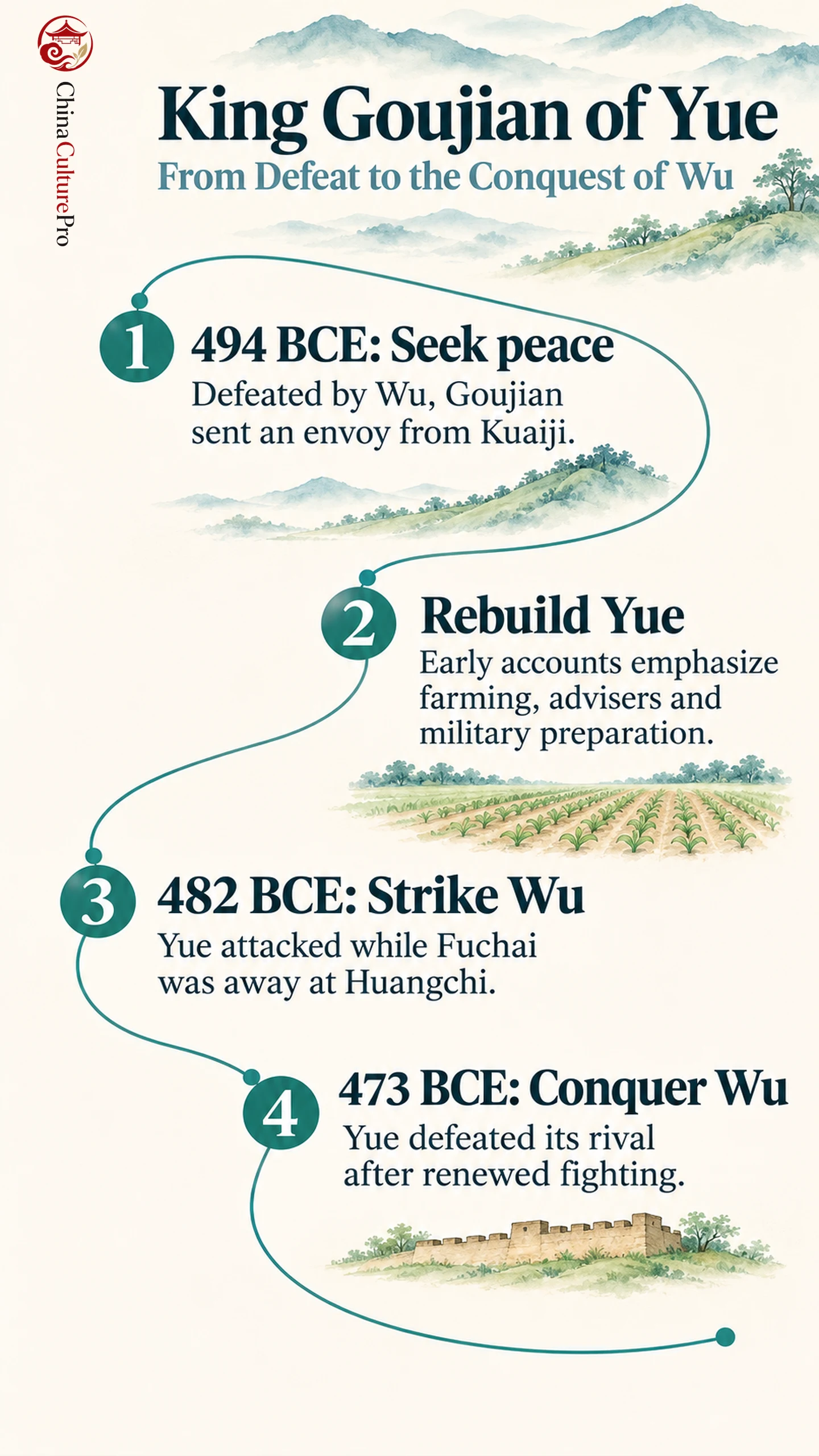
- Defeat: Fuchai (夫差, Fūchāi) defeated Goujian in 494 BCE. Goujian sought peace from Kuaiji (会稽, Kuàijī).[3]
- Reversal: Yue attacked Wu in 482 BCE and conquered it in 473 BCE.[2]
- Ingatan: Goujian’s defeat and recovery became associated with the expression “sleep on brushwood and taste gall” (卧薪尝胆, wò xīn cháng dǎn).[4]
A surviving sword bears a royal inscription connected to Goujian.[5]
Goujian’s story is often told through one ruler’s determination. Early accounts also ask how a defeated state could recover people, resources and the ability to wage war.
How Yue Survived the Defeat at Kuaiji
In 494 BCE, Fuchai of Wu defeated Yue at Fujiao. The Tradisi Zuo says Goujian took shelter at Kuaiji and sent a representative to negotiate. Fuchai accepted peace over a warning from his adviser Wu Zixu.[3]
Sima Qian’s account names Wen Zhong (文种, Wén Zhǒng) as the envoy and Fan Li (范蠡, Fàn Lǐ) as an adviser who helped Goujian consider how to respond to defeat.[1]
What the Early Texts Say About Yue’s Recovery
Sima Qian credits Goujian with living simply and putting Wen Zhong in charge of government. Fan Li says Wen was better able to stabilize the state and win over its people, while he was better at military affairs.[1]
The bamboo manuscript Yue Gong Qi Shi, now in Tsinghua University’s collection, puts more weight on the king’s example. It describes a period of easing pressure followed by policies to encourage agriculture, attract immigrants and strengthen military discipline.[2]
Historian Yuri Pines reads it as a lesson in how a weakened state could rebuild. The Tradisi Zuo gives the main military events without a comparable account of Yue’s domestic policies. These texts help explain what different writers thought a ruler should learn from Goujian.[2]
Why Yue Waited to Attack Wu
Sima Qian says Fan Li advised delay. In 482 BCE Fuchai went north for an interstate meeting at Huangchi (黄池, Huángchí), taking much of his army. Yue struck while he was away.[1]
The two sides made peace again after the attack. Yue eventually resumed fighting and defeated Wu in 473 BCE.[1][2]
What the Sword of Goujian Can Tell Us
The Hubei Provincial Museum holds a bronze sword found in 1965 at Wangshan. It measures 55.6 centimeters and has dark diamond patterns along the blade. Near the guard, eight characters in bird script are arranged in two columns. They name Jiuqian (鸠浅, Jiūqiǎn), identified by specialists as Goujian, and say the sword was made for his own use.[5]
FAQs About King Goujian
Did Goujian sleep on brushwood and taste gall?
Sima Qian describes Goujian tasting gall to remember his defeat. The brushwood detail belongs to later tellings. The distinction is one example of how historical accounts and legends can develop from the same story.[1][4]
What does the Goujian idiom mean today?
It describes accepting hardship and sustaining effort to recover from a setback or reach a difficult goal. For example, a student who persists after a poor result could use it to describe that effort.[4]
Why is Goujian’s sword associated with Chu?
The sword was excavated in a tomb of Chu (楚, Chǔ) in what is now Hubei. The inscription identifies a ruler of Yue. The tomb establishes where the sword was buried, and its route there remains open to interpretation.[5]
Sumber
[1] Sima Qian. Records of the Grand Historian, Hereditary House of King Goujian of Yue
[2] Yuri Pines. Didactic Narrative and the Art of Self-Strengthening
[3] Zuo Tradition. Annals of Duke Ai of Lu
[4] Ministry of Education, Taiwan. Dictionary of Chinese Idioms, Wo Xin Chang Dan
[5] Hubei Provincial Museum. Sword of Goujian, King of Yue