


Quick Answer: What Is Harbin Ice and Snow Art?
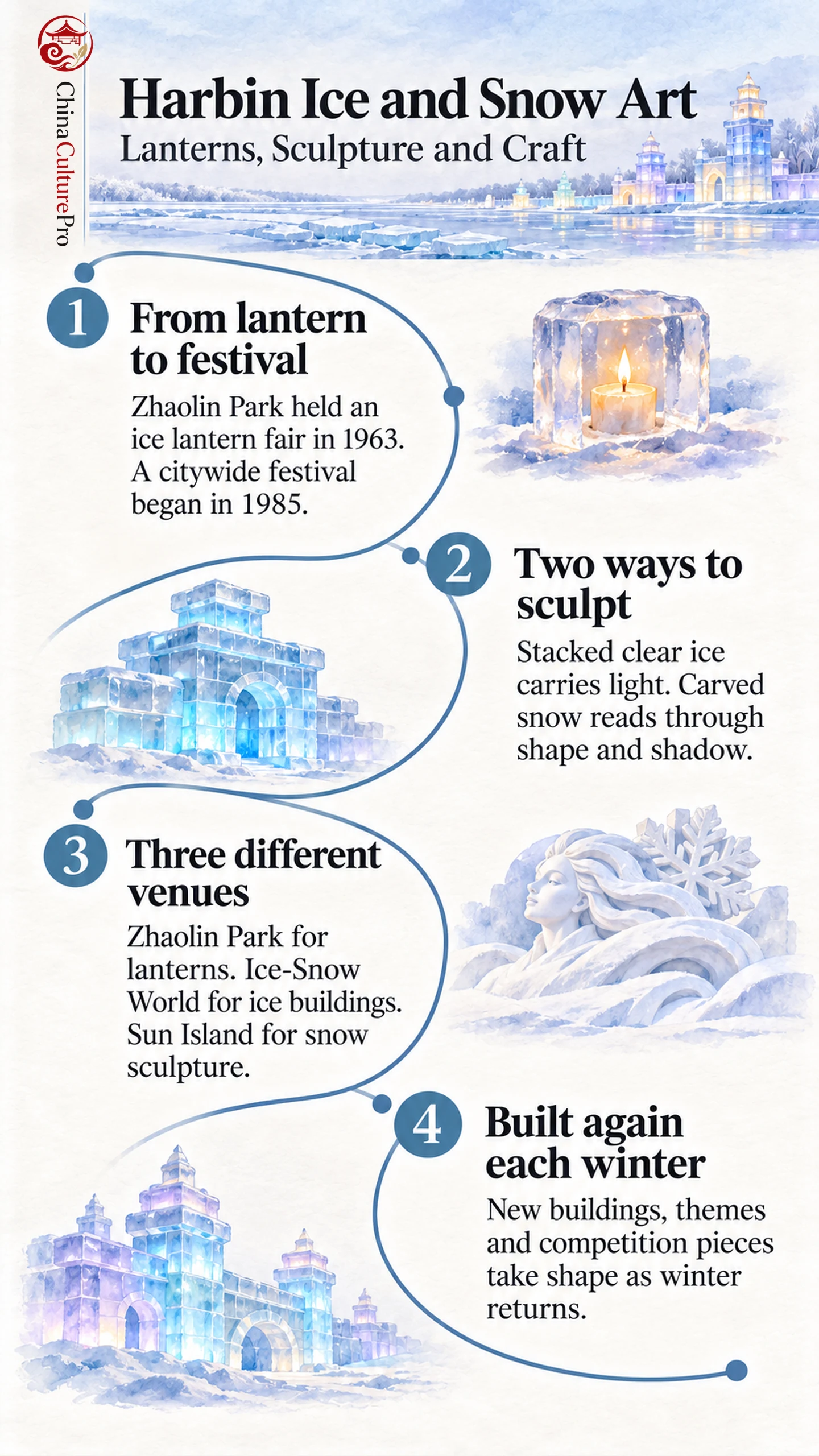
Harbin’s winter art brings together illuminated ice, clear ice architecture and sculpture carved from snow. The three overlap in the city’s festival season, but each uses cold, material and light differently.[1][4][6]
- Ice lanterns: An ice lantern (冰灯, bīngdēng) uses ice around a light source. Harbin developed the form into public displays after dark.[1][2]
- Ice architecture: At Harbin Ice-Snow World (哈尔滨冰雪大世界, Hā’ěrbīn Bīngxuě Dàshìjiè), stacked ice blocks form large walk-through buildings.[3][4]
- Snow sculpture: At Sun Island (太阳岛, Tàiyáng Dǎo), carvers use snow to create large forms whose surfaces read through shadow.[6]
The festival brings several kinds of work together across the city. Each venue has its own emphasis and seasonal schedule.[1][7]
An ice structure in Harbin changes as daylight fades. The glow of a tower at dusk and the recesses of a snow relief in daytime depend on different choices about how to shape the material.
From Ice Lanterns to a Citywide Festival
Local accounts connect Harbin’s ice lanterns to makeshift winter lights used by people such as fishermen. One traditional version set a candle inside a hollow piece of ice, where the ice sheltered the flame. A public ice lantern fair was held at Zhaolin Park (兆麟公园, Zhàolín Gōngyuán) in 1963.[2]
Harbin established an annual ice and snow festival in 1985. Ice-Snow World, the large-scale park known for ice architecture, began in 1999. These dates mark different developments: an organized lantern fair, a wider festival and a dedicated site for monumental work. For more on how winter arts fit into the city’s identity, see Harbin’s cultural history.[1][2][3]
How Ice and Snow Change the Design
Crews cut blocks from the frozen Songhua River (松花江, Sōnghuā Jiāng) and move them to building sites. They shape and stack the blocks to build up walls or towers, then carve details in place. The joints and depth of the material can remain visible in daylight. At night, electric lighting shines through translucent blocks and turns the structure itself into part of the lighting design.[2][4][5]
Snow presents a different problem. Its surface reflects light, so broad shapes, deeply cut lines and the shadows they cast help separate one form from another. In the competition works at Sun Island, the snow reads as a solid surface. Deep cuts leave dark edges that make neighboring figures easier to distinguish at a distance.[6][8]
Three Places to See Different Kinds of Winter Art
Start with the material you want to see. The three venues are associated with different scales and viewing conditions.[1][3][6]
| Venue | Hal yang perlu diperhatikan |
|---|---|
| Zhaolin Park | Ice lanterns and smaller illuminated ice displays. Look at how the light sits within or behind the carved ice.[1][2] |
| Harbin Ice-Snow World | Stacked ice buildings and large-scale sculpture. Look for seams and relief by day, and the way lighting changes the same forms after dark.[3][4][5] |
| Sun Island Snow Sculpture Art Expo | Outdoor snow works and carving competitions. Look at silhouettes, recesses and the shadows on a white surface.[6][8] |
Why the Outdoor Works Are Rebuilt
The seasonal outdoor structures depend on freezing temperatures. Building them anew also gives the organizers a fresh canvas. The 2024–25 edition of Ice-Snow World, for example, included designs inspired by the Asian Winter Games.[9]
Competitions renew the work on a smaller scale. In January 2026, teams from 13 countries made new snow sculptures at Sun Island over four days. The competition keeps carving visible as a shared practice even though each winter’s work is temporary.[8]
FAQs About Harbin Ice and Snow Art
Is the Harbin Ice Festival the Same as Ice-Snow World?
The festival is the wider seasonal program. Ice-Snow World is one large venue. Harbin’s lantern fair and Sun Island snow exhibition have separate sites.[1][3][6]
Are Ice Lanterns Part of the Chinese Lantern Festival?
Harbin’s ice lantern displays can overlap with the Lunar New Year season. The Festival Lampion is tied to the fifteenth day of the first lunar month. The winter displays have their own calendar.[1][7]
When Can You See Harbin’s Outdoor Ice and Snow Art?
Winter displays usually run across part of December, January or February, with dates varying by site and season. Ice-Snow World’s 2024–25 outdoor edition opened on the Titik Balik Matahari Musim Dingin in late December and closed in late February. Check the separate venue schedules before making plans.[7][9]
Sumber
[1] China Culture. International Ice-Snow Festival of Harbin, China
[2] Xinhua. Across China: River invigorates life, business in China’s northernmost province
[3] China Ice and Snow Economy. The Harbin Ice-Snow World
[4] Harbin Ice and Snow World. Ice harvesting on the Songhua River: how the giant ice buildings take shape
[5] Associated Press. AP PHOTOS: Making art and fun from the ice, snow and freezing cold in Harbin, China
[6] Xinhua. Sun Island Int’l Snow Sculpture Art Expo held in Harbin
[7] Xinhua. World’s largest ice-and-snow park concludes with record-breaking 3.56 million tourist visits
[8] Xinhua. Snow sculpture competition concludes in China’s Harbin
[9] Xinhua. World’s largest ice-and-snow theme park opens on Winter Solstice in China’s city of ice