

Quick Answer: What Is the Han Feizi?
The Han Feizi (韩非子, Hán Fēizǐ), or Book of Master Han Fei, is a fifty-five-chapter collection associated with Han Fei (韩非, Hán Fēi). It is a central text of Legalism (法家, Fǎjiā), concerned with strengthening the state and controlling officials.[1]
- Central problem: How a ruler can make standards, official responsibilities and incentives work together.
- Literary range: Arguments, dialogues, stories and commentary, rather than a list of statutes.
- Reading task: Examine how each chapter supports its political conclusion, while distinguishing the book from the historical thinker.[2][3][4][5][6]
Its proposals serve a ruler-centered political order. Understanding them requires attention to their setting and reasoning, not simply extracting slogans about harsh punishment.
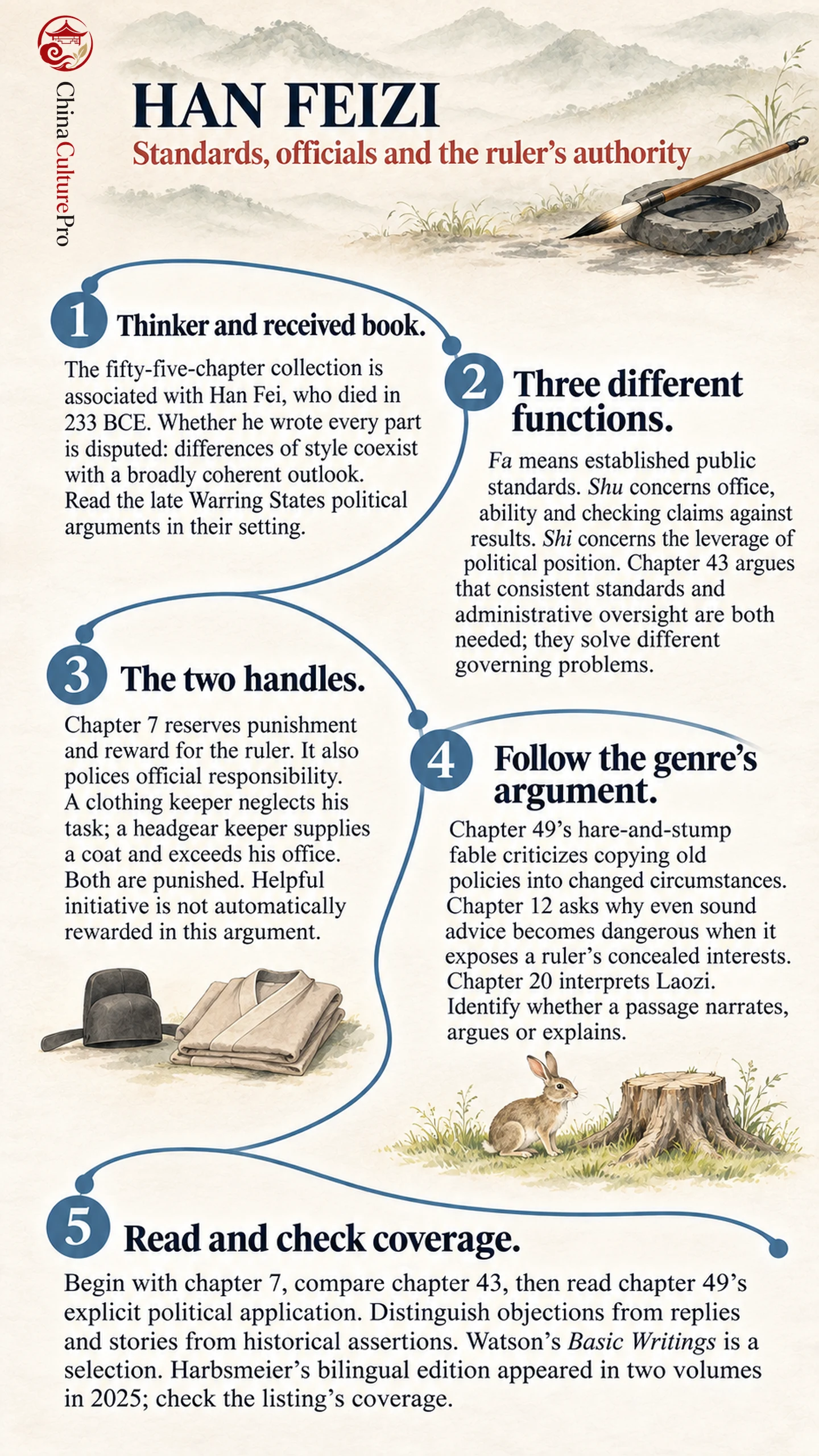
A farmer waits beside a tree stump; an official is punished after helping his ruler. The Han Feizi uses memorable stories to make demanding political arguments. Their point becomes clearer when the narrative is read alongside the problem of authority it is meant to solve.
Han Fei, the Warring States and the Received Book
Han Fei, who died in 233 BCE, belonged to the ruling family of the state of Han (韩, Hán) during the late Warring States (战国, Zhànguó) era. The book’s political setting is one of competition among states and tension between rulers and their officials.[7]
Whether he wrote every chapter remains disputed. Differences of style and argument can suggest multiple contributors, but can also reflect different audiences or intellectual development. A broadly coherent outlook does not settle the authorship of every piece.[1]
Fa, Shu and Shi: Three Different Governing Problems
Three concepts help distinguish the problems addressed by this political writing. They are related tools, rather than interchangeable terms for severity:[2][4]
| Konsep | Function in the argument |
|---|---|
| Fa (法, fǎ) | Publicly established standards and orders that guide conduct and attach consequences to compliance or violation. |
| Shu (术, shù) | Administrative techniques for assigning office, examining ability and checking whether official claims match results. |
| Shi (势, shì) | The leverage of political position: authority that does not depend simply on personal virtue or persuasive talent. |
Chapter 43 contrasts the approaches associated with Shang Yang (商鞅, Shāng Yāng) and Shen Buhai (申不害, Shēn Bùhài). Public standards without effective oversight can leave ministers exploiting the state’s resources. Administrative techniques without consistent standards leave room for conflicting rules. The argument calls for both, while also criticizing shortcomings in their earlier formulations.[2]
These standards are instruments of a ruler’s governing order. Their impersonal application should not be confused with a modern constitutional system that places enforceable limits on sovereign power.
The Two Handles and the Limits of Official Initiative
The Two Handles (二柄, Èr Bǐng), chapter 7, identifies punishment and reward as powers the ruler must retain. If ministers control who receives benefits or penalties, allegiance can shift from the ruler to those ministers. The concern is the ruler’s control of both penalties and benefits.[3]
The chapter connects this with matching claims and performance (刑名, xíngmíng): an official states a proposal, receives a corresponding responsibility and is assessed against the result. Yet the system also polices the limits of office. Doing more than promised is not automatically praised.[3]
A story makes that severity concrete. A keeper of the ruler’s headgear covers the sleeping ruler with a coat. The keeper of clothing is punished for neglecting the task, while the headgear keeper is punished for exceeding his office. The narrative places fixed responsibility above an official’s helpful initiative.[3]
Fables, Persuasion and Commentary within One Collection
The Five Vermin (五蠹, Wǔ Dù), chapter 49, tells of a farmer who abandons cultivation after a hare accidentally strikes a stump and dies. Waiting there produces no more hares. The text explicitly applies the fable to using ancient rulers’ policies unchanged for present people. Its argument is about adapting institutions to changed circumstances, not only avoiding laziness.[4]
The Difficulties of Persuasion (说难, Shuìnán), chapter 12, shifts toward the adviser’s predicament. Successful reasoning depends on understanding what the listener seeks and what the listener wishes to appear to seek. Even sound advice becomes dangerous when it exposes a ruler’s concealed interests or challenges the image he wishes to project.[5]
Explaining Laozi (解老, Jiě Lǎo), chapter 20, interprets passages of the Laozi (老子, Lǎozǐ), including its discussion of virtue. Its presence adds textual commentary to the book’s argumentative range. A reader should identify whether a passage is an explanation, a story, a reply to an objection or a direct political prescription.[6]
How to Begin Reading the Han Feizi
- Start with a concrete mechanism: Read chapter 7 and identify who controls reward, punishment and the boundaries of office.
- Compare the supporting argument: Read chapter 43 on standards and administrative technique, then chapter 49’s fable and its explicit political application.
- Check the voices and coverage: Distinguish an objection from a reply, a narrated example from a historical assertion, and a selection from the whole collection.
Burton Watson’s Han Feizi: Basic Writings offers selected chapters, including The Two Handles, The Difficulties of Persuasion and The Five Vermin. It is an entry point, not a translation of all fifty-five chapters.[7]
For bilingual study, Christoph Harbsmeier’s Han Feizi, The Art of Statecraft in Early China appeared as a two-volume edition in 2025, edited by Jens Østergaard Petersen and Yuri Pines. Check which volume or set a listing describes.[8]
FAQs About the Han Feizi
Is Han Feizi a person or a book?
Here it means the book named for Master Han Fei.[1]
Did Han Fei write all fifty-five chapters?
Single authorship remains disputed; stylistic differences and substantial coherence support competing interpretations.[1]
Is its fa the same as modern rule of law?
No. Public standards and consistent enforcement are part of its governing program, but they do not establish modern constitutional restraints on the ruler.[2]
Why does the book include material on Laozi?
The collection includes commentary on that text as well as administrative and political arguments. Its literary range is wider than a single form of statecraft essay.[6]
Sumber
[1] Yuri Pines, Stanford Encyclopedia of Philosophy. Legalism in Chinese Philosophy (revised 2023)
[2] Public-domain Chinese text. Han Feizi, chapter 43: Defining Standards
[3] Public-domain Chinese text. Han Feizi, chapter 7: The Two Handles
[4] Public-domain Chinese text. Han Feizi, chapter 49: The Five Vermin
[5] Public-domain Chinese text. Han Feizi, chapter 12: The Difficulties of Persuasion
[6] Public-domain Chinese text. Han Feizi, chapter 20: Explaining Laozi
[7] Burton Watson, Columbia University Press. Han Feizi: Basic Writings
[8] Christoph Harbsmeier, Brill. Han Feizi, The Art of Statecraft in Early China: A Bilingual Edition (2025)