


Quick Answer: What Defines Guangzhou Culture?
Guangzhou (广州, Guǎngzhōu), historically called Canton in English, grew along the Pearl River (珠江, Zhū Jiāng). Its older districts show how commerce took different forms, from overseas trade along the waterfront to household life in Xiguan (西关, Xīguān) and the public culture of teahouses and opera.[1][2][3][4]
- Port history: During the Qing Canton System, Western seaborne trade was concentrated in Guangzhou. The Thirteen Factories housed foreign trading establishments.[1][2]
- Xiguan life: Large residences and streets lined with covered shop arcades preserve different kinds of space in the older city.[3][5]
- Cantonese traditions: Morning tea brings people together over small dishes, while Cantonese opera (粤剧, Yuèjù) relates to guilds, performers and historical stages.[4][6][7]
The old waterfront, the interior of a residence and the covered walkway outside a shop each give a different view of the city.
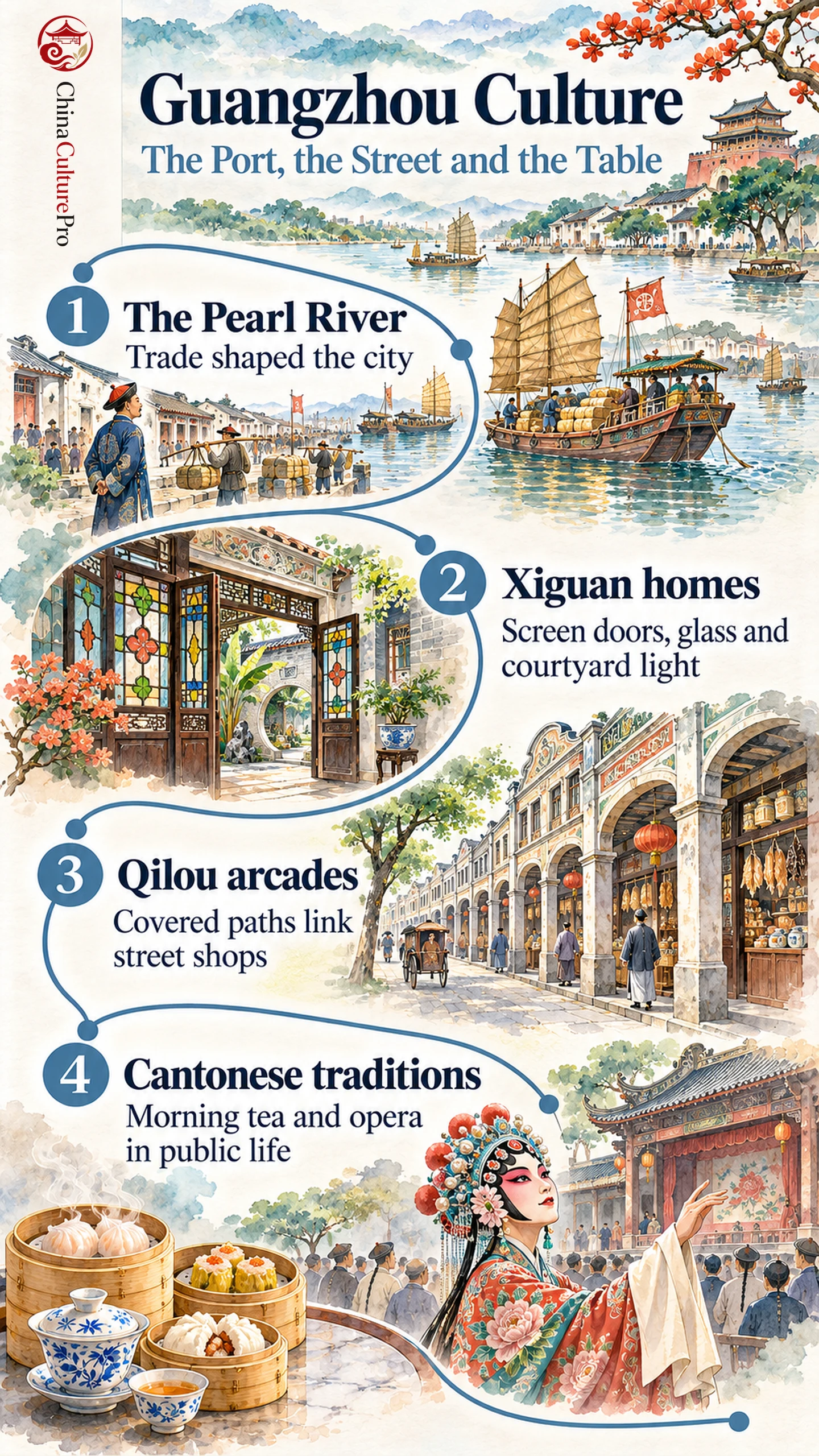
A covered path lets you keep walking during a sudden shower. A slatted screen lets air pass into a house. Those two ordinary details tell stories about how commerce and the subtropical climate shaped life in Guangzhou.
Four Places to Begin With Guangzhou Culture
| Titik awal | Hal yang perlu diperhatikan | What it explains |
|---|---|---|
| Thirteen Factories | Trading houses and export objects | How Qing-era foreign commerce was organized.[1][2] |
| Xiguan residences | Sliding timber screens and interior light wells | Household routines and the design of large older homes.[3][5] |
| Qilou streets | Ground-floor walkways under upper stories | The relationship between shops, shelter and street life.[5] |
| Tea tables and opera stages | Small dishes for a group or a performance linked to a guild | Social practices with ties across the Cantonese-speaking region.[4][6][7] |
How the Pearl River Shaped Canton
The Pearl River connected Guangzhou’s waterfront with seaborne trade. Between 1757 and 1842, Qing rules concentrated Western seaborne commerce in Canton. Under the Canton System, licensed Chinese merchants dealt with foreign traders. The Thirteen Factories were a waterfront district where foreign trading houses kept residences, stores and offices. In this context, a factory was the establishment of a commercial agent.[1][2]
Porcelain, painted objects and other goods traveled abroad through that network. Museum collections show objects made for export, including porcelain decorated in ways meant for overseas buyers. The trade system changed after the First Opium War. Guangzhou’s trading history extends beyond that Qing period, just as the earlier maritime story of Quanzhou belongs to a different network and time.[1][2] Nearby Shenzhen offers a more recent example of how Pearl River Delta cities changed as people moved there for work.[8]
Xiguan Houses and Qilou Streets
Xiguan is a historic area on the western side of old Guangzhou. Large Xiguan houses could have an inner courtyard that brought daylight into a deep building and a set of layered doors. One layer, the tanglong (趟栊, tànglóng), is a horizontal sliding screen of wooden bars. It lets light and air pass while marking a boundary between the house and the street.[3][5]
The qilou arcade (骑楼, qílóu) works at street level. An upper floor extends over a ground-floor walkway beside shop fronts. The shelter keeps pedestrians close to merchants during heat or rain. A walk under the arcade and a look into a historic residence reveal different ways a building can manage its public edge.[3][5]
Morning Tea and the Cantonese Stage
In a Guangzhou teahouse, yum cha means having tea, often with shared small dishes. For Cantonese morning tea, diners might choose shrimp dumplings and other steamed dim sum from a longer menu. The name of the gathering and the name of the food describe different parts of the same experience. See the distinction between yum cha and dim sum for the terms used at the table.[4]
Cantonese opera has its own history in Xiguan, where performers organized around guilds and performance spaces. A document from Liwan traces connections between local performers, the Bahe Guild and older Cantonese opera activity in Foshan. This Cantonese opera tradition also extends into eastern Guangxi, where varieties of Yue are spoken.[6][7]
FAQs About Guangzhou Culture
Is Canton the Same City as Guangzhou?
Canton is a historical English name for Guangzhou. It also appears in the names of institutions and practices associated with the city’s trade history.[1][2]
Are Xiguan Houses and Qilou Arcades the Same Style?
A Xiguan house is a type of residence associated with a particular part of Guangzhou. A qilou is an arcaded building with a covered walkway. Both can be found in the older city.[3][5]
What Is a Typical Cantonese Morning Tea?
Diners usually drink tea with small shared dishes, such as steamed dumplings, as part of a social meal. The food selection varies with the house and the group.[4]
Sumber
[1] Fitzwilliam Museum. Chinese Export Art: The Thirteen Hongs Collection
[2] MIT Visualizing Cultures. Rise and Fall of the Canton Trade System
[3] Liwan District Government. Xiguan Mansions and Lingnan Residential Architecture
[4] Guangzhou Government. A Day of Guangzhou Food and Morning Tea
[5] Guangzhou Government. Historic Architecture and the Lingnan City
[6] Liwan District Government. History of Cantonese Opera in Xiguan
[7] UNESCO. Yueju Opera
[8] Jonathan Bach. Urban Villages and the Making of Shenzhen