


Quick Answer: What Is Guangling San?
Guangling San (广陵散, Guǎnglíng Sǎn), or the Guangling Suite, is a traditional piece for guqin (古琴, gǔqín). The 1425 Shenqi Mipu preserves a score. Early accounts connect it with the musician Ji Kang (嵇康, Jī Kāng).[2][3]
- Structure: One published account describes 45 sections in six larger parts.[1]
- Sound: Forceful passages alternate with softer phrases.[2]
- Versions: Concert programs also identify abridged and 24-section selections.[2][5]
Read the realization and section credits before comparing two performances.
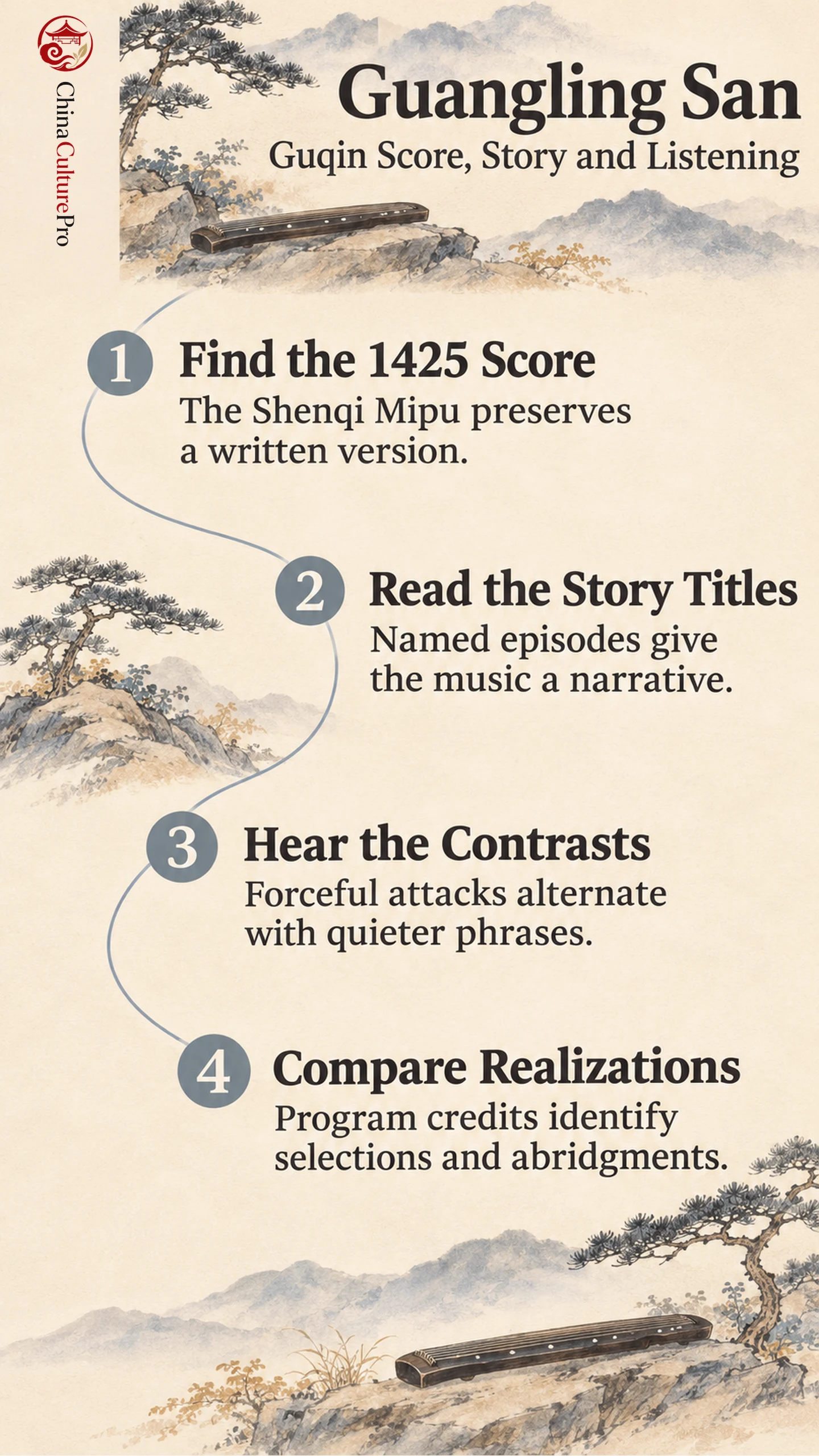
A broad title like Guangling Suite can hide substantial differences between recordings. Start with the chosen sections. Then hear how a player moves between close, forceful attacks and lines with more space.
The Surviving Score and Ji Kang’s Story
The Hong Kong Music Office identifies the Shenqi Mipu of 1425 as a surviving source. An early textual tradition portrays Ji Kang speaking before his death of the music ending with him. That episode explains part of the work’s literary reputation. The 1425 score documents a written version long after Ji Kang’s lifetime.[2][3]
Drunken Ecstasy also appears in the 1425 collection. Its own traditional attribution and realization belong to another piece in the repertory.[7]
What the Section Titles Tell You
Renmin University’s recital notes connect the named episodes with a tale about Nie Zheng and the ruler of Han. The Records of the Grand Historian recounts a different story about Nie Zheng, involving a minister of Han. Read the Shiji guide for the role of biography in that historical work.[1][4]
The section names are useful for following the musical narrative. They give the player and listener a sequence of episodes even when the performance is entirely instrumental.
How to Hear the Dramatic Contrast
The Hong Kong Music Office describes shifts between intense and gentler passages. In a guqin performance, hear where a firm pluck breaks the quiet. When the pace eases, listen to the space the player leaves for the note to fade.[2]
Ambush from Ten Sides provides a comparison on pipa. Both works use instrumental contrast to suggest episodes, while the plucks and pacing belong to different repertories.
Compare Realizations and Abridgments
Wu Jinglue made a dapu (打谱, dǎpǔ), or playable realization from tablature, in 1954. The Hong Kong Music Office presents Wang Youdi playing an abridged demonstration of Wu’s version.[1][2]
A separate Hong Kong program names a 24-section selection from three parts, credited to Yao Bingyan’s realization.[5] A Xi’an Conservatory list credits a realization by Guan Pinghu, also known for Flowing Water.[6]
Dialogue Between Fisherman and Woodcutter offers another example of a program giving the tablature and realization separate credits.
FAQs About Guangling San
Did Ji Kang compose Guangling San?
He is famous in early accounts as a player of the work. That connection does not establish who composed the surviving score.[3]
Does every version contain 45 sections?
The 45-section description applies to one complete version. Concert and demonstration versions may use a selection of passages.[1][5]
What does a Dapu credit mean for this work?
It names the musician who interpreted the tablature as a playable version. A program may credit that musician separately from the person playing onstage.[1][2]
Sumber
[1] Renmin University of China School of Arts. Guqin Summer Gathering: Guangling San
[2] Hong Kong Music Office. The Guangling Suite: Guqin Exhibition Demonstration
[3] Chinese Text Project. Collected Old Histories of Jin: Ji Kang
[4] Chinese Text Project. Records of the Grand Historian: Biographies of Assassins
[5] Hong Kong Leisure and Cultural Services Department. Guangling Melody: 24 Sections Version
[6] Xi’an Conservatory of Music. Prescribed Guqin Repertoire
[7] Hong Kong Music Office. Guqin Roving Exhibition: Selected Works