


Quick Answer: What Is Fish-Fragrant Eggplant?
Yuxiang qiezi(鱼香茄子,yúxiāng qiézi)is a Sichuan eggplant dish with soft flesh and a sauce that combines aromatic, savory, sweet, sour and spicy notes. “Fish-fragrant” describes a seasoning style; fish meat is not a required main ingredient.[1]
- The vegetable: Eggplant becomes tender and takes up the sauce.
- The seasoning: Chili, ginger, garlic, scallions and a sweet-sour balance create several layers.
- The versions: Some include minced meat, while others center on the eggplant alone.
The name does not guarantee a seafood-free or vegetarian plate. Stock, sauces and chili preparations must be checked individually, even when no fish or meat is visible.
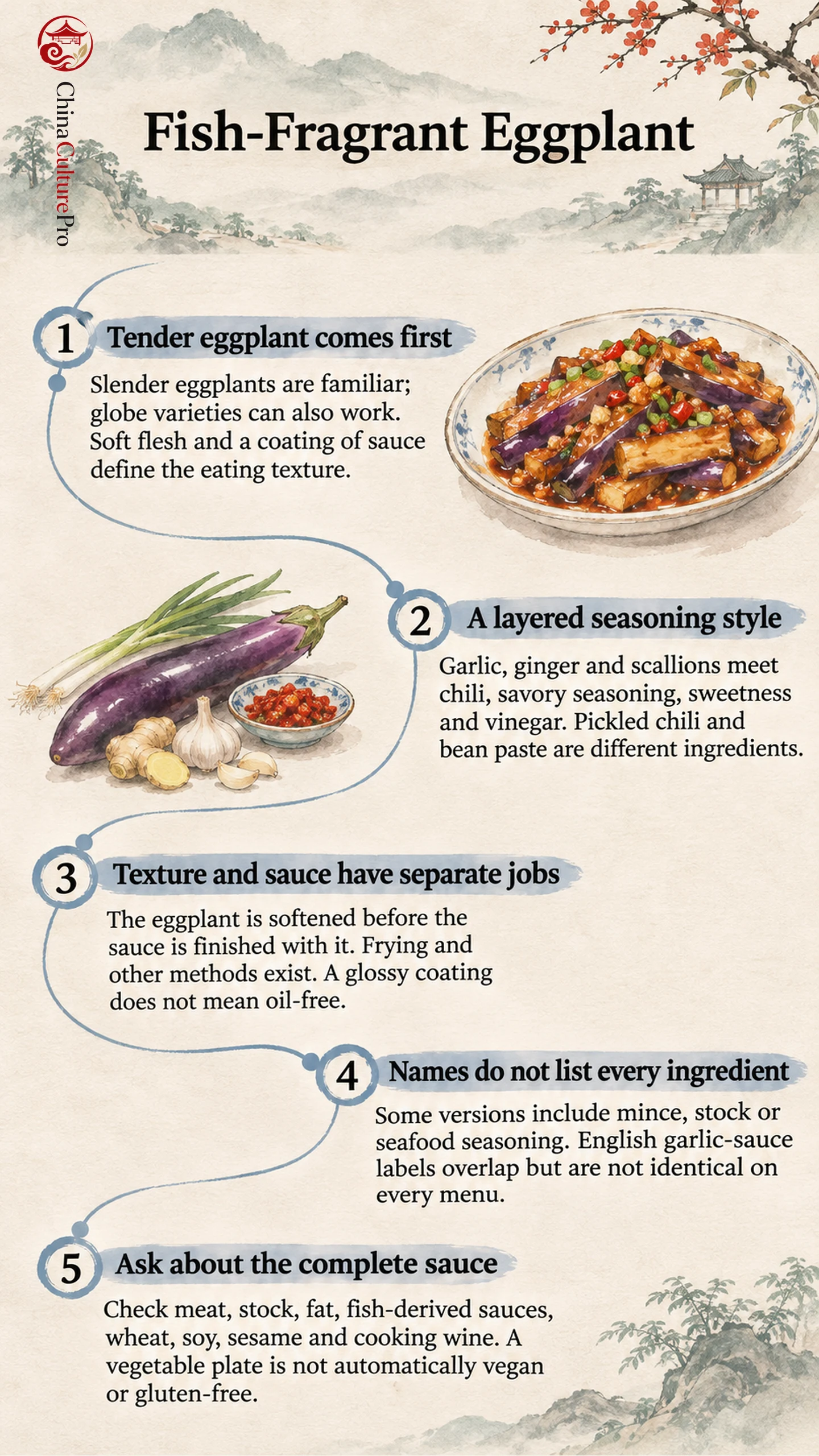
Soft eggplant batons glisten under a reddish-brown sauce, with ginger, garlic and scallion aromas rising from the plate. The flesh yields easily while the skin helps the pieces hold their shape. This is one of the dishes that shows how Sichuan cuisine can build flavor around a vegetable rather than around a large piece of meat.
Eggplant Texture and the Choice of Variety
Long, slender Chinese or Japanese eggplants are familiar choices for this dish. A cook’s published guide favors their thinner skin and tender texture but also accepts globe eggplant as an alternative.[1] The variety affects the bite and preparation; it does not change the sauce’s name by itself.
The aim is soft flesh under an even coating of seasoning. An eggplant piece should not be confused with a crisp battered snack simply because frying appears in the preparation. Its appeal here is a yielding interior that contrasts with the aromatic sauce and any small pieces of meat.
Pieces may be cut into batons, wedges or another manageable shape. Similar-sized pieces help a cook develop an even texture, while gentle handling matters once the flesh has softened. Neither a particular shade of purple nor one cut is enough to identify every kitchen’s version.
The Layers of the Fish-Fragrant Flavor
The seasoning works as a combination. Garlic, ginger and scallions supply aroma; chili supplies pungency; vinegar and sugar create a sweet-sour balance; salty seasonings provide a savory base. A Chengdu culinary-school explanation describes that layered flavor pattern across several fish-fragrant dishes.[2]
Pickled chili and spicy doubanjiang(豆瓣酱,dòubànjiàng)can both appear in published preparations, separately or together. They are different ingredients: the bean paste adds fermented broad-bean savoriness, while pickled chili brings its own acidity and pepper flavor.[3] The doubanjiang guide explains the paste in more detail.
The combined seasonings give the dish more than a garlic aroma. Chili heat sits alongside the aromatic, sweet, sour and savory notes. The balance may differ between cooks, with one plate sharper, another sweeter or more strongly fermented. Those differences are best described through the actual seasonings used.
Softening the Eggplant and Finishing the Sauce
In Fuchsia Dunlop’s published preparation, frying softens the eggplant before a separate sauce stage and gentle finish with the vegetable. It also offers shallow-fried or roasted alternatives, with a different approach to combining the sauce and eggplant.[3]
The vegetable stage creates the tender texture; the sauce stage develops the aromatics and coating. Those jobs are connected, but they are not interchangeable. Adding more sauce to a firm eggplant piece does not reproduce the texture of a properly softened one.
Starch may help the sauce cling, producing a glossy coating rather than a bowl of soup. Oil can also be present even when the finished dish is not deep-fried. For the broader distinction between frying, braising and saucing, see Chinese cooking methods. The dish does not require one identical technique in every home or restaurant.
Meat, Meat-Free Versions and English Menu Names
Minced pork can add another savory layer, but it is not present in every version. The absence of mince still says little about the stock. One published preparation includes chicken stock, oyster sauce and optional fish sauce.[4] A cook can therefore serve a plate without fish pieces that still contains fish-derived seasoning.
“Eggplant with garlic sauce” is a useful menu clue, but it is not a universally exact translation. One Chinese-American recipe author distinguishes her restaurant-style garlic-sauce version from a separate Sichuan fish-fragrant preparation, although other writers use the names together.[5] Treat that as evidence of varied English usage, not a rule that every menu follows the same distinction.
Ask what the restaurant means by its label: the chili base, sweetness, meat and sauces tell you more than the English title alone. A plain-rice accompaniment lets the seasoned eggplant form part of a meal, whether shared with other dishes or ordered as a main plate.
Memesan Hidangan dan Memeriksa Kesesuaian Diet
For a vegetarian or vegan version, confirm the meat, stock, cooking fat and all sauces. Removing visible pork does not remove a meat-based liquid already mixed into the dish. A mushroom topping can still be paired with animal stock or oyster sauce; the Chinese vegetarian food guide explains that wider check.
The eggplant itself does not contain wheat gluten, but soy sauce, chili bean paste and other compound seasonings may introduce ingredients that matter to a restricted diet. Fish-derived sauce, soy and sesame-containing additions are separate questions. The FDA identifies fish, soy, wheat and sesame among major food allergens.[6] Check product labels and relevant shared preparation equipment rather than relying on the vegetable name.
Cooking wine is another ingredient to ask about if alcohol avoidance matters; the Shaoxing cooking wine guide explains its culinary use. A mild or meat-free order does not automatically change that seasoning. Make requests before the sauce is combined with the eggplant.
FAQs About Fish-Fragrant Eggplant
Does fish-fragrant eggplant contain fish?
Fish meat is not required, but a particular preparation may contain fish sauce or other seafood-derived seasoning. Ask about the ingredients.
Is yuxiang qiezi vegetarian or vegan?
It can be adapted, but meat, stock, fat and sauces must all be suitable. A vegetable main ingredient is insufficient evidence.
Is eggplant with garlic sauce the same dish?
The labels overlap, but English menu usage varies. Ask whether the kitchen means a Sichuan fish-fragrant version or another garlic-sauce preparation.
Does fish-fragrant eggplant have to be deep-fried?
No. Published cooks also use other ways to soften the eggplant, with differences in texture and how the sauce is added.
Sumber
[1] Wei Guo. Fish-Fragrant Eggplant: Ingredients and Eggplant Varieties
[2] Dai Chaobo, Chengdu New East Culinary School. The Fish-Fragrant Seasoning Profile
[3] Fuchsia Dunlop, licensed excerpt from Every Grain of Rice. Fish-Fragrant Eggplant: Seasoning and Preparation Variations
[4] Bill, The Woks of Life. Fish-Fragrant Eggplant: Meat, Stock and Optional Fish Sauce
[5] Sarah, The Woks of Life. Chinese-American Eggplant with Garlic Sauce
[6] U.S. Food and Drug Administration. Food Allergies: What You Need to Know (Alergi makanan: hal yang perlu diketahui)