


Quick Answer: What Is Shen Zhou’s Feeling of Rain?
Feeling of Rain (雨意, Yǔ Yì), by Shen Zhou (沈周, Shěn Zhōu), is the ink landscape catalogued as Rainy Thoughts in the National Palace Museum, Taipei.
- Date: The inscribed year is catalogued as 1487.
- Format and size: Ink on paper, a hanging scroll measuring 67.1 × 30.6 cm.
- Look first: Compare the softly defined mountain with its darker tree accents.
- Look closer: A small pavilion and two seated figures occupy the lower part of the landscape.
Read the poem’s rainy-night occasion alongside the mountain, pavilion and open intervals.
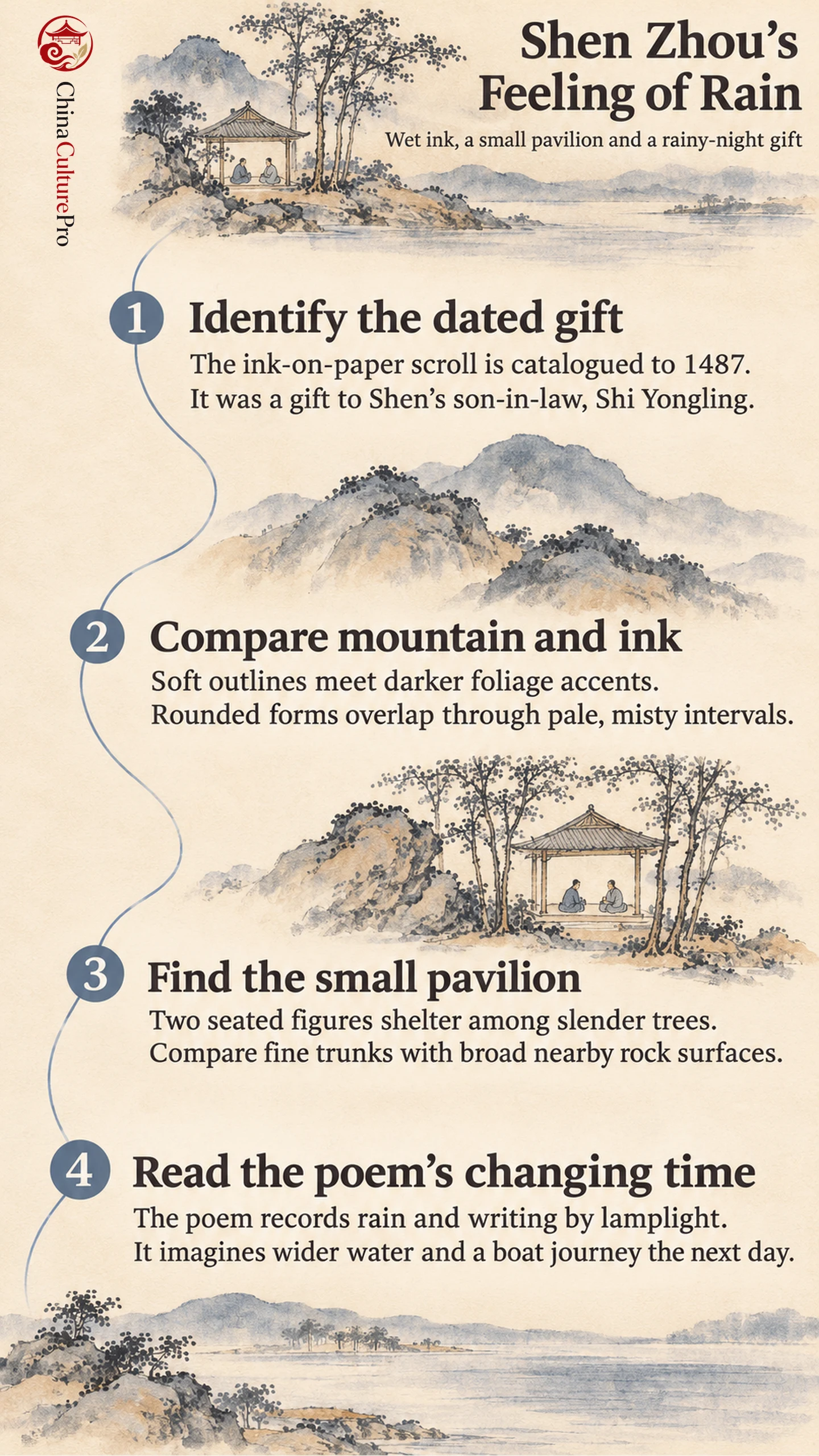
A rounded mountain rises through a pale, misty interval. Dark horizontal accents gather along its slopes, while more distant peaks remain much lighter toward the upper right.
Below, slender trunks stand around a small pavilion. The difference between their fine lines and the broader wash of nearby rocks offers a close view of how the landscape changes density.
Identify the Dated Gift for Shen’s Son-in-Law
The Taipei work, 故畫001315, measures 67.1 × 30.6 cm. Its inscription gives the final lunar month’s third day, with the year catalogued as 1487. [1]
Dezheng (德徵, Dé Zhēng), the style name of Shi Yongling (史永龄, Shǐ Yǒng Líng), identifies the painter’s son-in-law through his youngest daughter. Their night together prompted the inscribed gift. [1]
The date belongs to a traditional calendar expression. Reading it as a modern December 3 would replace the inscription’s calendar with a different one.
The scroll-format guide explains the vertical format. Here, the narrow field connects a small inhabited foreground with the much larger mountain above it.
The inscriptions-and-seals guide helps distinguish the artist’s written occasion from later collection marks. Compare the poem’s relatively small columns at the top with the larger landscape forms below, then return to the recipient’s place in the work’s history.
Read the Mountain through Wet Ink and Rounded Forms
Mi-dot texture strokes (米点皴, Mǐ Diǎn Cūn) form part of the museum’s technical classification. [1]
Look at the upper mountain’s outer edge. Some stretches remain easy to follow, while others become less distinct against the surrounding pale field.
Inside that outline, darker marks form short, roughly horizontal groups. Compare one group with a nearby patch of lighter mountain face: a small increase in density can change where the eye settles.
The painting-techniques guide supplies a vocabulary for wash, contour and texture. In this work, their differences are clearer when a single dark cluster is compared with the broader surface beneath it.
A compositional reading of the painting emphasizes how related shapes echo one another and maintain balance as the mountain bends through the vertical field. Compare the mountain’s repeated rounded shapes as well as its soft edges. [2]
Compare the large upper mass with a smaller rounded form lower down. Their relative sizes and overlapping edges help the space continue through the misty interval.
Then look toward the pale peaks at the upper right. They occupy much less dark ink than the nearer mountain, so their distance depends partly on a reduction in visible detail.
Find the Pavilion within the Nearer Trees
The illustrated lower detail shows two seated figures beneath a roof. A few small marks establish their bodies, while the pavilion’s straight edges provide a recognizable shelter.
The nearby trees use a different rhythm. Their long trunks rise vertically, with branches and foliage interrupting those lines at irregular heights.
Compare the trees at the left with the broad rock mass to the right of the pavilion. Compare a single trunk with the broad pale rock surface and its darker lower edge.
The landscape-painting guide develops the relation between small buildings and surrounding terrain. Here, the pavilion becomes a scale reference for rocks and trees that might otherwise read only as overlapping shapes.
Look below the shelter as well. Its supporting structure is much more lightly indicated than the heavy ink along parts of the bank. That difference keeps the building recognizable without giving it the same weight as the foreground terrain.
The two figures also invite a comparison with the recorded night together. The inscription supplies the occasion; the painted people do not independently establish authenticated likenesses of the participants.
Compare the Poem’s Night with Its Imagined Morning
The poem moves from painting in rain and lamplit writing to an imagined next-day return by boat across wider spring waters. [1]
Its movement is temporal. An evening activity leads toward an anticipated morning, while the painted landscape remains available as one field of mountain, shelter and water.
The guide to painting and scholarly exchange develops the relation between a picture, its writing and its recipient. Here, the gift preserves an occasion while offering a landscape that extends beyond the immediate room or conversation.
Compare the poem’s named activities with what the image makes visible. The shelter and seated company can be located; the writing also introduces actions and future moments that need not appear as separate painted objects.
The calligraphy-and-painting guide explains their shared brush medium and different jobs. The written lines provide language and sequence; the landscape offers overlapping surfaces, distances and areas of changing ink density.
Return to the dark accents against the light mountain. Their relationship remains a useful way to examine the feeling of damp, softened terrain after reading the more specific occasion in the poem.
FAQs About Shen Zhou’s Feeling of Rain
Why is Feeling of Rain also called Rainy Thoughts?
The two English titles refer to the same Taipei painting, identified by its Chinese title 雨意, dimensions and collection number 故畫001315.
Who received the painting?
It was given to the painter’s son-in-law, Shi Yongling, whose style name was Dezheng. The inscription records their night together.
How does the painting suggest rain?
Softly defined forms and broad, pale ink areas surround darker accents. Their changing density creates a misty atmosphere without depending on a field of individually drawn raindrops.
Sumber
[1] National Palace Museum. Shen Zhou: Rainy Thoughts, collection record 故畫001315
[2] Du De; Northern Art, Tianjin Academy of Fine Arts. Reconstruction of Wen Zhengming’s Painting Field from a Social Perspective: discussion of Shen Zhou, pages 55–56