


Quick Answer: How Should You View Ducks Sleeping on a Lotus Shoal?
Ducks Sleeping on a Lotus Shoal (荷渚睡凫图, Hé Zhǔ Shuì Fú Tú) bears the name of Lü Ji (吕纪, Lǚ Jì), but the museum regards it as probably an imitation of his style.
- Collection: National Palace Museum, Taipei; identifier 故畫002981.
- Medium and size: Ink and color on silk, 174.5 × 104.2 cm.
- Main scene: Resting waterfowl beneath lotus foliage, with reeds and a pale moon above.
- Look first: Compare the birds’ rounded bodies with the long curves of the reeds.
Read the attribution alongside the birds, lotus foliage and open upper field.
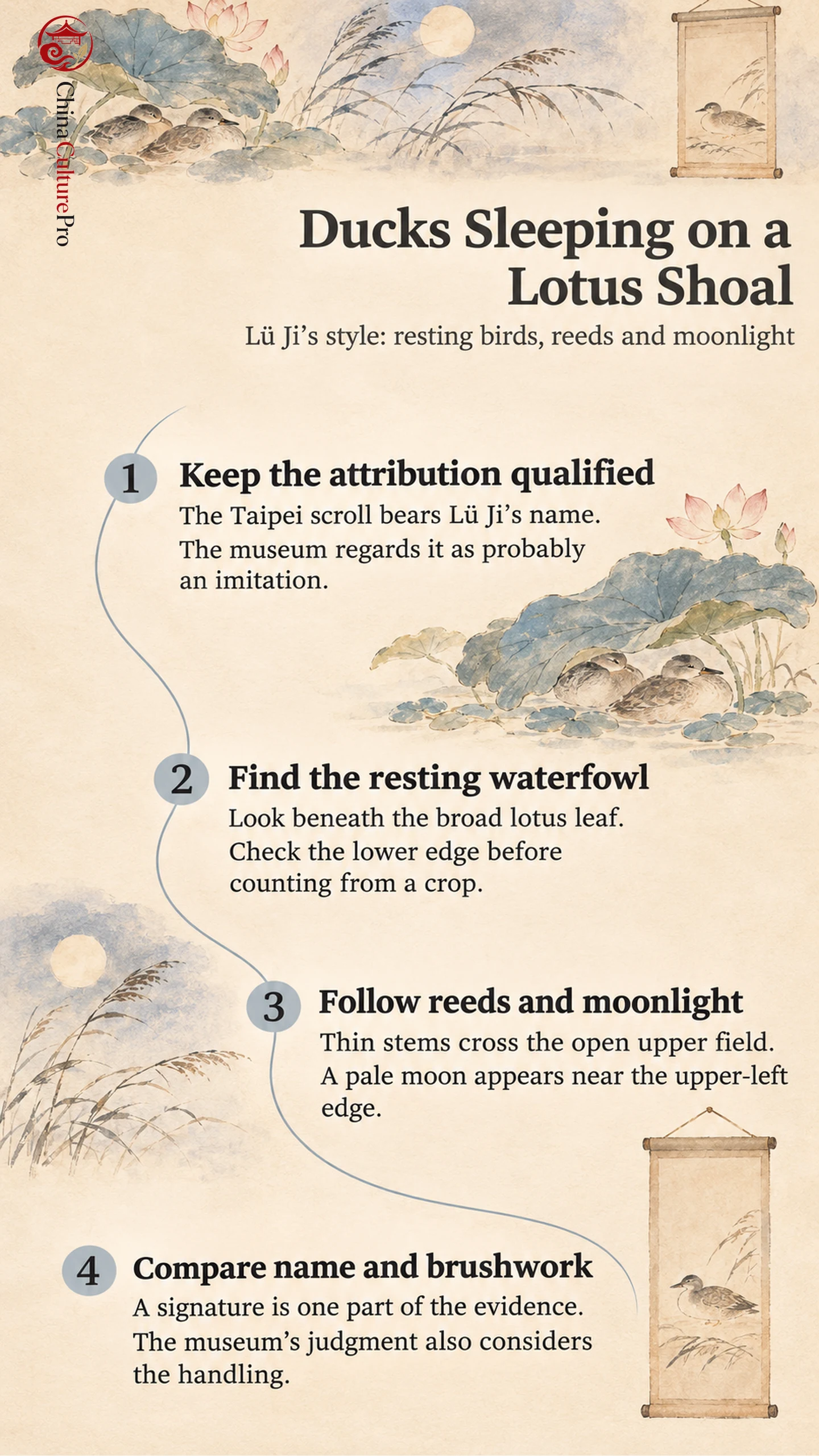
A large lotus leaf bends over the lower group of birds. Above it, thin stems and long reed leaves cross a much more open field. A pale circle appears near the upper-left edge.
The birds become easier to locate when the lower part is enlarged. Two complete resting bodies stand out beneath the broad leaf, while other waterfowl are partly cut by the lower edge of the composition.
Identify the Taipei Scroll and Its Attribution
Catalogued as 故畫002981, the Taipei silk hanging scroll measures 174.5 × 104.2 cm. [1]
It is probably the work of an unidentified painter following his style. Keep that qualification with the artist’s name when matching a reproduction to the collection record.
The size matters to looking. This is a substantial vertical field, within which individual birds can remain relatively small. A reduced photograph makes the whole scene available at once while compressing the details of feathers, stems and leaf edges.
Begin by locating the large leaf, the resting birds below it and the much sparser vegetation above. Then check how the pale moon occupies another part of the same open field.
The bird-and-flower painting guide gives this combination of animals and plants a broader artistic setting. Here, their arrangement is specific: heavy rounded forms gather low in the picture, while thinner lines travel upward.
Find the Birds beneath the Large Lotus Leaf
Look first at the bird nearer the middle of the lower group. Its rounded body contains repeated feather markings, and the head turns back toward the body rather than projecting into a long forward-facing profile.
The bird behind and to the right forms another compact shape. Compare its position with the larger central leaf: the bird remains partly surrounded by stems and smaller leaves, while the leaf spreads much farther across the surface.
Now check the bottom edge. Parts of other birds extend beyond the lower boundary. A tight crop of the two central birds therefore gives a different impression of the group from the complete composition.
Follow the large leaf’s rim. Its uneven contour and darker folds differ from the more regularly repeated feather patterns beneath it. A seedpod hangs nearby, adding another small, rounded form among the long stems.
Compare a bird’s back with the pale area directly beside it. Where the outline is clear, the body separates readily from its surroundings. Compare the bird’s rounded outline with the crossing reed leaves beside it.
The techniques guide provides vocabulary for these differences in outline, texture and wash. Use the words to describe a particular edge or surface, rather than treating every plant and bird as if it were painted in the same manner.
Follow Reeds toward the Pale Moon
It depicts a misty moonlit setting, largely omitting a distant background. [1]
Find the pale moon near the upper-left edge. Its broad circular shape differs from the narrow, bending leaves that cross the upper-right area.
Follow one of those long stems downward. It changes direction as it approaches the denser lower vegetation, linking the open upper field with the larger leaf and birds beneath.
A small perched bird introduces another scale among the reeds. Compare its narrow body and tail with the much larger waterfowl below. Compare the small bird’s open perch with the waterfowl’s more crowded setting beneath the lotus leaf.
The landscape-painting guide explains how open areas can separate and connect forms. Here, the broad interval between the moon and lower foliage does not need a distant mountain range or a detailed horizon to remain part of the scene.
Look across that interval before returning to a dark stem. The contrast makes the thin line easier to follow. Then compare the isolated line with the congested crossing of leaves farther down.
Separate a Signature from a Judgment of Authorship
The museum judges its brushwork weaker than Lü Ji’s mature handling and considers it a relatively faithful imitation of his style. [1]
The signature and the judgment answer different questions. One records the name borne by the picture; the other evaluates whether the handling supports that name as an autograph attribution.
The inscriptions-and-seals guide explains those different roles. A visible name can be useful evidence without settling every question about the hand that made the image.
The museum compares its arrangement and atmosphere with Autumn Shoals and Waterfowl (秋渚水禽图, Qiū Zhǔ Shuǐ Qín Tú). [1]
Return afterward to one small area of this scroll: the feather pattern on a resting bird, the edge of the broad lotus leaf or a reed bending into open space. Those forms remain available for close looking while the historical attribution stays qualified.
FAQs About Ducks Sleeping on a Lotus Shoal
Are the birds ducks or geese?
The title and subject index use duck-related terms, while the descriptions call the four large birds geese. “Waterfowl” preserves that naming uncertainty. [1]
Where is the moon in the picture?
Look for the pale circular area close to the upper-left edge. It is easier to locate in a complete view than in a detail centered on the birds.
Does the signature prove that Lü Ji painted it?
The museum does not treat the signature as conclusive. Its brushwork assessment favors an imitation of his style.
Sumber
[1] National Palace Museum. Ducks Sleeping Among Lotuses on a Sand Bar: digital collection record 故畫002981