

Quick Answer: What Is Dehua White Porcelain?
Dehua (德化, Déhuà) white porcelain comes from a ceramic center in Fujian, southeastern China. The French name blanc de Chine means “white from China” and commonly refers to Dehua’s white wares in museum and art history writing.[1]
- Surface: Historic examples often have a glossy, translucent glaze with a warm ivory cast.
- Forms: The repertoire includes devotional figures, incense vessels, cups and objects for a scholar’s desk.
- History: Song and Yuan kiln sites document an earlier export industry. The white wares especially associated with blanc de Chine became celebrated later.
Color and shape help you describe an object. Its place of manufacture and date require additional evidence.[2][4]

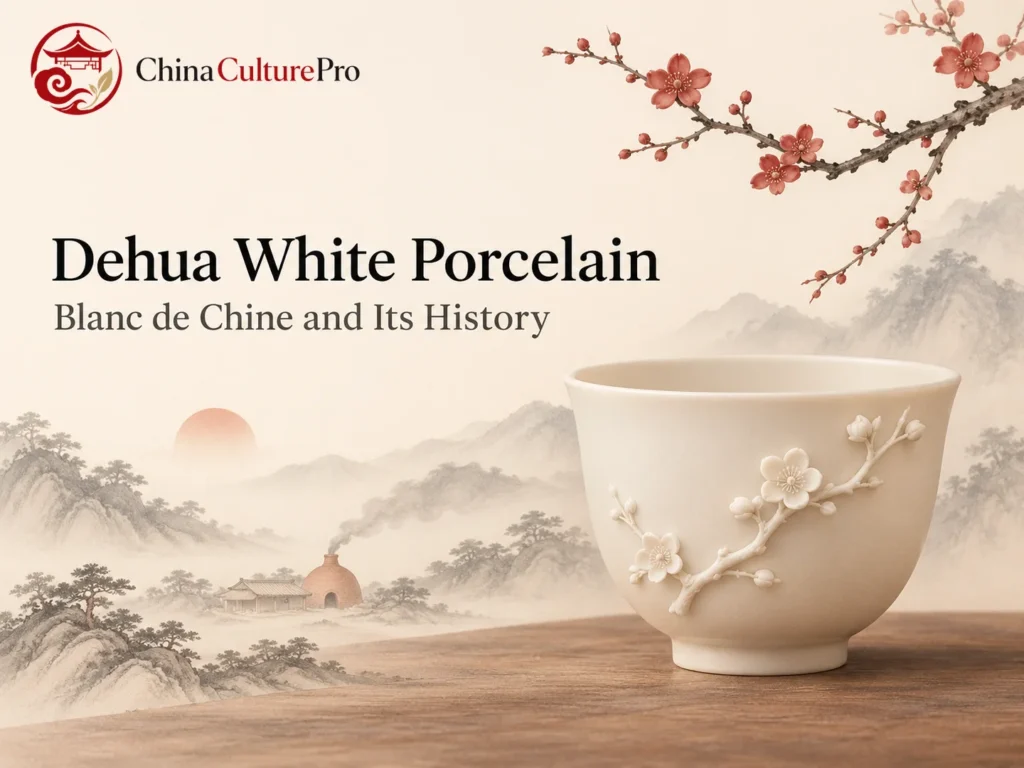
A white figure, a flowered cup and a small incense burner can all belong to the Dehua tradition. Each lets you see a different use for a pale glaze, from catching light on a robe fold to bringing out raised ornament on a vessel.
Where the White Color Comes From
The finished color depends on the fired porcelain body, the glaze and the conditions inside the kiln. Local porcelain stone supplies a light body, and the transparent to translucent glaze allows that body to influence the visible color. Oxygen-rich firing is associated with the warm ivory finish found on historic examples. Thin edges can transmit light, while a thick fold or foot can look more opaque on the same object.[2]
Under angled light, look at where a smooth surface becomes a ridge or a recess. The shadow of a raised petal, the reflection along a rim and the cream tone of a thicker glazed area all contribute to the effect. The glaze can make a vessel look visually complex even when it carries no painted design.
The wider family of Chinese porcelain includes other white wares and production centers. Similar color is a reason to compare objects, while an attribution needs evidence specific to the piece.
The Earlier Dehua Kilns and Their Maritime Trade
Dehua was already a production center during the Song and Yuan periods. Excavated wares include qingbai (青白, qīngbái), porcelain with a pale bluish glaze, alongside white wares. Bowls, bottles and other useful vessels moved from inland kiln districts toward the port of Quanzhou (泉州, Quánzhōu). The Weilin–Neiban (尾林–内坂, Wěilín–Nèibǎn) and Qudougong (屈斗宫, Qūdǒugōng) sites preserve evidence of that production system.[3]
The late-twelfth-century Nanhai I (南海一号, Nánhǎi Yī Hào) shipwreck offers a different kind of evidence. Researchers compared the elemental composition of samples of its Dehua-style cargo with material from kiln sites. The study was able to assign sampled wares more narrowly within the Dehua production region. The result supports a production attribution for the samples that were tested.[4]
The Song and Yuan material places Dehua early in Chinese porcelain history. When a label dates an ivory-white figure to the Ming or Qing, it is dating a particular object or type within that longer local history.
Guanyin Figures, Cups and Censers
Guanyin (观音, Guānyīn), the bodhisattva associated with compassion, is a prominent subject in Dehua sculpture. A Ming figure in the Shanghai Museum bears the inscription of He Chaozong (何朝宗, Hé Cháozōng). The catalogue records the mark along with the material, place and period. The sculpture rewards a close look at the continuous white surface across its face, robe and base.[7]
| Kelompok benda | Hal yang perlu diperhatikan |
|---|---|
| Devotional figures | A figure’s pose, clothing and base carry much of its visual detail. A sectional mold can form the body while smaller details are modeled or attached separately.[1] |
| Cups and scholar’s vessels | Raised flowers or other applied ornament can stand out against a pale surface. The vessel opening and foot remain useful clues to its intended use.[1] |
| Censers | One recorded Dehua censer, dated 1600–1644, has two stylized dragon handles and a ring foot. Its impressed mark is catalogued separately from the production date.[5] |
For the religious meaning of the image, see Guanyin in Chinese Buddhist traditions. Its iconography gives the figure a purpose that glaze color alone cannot convey.
How Blanc de Chine Traveled and Changed in Europe
Dehua white wares reached European collectors through maritime trade in the seventeenth and eighteenth centuries. Collections gave potters working examples of Chinese shapes and ornament. Meissen, for example, produced white porcelain decorated with prunus relief in response to Dehua models.[1][2]
A museum may place a Dehua original next to a European imitation because the relationship is the subject of the display. Look at the manufacture field first. Two cups can share a shape or a relief motif while having separate workshops, materials and histories of ownership. Chinese export porcelain gives the broader trade context.
How to Read a Dehua Porcelain Label
Read a museum label in layers. “Porcelain with clear glaze” describes materials. “Dehua” identifies the attributed production place. A period or date range estimates when the object was made. The accession number identifies that particular object in the collection. It can take you to a fuller record with measurements, photographs and provenance, the documented history of ownership and custody.
A mark is another field. Start with what the catalogue says the mark reads, then see whether the maker is named, attributed or left unknown. The censer record and the Shanghai figure record show why the inscription and the catalogue date should be read separately.[5][7]
Use the guides to Chinese porcelain marks and Chinese museum collections to compare the wording on the label with the evidence behind it. For a disputed object, photos and a familiar motif may support a comparison, while a defensible attribution needs more context.
FAQs About Dehua White Porcelain
Does blanc de Chine mean any white Chinese porcelain?
In ceramic catalogues the French term usually points to the white porcelain associated with Dehua. Read the production field as well, especially when the object is described as made in a Dehua style.
Is Dehua white porcelain always pure white?
The shade varies. Many historic examples look warm or creamy, and the thickness of the porcelain and the lighting can change how the same object appears.
Can an impressed seal date a Dehua figure?
A seal provides evidence to interpret alongside the form, surface and documented history. Catalogue wording such as “bearing the mark of” states a different level of certainty from a confirmed maker attribution.
Is Dehua porcelain still made?
Yes. Dehua remains a production center. A China Art Museum exhibition in 2025 brought together contemporary examples by several generations of makers, including both vessels and sculpture.[6]
Sumber
[1] Victoria and Albert Museum. Blanc de Chine – white porcelain from China
[2] Asian Civilisations Museum. Ceramics Gallery Large Print Guide, Blanc de Chine
[3] Quanzhou Municipal Government. Sites of Dehua Kilns (Weilin-Neiban Kilns and Qudougong Kiln)
[4] Wenpeng Xu and colleagues. Unveiling Maritime Trading Practices: Micro-Provenance Analysis of Dehua-Style Porcelain from the Nanhai I Shipwreck
[5] Museum of East Asian Art. Dehua Blanc de Chine Censer, BATEA 632
[6] Shanghai Municipal Government. Exhibition Celebrates the Artistry of Dehua Porcelain
[7] Shanghai Museum and Museum of Oriental Ceramics, Osaka. Figure of Guanyin, Shanghai Museum Accession 37597