

Quick Answer: What Can a Chinese Zodiac Tattoo Represent?
A Chinese zodiac(生肖,shēngxiào) tattoo can mark a birth-year animal, a family connection or a personal interpretation of an animal motif. The drawing, the written label and the story you attach to it are separate design choices.
- Personal connection: Decide whether you are identifying a birth year or choosing an animal for another reason.
- Written form: Chinese characters(汉字,Hànzì) require checking the intended word and the actual final drawing.
- Visual context: A realistic animal, a brush-style image and a historical motif do not necessarily communicate the same thing.
Traditional symbolism offers possibilities for interpretation. It does not guarantee protection, personality traits, compatibility or future luck.
A zodiac tattoo can begin with a birth year, a family connection or an animal you simply want to draw. A useful design brief explains that connection before choosing lettering or combining symbols. It gives the artist a specific cultural reference to discuss.
Confirm the Animal and the Birth-Year Boundary
The familiar animal-year system has twelve positions, which repeat in sequence.[1] For a birth-year design, record the full birth date rather than using the Gregorian year number alone.
Popular Chinese zodiac lookups commonly change the animal year at Lunar New Year. Four Pillars(八字,bāzì) practice commonly uses Start of Spring(立春,Lìchūn) for the year pillar. These are different conventions, especially relevant to a birth near the beginning of the Gregorian year.[2] Decide which convention you mean before incorporating a year label into permanent artwork.
If you want an element-animal designation, check Wuxing(五行,wǔxíng) too: Wood, Fire, Earth, Metal and Water form a separate classification within the larger cycle. An animal label alone does not identify that year’s phase.[3]
The Chinese and Gregorian calendar comparison provides background for checking the date. If your family follows another Asian zodiac tradition, check its animal sequence too; the regional comparison explains why a familiar animal image may differ.
Animal Names, Characters and Optional Themes
The names below use simplified characters and Mandarin pinyin. The themes summarize one published popular-zodiac interpretation, recast as possible design ideas. They are not dictionary definitions of the animal words, universal Chinese opinions or descriptions of everyone born in those years.[4]
| Animal name | Literal label and optional design theme |
|---|---|
| Rat(鼠,shǔ) | Rat or mouse; quick thinking |
| Ox(牛,niú) | Ox or cattle; dependability |
| Tiger(虎,hǔ) | Tiger; bravery |
| Rabbit(兔,tù) | Rabbit; consideration for others |
| Dragon(龙,lóng) | Dragon; imagination |
| Snake(蛇,shé) | Snake; intuition |
| Horse(马,mǎ) | Horse; an adventurous spirit |
| Goat(羊,yáng) | Sheep, goat or ram; composure |
| Monkey(猴,hóu) | Monkey; resourcefulness |
| Rooster(鸡,jī) | Chicken, conventionally rooster in the cycle; self-assurance |
| Dog(狗,gǒu) | Dog; faithfulness |
| Pig(猪,zhū) | Pig; generosity |
The animal word also differs from its associated calendrical sign. The Earthly Branches(地支,dìzhī) have their own characters. Mao(卯,Mǎo), for example, is the branch paired with Rabbit; the ordinary animal word is 兔. A branch character can be an intentional calendar reference, but it should not be presented as a literal translation of the animal name.[5]
Choose what the artwork should communicate: an animal image, its written name or a calendrical designation. Combining them is optional rather than a requirement for an authentic-looking design.
An Animal Motif Has More than One Context
An animal’s cultural associations can extend beyond birth-year symbolism. In Chinese art, Tiger has been connected with authority, military command and protective imagery.[6] Those uses can inform an artistic reference without making a modern tattoo a protective device.
Pose and surrounding details also belong in the brief. A quiet animal study, an energetic composition and a family grouping tell different visual stories. You can explain the quality you want to evoke while acknowledging that it is your interpretation.
Keep a particular historical or religious image identifiable when using it as a reference. Ask what its accompanying objects or figures represent before removing them or assigning a new meaning. Calling every animal image a zodiac design can obscure the actual subject. The wider Chinese tattoo-symbol guide distinguishes written meanings, visual associations and personal stories.
Calligraphy, Script Forms and the Final Drawing
Chinese calligraphy(书法,shūfǎ) involves controlled brush movement and established forms. In regular script(楷书,kǎishū), strokes are articulated more distinctly; cursive script(草书,cǎoshū) can abbreviate and link forms.[7] An unfamiliar shape is not necessarily wrong, but it needs verification in the actual script being used.
Simplified and traditional characters are another distinction. The table’s 龙, 马, 鸡 and 猪 correspond to traditional 龍, 馬, 雞 and 豬. These are writing forms of the same animal words.[1] “Traditional” does not, by itself, identify an ancient calligraphic style.
Historical calligraphy models can also differ from ordinary classroom writing standards. Zodiac teaching resources explicitly distinguish expressive models from everyday standard forms.[8] A decorative internet image therefore needs more checking than recognizing its typed equivalent.
Use the calligraphy-style guide to discuss the intended appearance. Have a competent reader assess the finished lettering, including orientation, missing or merged strokes and its fit with the intended word. Checking a typed character first does not verify every later alteration in the drawing.
Preparing a Clear Brief for Your Artist
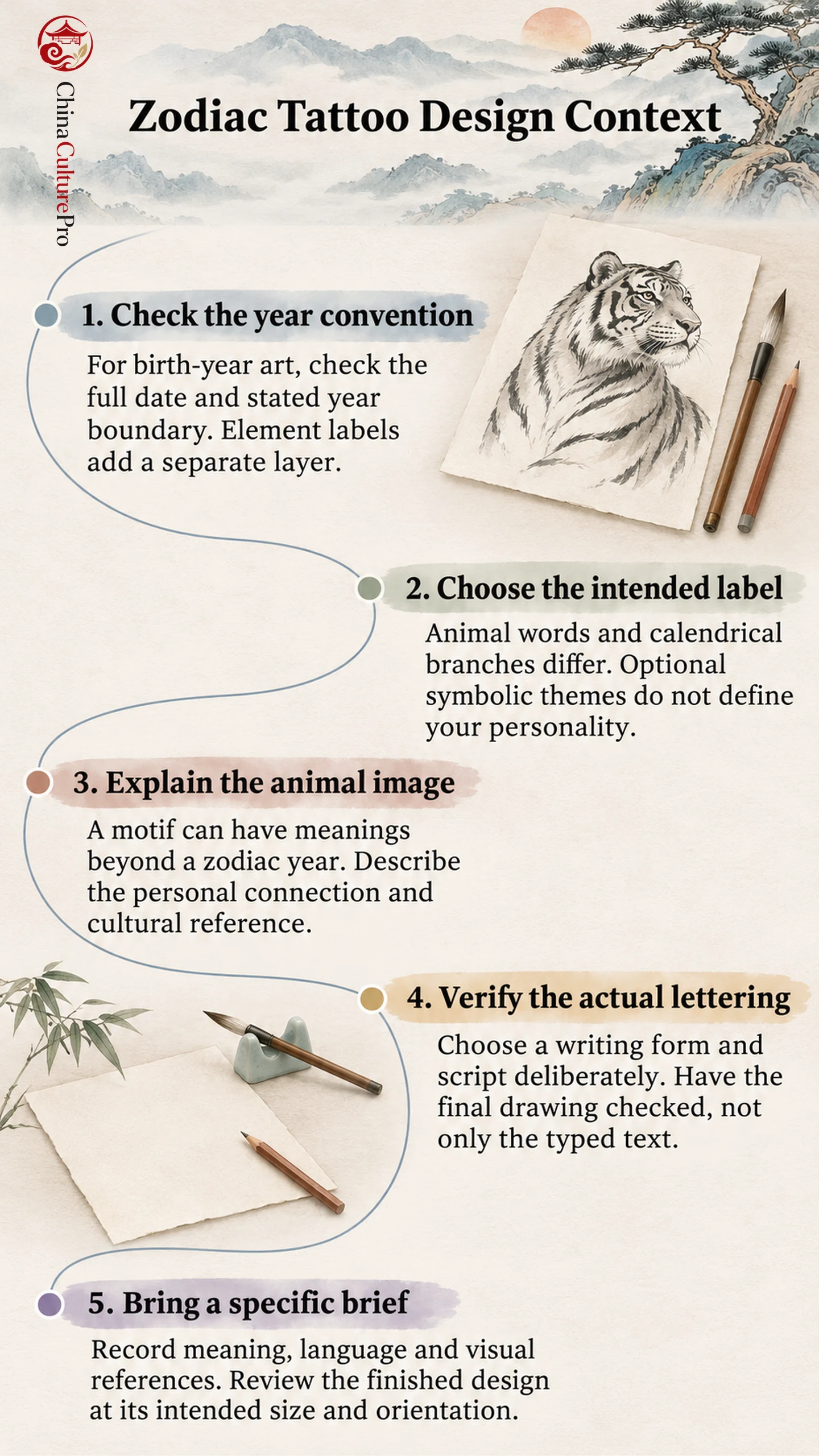
Bring the information needed to discuss the actual design:
- Meaning: State the animal, the personal connection and whether the work identifies a birth year.
- Language: Supply the checked character, pronunciation, literal meaning and chosen writing form when text is included.
- Visual references: Identify the source and explain which features interest you; ask for an original composition suited to your brief.
- Final presentation: Review the finished drawing at its intended size and orientation, and discuss any simplification with the artist.
Keep a copy of the verified wording beside the final design. If lettering changes, have that version checked again. This makes the conversation specific: the goal is to approve the work you will actually use, rather than rely on a label attached to an earlier reference image.
FAQs About Chinese Zodiac Tattoos
Must I choose my own birth-year animal?
No. An animal can have a personal meaning unrelated to your birth year. Describe that choice honestly rather than giving it an incorrect calendar label.
Does a zodiac tattoo need Chinese characters?
No. An animal image can stand on its own. Add text when it serves an intended meaning and can be verified.
Can I use a birth-year branch instead of the animal word?
Yes, if you intend a calendrical reference. The branch and the ordinary animal word are different labels.
Will a zodiac tattoo bring good luck?
It may express a personal wish or traditional association. The design cannot guarantee luck, protection or a particular outcome.
Sumber
[1] Hong Kong Observatory. Twelve Zodiac Animals
[2] Hong Kong Government News. Discussion of New Year and Zodiac Boundaries
[3] International Dunhuang Programme, British Library. Astrology and Astronomy
[4] ChinaCulture.org, from ECNS. The Chinese Zodiac: Popular Animal Interpretations
[5] Taiwan Ministry of Education. Revised Mandarin Chinese Dictionary: Twelve Zodiac Animals
[6] Metropolitan Museum of Art. Celebrating the Year of the Tiger
[7] Dawn Delbanco, Metropolitan Museum of Art. Kaligrafi Tionghoa
[8] Hong Kong Education Bureau. Lunar New Year Cultural Resources: Zodiac Calligraphy Models