


Quick Answer: What Is Chinese Osmanthus Syrup?
Chinese osmanthus syrup, often sold as sweetened osmanthus (糖桂花, táng guìhuā), is a sweet floral ingredient used in desserts and drinks. It combines flower flavor with a sweet base and may contain visible flower pieces.[1][2][3]
- Flower: Supplies the characteristic aroma.
- Sweet base: May be sugar syrup, honey or a combination.
- Use: Adds floral sweetness to a dish or drink.
Dried flowers, sweet preserves and floral wine are different products, even when all feature the same flower.[1][3]
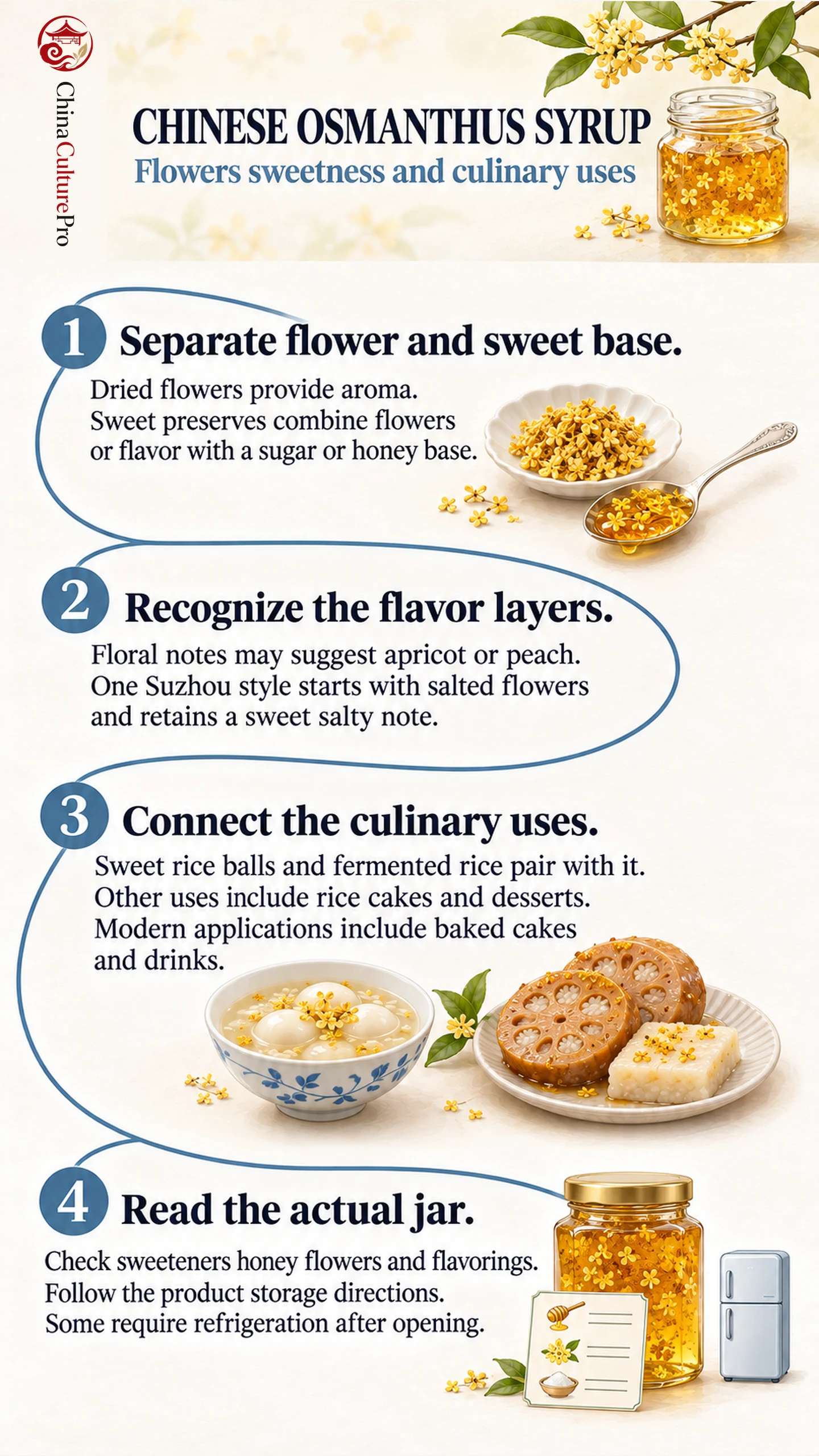
A spoonful of floral syrup can finish a sweet rice dish or scent a drink, but jars with similar English names can have different ingredients. Understanding the flowers, sweet base and product form makes the label more useful than the golden color alone.
Flowers, Sugar and the Names on the Jar
Osmanthus (桂花, guìhuā) is the fragrant flower behind the ingredient. It is also sold dried for floral infusions. A dry flower contributes aroma without supplying a syrup’s ready-made sweet base.[3]
| Label or form | Hal yang perlu dibedakan |
|---|---|
| Sweetened osmanthus | Flowers or their flavor in a sweet preparation. |
| Osmanthus sauce (桂花酱, guìhuā jiàng) | A jar label to check for its actual texture and ingredients. |
| Osmanthus honey (桂花蜜, guìhuā mì) | Check whether honey is an ingredient rather than assuming a fixed base. |
| Dried osmanthus | Dry flowers, not a liquid sweetener. |
English syrup, sauce and preserve labels can overlap. One commercial product uses fructose and starch syrup alongside dried flowers, flavorings and coloring.[1][5]
Floral Sweetness and a Possible Salty Note
The aroma is floral, with honey-like and stone-fruit associations; apricot and peach are useful descriptions, not proof that those fruits are ingredients. The sweet base and floral aroma are distinct parts of the flavor.[2]
A slight salty note is possible. One Suzhou production method combines salted osmanthus (咸桂花, xián guìhuā) with sugar syrup, leaving a sweet-salty preserve. This is a local style, not a universal formula.[1]
How Osmanthus Syrup Appears in Chinese Food
In Suzhou, the preserve accompanies small sweet rice balls, fox nuts and jiuniang (酒酿, jiǔniàng), or sweet fermented rice. Contemporary uses also include coffee drinks.[1]
The wider osmanthus dessert family includes sticky-rice-stuffed lotus root, sweet taro and rice-flour cakes. Lotus root supplies tender slices around sticky rice. In rice-based cakes, sweetened flowers provide fragrance alongside the grain ingredients.[4]
Syrup also appears in modern baked cakes: one original recipe combines it with vanilla in a yellow cake. This is a baking variation, distinct from rice-flour cakes.[3]
Reading the Ingredients and Storage Directions
Check sweeteners, honey, flower material and flavorings separately. A honey-like aroma does not prove that honey is present; color alone does not establish flower content.[2][5]
One producer specifies cool, dry storage and refrigeration after opening. Follow the actual jar’s directions for its opened or unopened state.[6]
FAQs About Chinese Osmanthus Syrup
Is osmanthus syrup always made with honey?
No. Sugar-based products exist; check the ingredients for honey.
Is dried osmanthus the same ingredient?
No. Dried flowers supply aroma, while syrup also supplies a sweet liquid base.
Is osmanthus syrup the same as osmanthus wine?
No. Osmanthus wine is an alcoholic product, distinct from sweet syrup.
Does an opened jar need refrigeration?
Some products explicitly require it. Follow the opened-product instructions on the actual jar.
Sumber
[1] Suzhou Daily, republished by Suzhou Government. Why Sweet Osmanthus Preserves Can Taste Salty
[2] Kei Fu Foods. Osmanthus Fragrans Flavor Syrup
[3] Kaitlin, The Woks of Life. Jarred Osmanthus Syrup in a Tea Cake
[4] Shanghai Government English Portal. A Culinary Journey Through Osmanthus-Infused Delicacies
[5] Cheng Fong Food Service. Osmanthus Flavor Syrup: Product Ingredients
[6] Hesheng Food. Osmanthus Syrup Storage Instructions