

Quick Answer: What Are Chinese Opera Costumes?
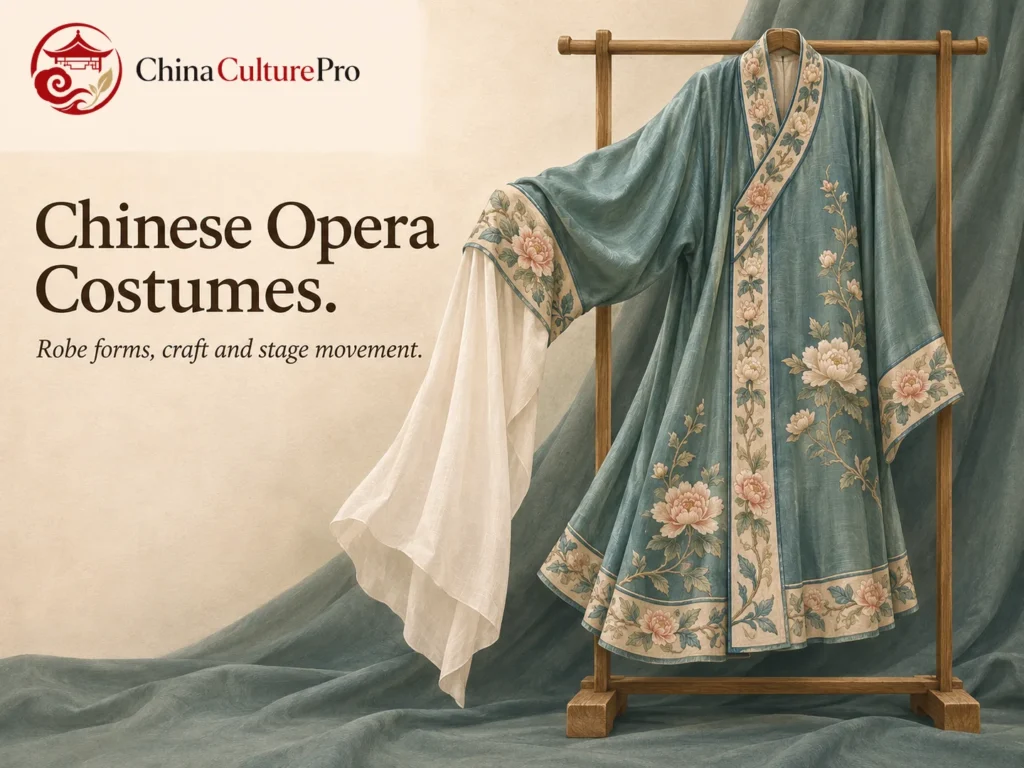
Chinese opera costumes help show who a character is, what situation they are in and how they move. A formal robe can indicate a court scene. A martial costume can broaden a performer’s outline. Long sleeves and flags can make a small action visible across a stage.
In Peking opera, several familiar garment forms help distinguish an official appearance, informal clothing and military dress. Other forms of Chinese opera can use different conventions. Read color and decoration with the garment’s shape, the character and the scene.
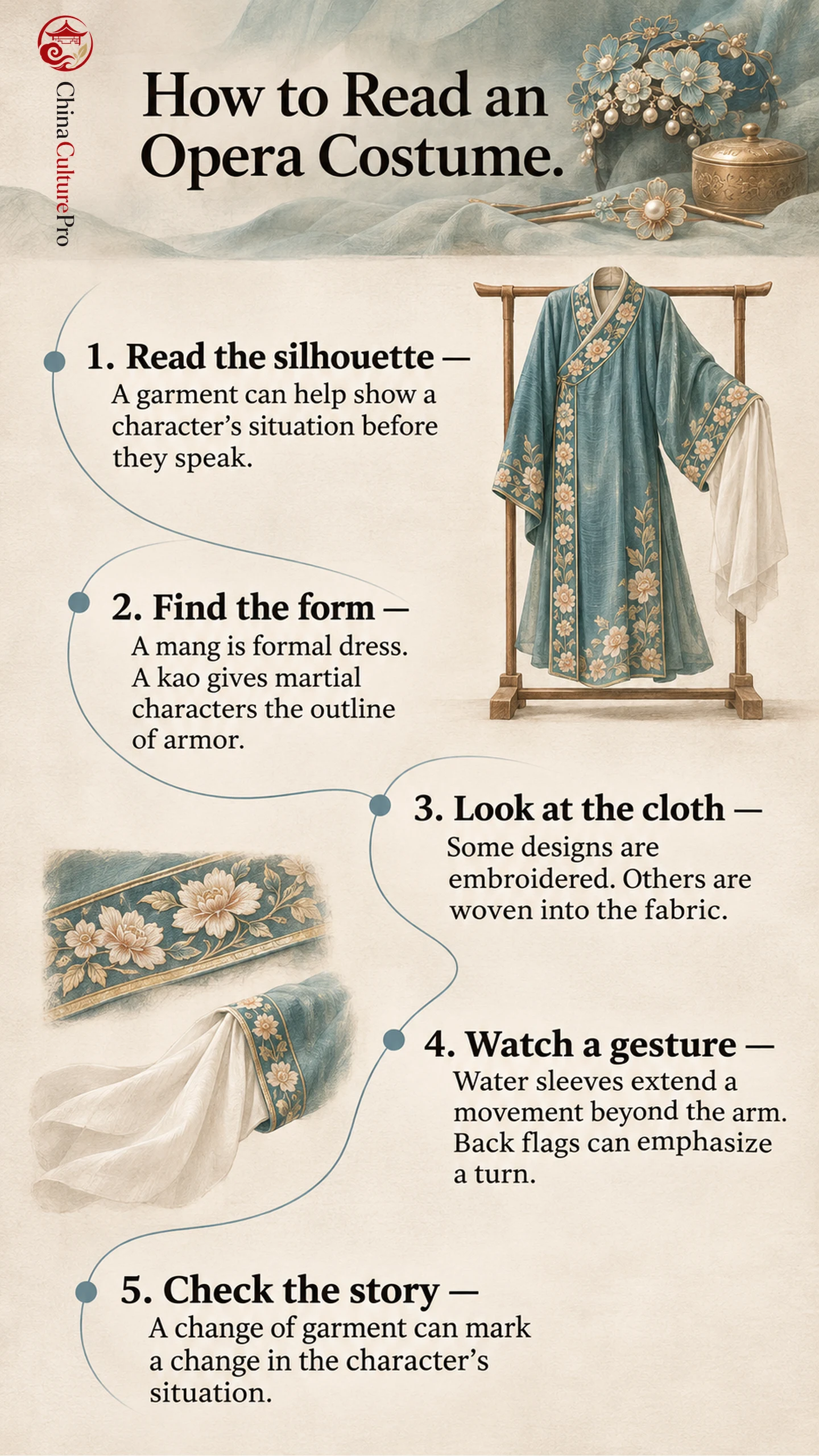
A robe can change before the character says a word. If the next scene gives the same person a different costume, the audience may already know that their status or situation has changed. The cut and weight of the fabric can also change the way the next gesture looks.
What a Costume Tells the Audience
On an open Opera Tiongkok stage, a garment can give information that scenery would otherwise supply. Its outline, length and sleeve shape can suggest a formal visit, a military encounter or a less public setting. Garments from Qing court theatres were made for roles as varied as officials, generals and immortals. [1]
Costume works alongside speech, posture and makeup. An actor can carry the same garment differently in two scenes. A change of robe can signal a new social position even when the role family stays the same. The audience can register the change before hearing the next line. [2]
Common Peking Opera Costume Forms
These names describe familiar garment forms in Peking opera. They are useful first clues when you can see the actor’s full silhouette. [2]
| Bentuk | Typical stage use | Feature to notice |
|---|---|---|
| mang(蟒,mǎng) | Formal robe for high-status figures such as rulers or senior officials | An ample robe with extensive decoration. |
| pei(帔,pèi) | A less formal robe for some affluent or high-status characters | Broad sleeves and a front that opens down the center. [3] |
| kao(靠,kào) | Armor costume for military characters | A structured body and, in some uses, flags rising from the back. |
| zhezi(褶子,zhězi) | A robe for ordinary or informal dress across several roles | A less formal silhouette, with decorative or plain variants. |
| yi(衣,yī) | A broad group that includes shorter garments and some official dress | Check the subtype and the scene before interpreting the form. |
Start with the cut and construction, then read the color and motifs within that form. A richly decorated robe may belong to one setting, while a shorter garment may signal a different kind of action. An individual work can also place the same character in several types of clothing. [2]
Materials, Decoration and Museum Objects
Some costumes are embroidered, while others use decoration woven into the cloth. The Metropolitan Museum of Art catalogs an eighteenth-century theatrical robe for a military role made of silk brocade with metallic thread. The collection identifies it as light military dress. The cut and intended use distinguish it from the structured armor costume in the table. [4]
Museum records can identify the material and date of a particular garment. Onstage, viewers see the movement and scale of the design. A broad pattern can make the torso’s turn clearer, while a border can emphasize the edge of a sleeve. Compare what a textile looks like in a photograph with what a comparable garment does in a scene. [1]
How Sleeves, Flags and Fabric Move
Water sleeves, or shuixiu(水袖,shuǐxiù), extend beyond the ends of costume sleeves. A nineteenth-century theatrical jacket in the Met preserves those extensions. The actor can move the cloth as part of a dance or narration. Like the long cloth in ribbon dance, an extension can continue moving after the arm changes direction. Its attachment to the garment gives it a different starting point. [5]
Flags fitted to some armor costumes extend the performer’s outline in another direction. As the body turns, the flags can emphasize the rotation. The national company describes them as decorative aids to performance. Watch how the flags turn with the garment. [2]
How to Read a Costume in a Scene
In a documented stage example, Wang Baochuan wears a plain zhezi during hardship and a formal mang after becoming a royal consort. The contrast helps viewers follow the story across scenes. Start with the shape of the garment, then look at the amount of decoration and how the performer moves in it. [2]
If you recognize a design from a museum display or an image, check the programme and role before assigning it a fixed meaning. The same costume feature can have several uses. It becomes more informative when you know what is happening onstage.
FAQs About Chinese Opera Costumes
Are Chinese opera costumes exact historical clothes?
Stage garments use conventions developed for performance. They can draw on historical clothing while changing its shape and decoration for the stage.
Do robe colors always indicate rank?
Color can be a clue, but the garment form, character and setting are also important.
What are water sleeves?
They are fabric extensions at the ends of costume sleeves. Performers use them to carry a hand or arm gesture into the surrounding space.
Sumber
[1] Metropolitan Museum of Art. From the Imperial Theater, Chinese Opera Costumes
[2] China National Peking Opera Company. How Does Costume Relate to Character Status?
[3] Palace Museum. Auspicious Designs on Qing Palace Theatre Costumes
[4] Metropolitan Museum of Art. Theatrical Robe for a Military Role, Object 35.84.2
[5] Metropolitan Museum of Art. Woman’s Theatrical Jacket, Object 62.27.2