
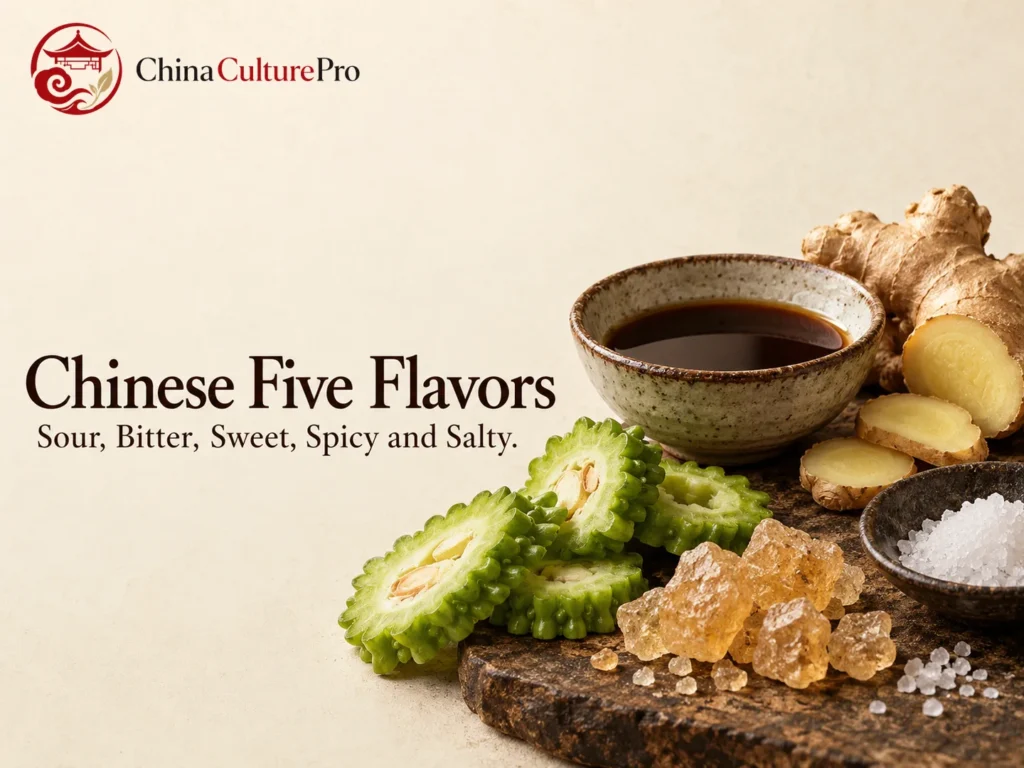

Quick Answer: What Are the Chinese Five Flavors?
The Chinese five flavors are sour(酸,suān), bitter(苦,kǔ), sweet(甘,gān), pungent(辛,xīn)and salty(咸,xián). Five flavors(五味,wǔwèi)is a traditional framework for describing food and discussing harmony. “Spicy” is a convenient English shorthand for pungency, but it is narrower than the traditional category.
- The traditional list: Acidity, bitterness, sweetness, pungency and saltiness are the five named qualities.
- Food examples: Vinegar, bitter melon, sugar, ginger and salt offer recognizable reference points.
- Modern distinction: Taste science commonly identifies sweet, sour, bitter, salty and umami(鲜,xiān); chili heat is a different sensation.
- At the table: Use the framework to notice contrasts, rather than to require equal amounts in every dish.
Five flavors are not five ingredients, and they are not the same thing as five-spice powder. The traditional framework and modern sensory classification answer different questions. [1][2][3]

A sweet-and-sour sauce, a bitter vegetable and a sharp piece of ginger reveal different aspects of Chinese flavor. The useful question is not just whether food is “strong”: it is which sensations lead, which support them, and how aroma and texture complete the experience. Explore this within Chinese food culture.
The Traditional Five Flavors and Their Chinese Names
The table retains the classical sweet term. Tian(甜,tián)is another common word for sweet in everyday food descriptions. The following ingredients are sensory examples, not exclusive assignments: one ingredient can contribute more than one quality. Traditional sources describe this classification, while contemporary product labels and recipes show how flavors overlap. [1][2][5][6][9]
| Traditional flavor | A useful food reference |
|---|---|
| Sour(酸,suān) | Vinegar supplies acidity; its aroma varies by product. |
| Bitter(苦,kǔ) | Bitter melon gives a clear vegetable example. |
| Sweet(甘,gān) | Sugar is an obvious reference; sweetness is not limited to desserts. |
| Pungent(辛,xīn) | Ginger and other sharp aromatics show why this means more than chili heat. |
| Salty(咸,xián) | Salt and soy sauce supply saltiness; soy sauce can also taste savory. |
Pungency, Chili Heat and Sichuan Pepper Tingle
Pungency covers a broader impression than “very hot.” Ginger’s sharpness and chili’s burning sensation need not feel the same. Modern sensory science distinguishes chili irritation from basic taste, and the aroma of an aromatic ingredient adds yet another dimension. Minyak cabai therefore changes more than a single taste label. [3]
Mala(麻辣,málà)combines the numbing or tingling impression of Sichuan peppercorns with chili heat. Research on pepper-induced tingle examines tactile sensory pathways; it should not be treated as another name for saltiness, bitterness or chili burn. Ask about chili and Sichuan pepper separately when those sensations matter to you. [4]
Where Umami Fits in the Picture
Umami(鲜,xiān)describes a savory basic taste. It is not the salty term xian: 咸 has the rising tone xián, while 鲜 has the level tone xiān. Unmarked English spelling can hide this difference. Modern taste science includes umami alongside sweet, sour, bitter and salty. [3]
A savory ingredient may also be salty, sweet or aromatic. Kecap asin is a useful example of overlapping sensations, rather than proof that salty and savory mean the same thing. Jamur and fermented foods offer further ingredients to explore by their own character. [6][9]
How Flavors Combine in Chinese Dishes
Sweet-and-sour sauce makes a straightforward pairing: a documented bottled version combines sugars, fruit ingredients and acid with salt. It illustrates how sweetness and acidity can lead while other qualities support them. That product is one formula, not a definition of every Chinese sweet-and-sour dish. [5]
Bitter melon can remain distinctly bitter within a savory preparation. A documented vegetable stir-fry pairs it with fermented black beans, mushrooms and zucchini. The aim of that recipe is a contrast of bitter, salty, savory and gently sweet components, rather than complete removal of bitterness. See Chinese vegetables for ingredient differences. [6]
Chinese black vinegar also shows why one label is incomplete. The official account of a Zhenjiang vinegar craft describes acidity alongside aroma and slight sweetness. “Sour” identifies one part of the experience, not the whole product. [7]
Reading Flavor Descriptions and Choosing a Meal
These are useful questions for reading a menu or discussing a shared meal. They describe preferences, not a required tasting ritual or a rule that each dish must cover the entire framework.
- Notice the leading impression: sharp acidity, sweetness, bitterness, saltiness or pungency. Then notice supporting qualities.
- Separate aroma and mouthfeel from taste: fragrant ginger, a crisp vegetable and a thick sauce contribute different information.
- Ask about chili heat and pepper tingle separately. “Less spicy” can leave the intended change unclear.
- Compare dishes across the meal. A strongly seasoned dish and plain rice create a different experience from the seasoned dish alone.
- Check ingredients separately from flavor. “Sweet,” “savory” or “mild” does not establish allergens or vegetarian suitability. [3][9]
Five Flavors, Five Spice and Cultural Meanings
The Hong Fan(洪范,Hóngfàn)chapter of the Shang Shu(尚书,Shàngshū)links the five flavor terms with the five phases. This establishes a classical cultural association; it does not establish a modern recipe, an invention date or a physiological rule. Traditional medical writings use related classifications, but this food guide does not turn those associations into health advice. [1][2]
Chinese five spice is a spice blend. A documented version contains star anise, cloves, fennel, cinnamon and Sichuan peppercorns. Adding it is not equivalent to adding sourness, salt and every other flavor in a predetermined balance. Read the blend’s ingredients and the dish’s seasoning separately. [8]
FAQs About Chinese Five Flavors
Does Every Chinese Dish Need All Five Flavors?
No. Treat the five as a vocabulary for noticing qualities, not a compulsory ingredient checklist. A dish may emphasize one or two impressions, while other dishes provide contrast.
Is Spicy One of the Five Basic Tastes?
Chili burn is a chemical irritation sensation, rather than one of the commonly identified basic tastes. Traditional pungency belongs to a broader cultural classification. [3]
Are Salty and Umami the Same?
No. They can occur together in one ingredient, but saltiness and savory umami are distinct qualities. The Chinese terms 咸 and 鲜 also have different tones.
Does Five-Spice Powder Supply All Five Flavors?
No. It is an aromatic spice mixture, not a complete system of sour, bitter, sweet, pungent and salty seasonings. Its name does not replace checking the actual blend. [8]
Sumber
[1] Wikisource, primary-text transcription. Shang Shu: Hong Fan
[2] Hong Kong Department of Health. Traditional five-flavor classification
[3] NIDCD. Taste Disorders: How taste works
[4] Hagura, Barber and Haggard. Food vibrations: Asian spice sets lips trembling
[5] Lee Kum Kee. Sweet & Sour Sauce: Ingredients
[6] Sarah Leung. Bitter Melon Stir-fry with Black Bean Sauce
[7] China Intangible Cultural Heritage. Zhenjiang Hengshun Aromatic Vinegar Making Technique
[8] Spices Inc.. Chinese Five Spice Product Specification
[9] Lee Kum Kee. Soy Sauce: Ingredients and Allergens