

Quick Answer: How Do Chinese Dowry and Bride Price Differ?
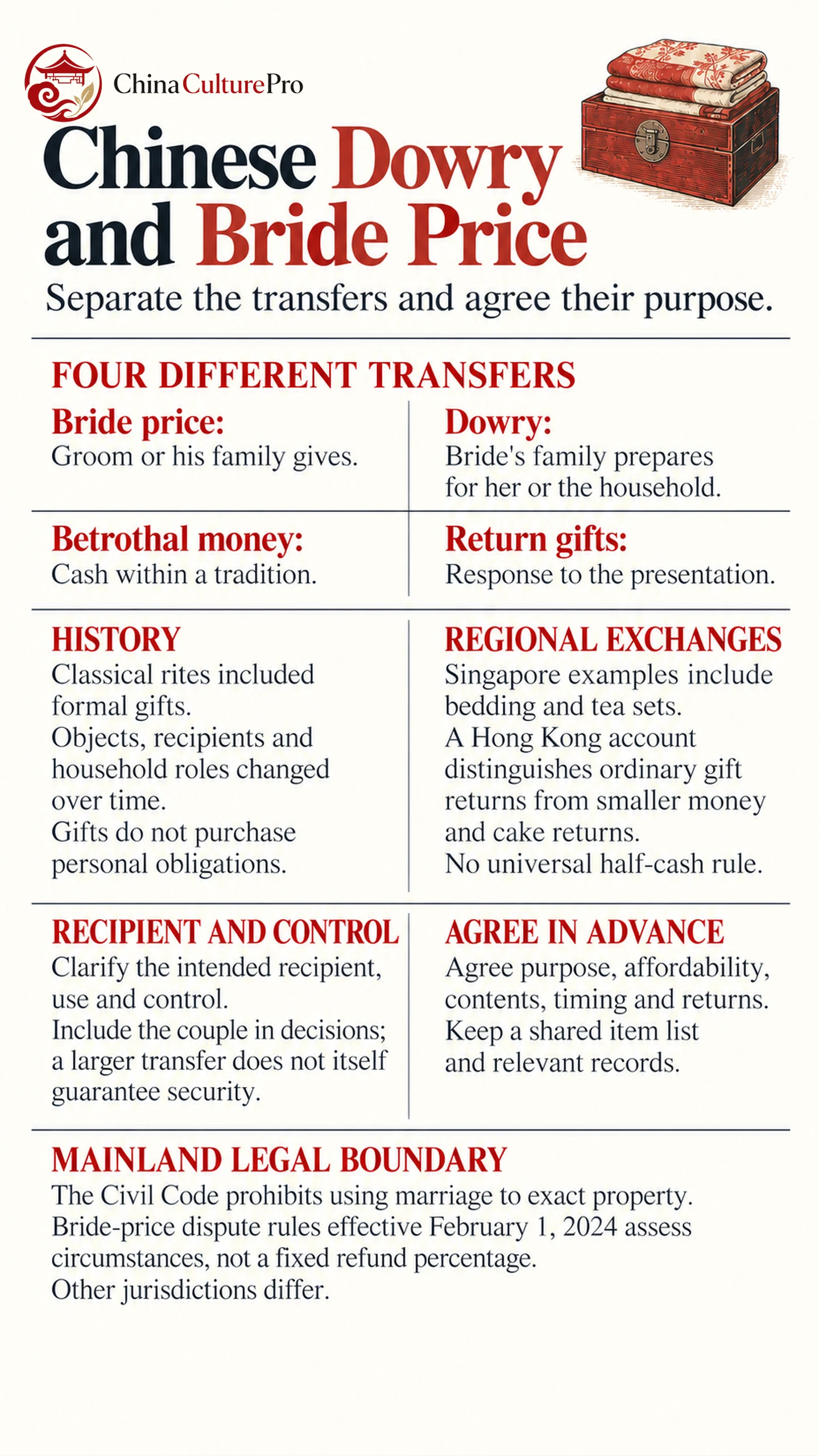
Caili (彩礼, cǎilǐ), usually translated as bride price or betrothal gifts, traditionally comes from the groom or his family. Jia zhuang (嫁妆, jiàzhuang), a dowry or trousseau, is associated with what the bride’s family prepares for her or the new household. The destination and use of the property vary by arrangement.[1]
- Bride price, dowry, return gifts and a guest’s wedding envelope are different transfers.
- Money, jewelry and household goods may appear in more than one category; purpose matters.
- No national cultural tariff tells every family what to give or keep.
A wedding gift does not establish ownership of a person or replace the couple’s freedom to decide whether to marry.
Two families can use the English word “dowry” while referring to money moving in opposite directions. A jewelry set displayed at a ceremony can also be intended for the bride, for household savings or for another agreed purpose. Clarifying the words is the first step toward understanding the exchange.
Within Chinese wedding traditions, these gifts can express recognition, affection and support. They can also become a source of pressure. Both meanings deserve attention without reducing a marriage to its financial arrangements.
Separate the Terms Before Discussing Money
Pin jin (聘金, pìn jīn) means betrothal money in traditions using that term. Hui li (回礼, huí lǐ) means return gifts. Guo da li (过大礼, guò dà lǐ) names the formal gift-presentation event in many southern Chinese and diaspora settings, rather than only the money inside it.[1][2]
| Istilah | Makna budaya | Perbedaan penting |
|---|---|---|
| Caili | Betrothal money or goods traditionally provided by the groom or his family | The intended receiver and use require clarification |
| Jia zhuang | A dowry or trousseau prepared for the bride or the new household | It is not simply another name for the groom’s payment |
| Pin jin | Betrothal money named within a particular wedding tradition | It is one component of an exchange, not every wedding expense |
| Hui li | Return gifts given in response to a betrothal presentation | Returning gifts and preparing a dowry are related but different actions |
English-language accounts sometimes use “dowry” loosely for several transfers. When discussing an actual arrangement, ask who gives what, who receives it and what the family calls it. The guide to guo da li and betrothal gifts explains the wider presentation.
A friend’s wedding gift belongs to another category again. These cultural definitions do not determine legal ownership. A label on an envelope alone cannot settle a later property dispute.
Historical Gifts and Changing Household Roles
Formal betrothal gifts belong to a long history of family-mediated marriage. The classical six-rite framework included a substantial gift-presentation stage, but the framework describes a ritual ideal rather than every household’s practice across Chinese history.[3] The separate account of the three letters and six rites sets out that sequence.
It is useful to distinguish the existence of a gift custom from its contents and social purpose. A ceremonial gift, a bride’s trousseau and a modern cash transfer should not be assumed to have identical recipients or purposes simply because all accompany marriage.
Residence and family roles matter too. Where a bride joined her husband’s household, gifts and a trousseau could be discussed alongside expectations about her work, kinship obligations and place in that household. Those historical expectations should not be presented as duties that a contemporary gift purchases. For the broader institutional changes, see Chinese marriage history.
Regional Exchanges and Return Gifts
A Singapore clan-association account describes dowry items such as sewing supplies, tea and bowl sets, bedding and symbolic household objects. It also distinguishes jewelry traditions among dialect communities.[1] These are documented examples of preparing for married life, not a compulsory shopping list for Chinese brides.
In a Hong Kong practitioner account, the receiving family returns half of ordinary betrothal items, while returning only a smaller portion of money and cakes.[2] That distinction matters: “return half” cannot safely be applied to every part of the exchange.
For a real presentation, decide which objects are retained, returned, shared with relatives or delivered to the couple’s home. Keep jewelry gifts, cash and consumable gifts on separate lines. A symbolic item intended for bed setting may need different handling from savings given to one partner.
Do not assume the bride’s family must match the incoming gift’s value. Nor should the return of an item be read as rejection without understanding the local exchange convention.
What a Gift Means Depends on Who Controls It
A gift’s ceremonial presentation does not tell the whole story. The person receiving it publicly may not be the person who decides how it is spent. Ask whether money is intended for a parent, the bride, the couple or a particular household purchase.
A qualitative study drawing on interviews in four Chinese provinces in 2018–2019 examined how bride-price negotiations could limit women’s participation and reinforce expectations about their family roles.[4] Its findings illuminate particular experiences; they do not describe every Chinese woman or provide a current national rate.
The practical lesson is to include the people whose marriage and finances are being discussed. A large transfer does not by itself guarantee security or respect, and a small or symbolic gift does not establish a lack of care. Meaning depends partly on consent, control and the obligations people attach to it.
Keep this conversation separate from public comparisons with neighbors or cousins. Different incomes, housing arrangements and family circumstances can produce very different choices.
Questions to Agree Before the Exchange
A short shared record can prevent two families from attaching conflicting meanings to the same contribution. Discuss these points with the couple directly:
- Purpose and recipient: Is the contribution a personal gift, household support, ceremonial return or another arrangement? Who is intended to receive and control it?
- Affordability: What can each contributor give comfortably? Do not treat borrowing or a relative’s reported payment as the standard.
- Contents and use: Which cash, jewelry or goods are included, and will any amount be used for the banquet or housing?
- Timing and returns: When will each transfer happen, and which items or portions will be returned?
- Documentation: Keep a mutually understood item list and relevant transfer records, without assuming that an informal note decides every legal question.
Add the agreed presentation and deliveries to the wedding timeline. If expectations change, discuss them before the ceremony rather than using a public exchange to pressure someone into accepting new terms.
Custom and Law in Mainland China
Mainland China’s Civil Code protects freedom of marriage and gender equality and prohibits using marriage to exact property.[5] That prohibition should not be simplified into a claim that every voluntary betrothal gift is illegal.
Specific bride-price dispute rules took effect on February 1, 2024. They consider purpose, local custom, timing, value, giver and receiver when identifying bride price; small commemorative gifts and ordinary relationship expenses are excluded.[6]
Where a couple has registered and lived together, courts generally do not order return at divorce, with an exception involving short cohabitation and an excessive amount. The rules also address unregistered couples who have lived together. Actual use, dowry, shared life, pregnancy or childbirth circumstances, fault and local custom can affect the assessment; there is no single refund percentage.[6]
These are mainland rules, not a legal summary for Hong Kong, Taiwan or every diaspora jurisdiction. For an actual dispute, use qualified advice in the relevant jurisdiction rather than infer an outcome from a cultural term.
FAQs About Chinese Dowry and Bride Price
Does every Chinese marriage involve bride price?
No. Families may choose a substantial transfer, a symbolic exchange, other support or no such payment. A customary gift is not a universal cultural requirement.
Must the dowry equal the bride price?
There is no universal custom requiring equal values. Dowry, betrothal money and return gifts have different purposes; the families should clarify their arrangement rather than assume a matching formula.
Is a guest red envelope the same as bride price?
No. A guest’s congratulatory gift belongs to a different relationship and occasion from a betrothal transfer arranged between the couple or their families.
Is bride price always returned if a couple separates?
No automatic answer applies to every case. Jurisdiction, registration, shared life, the nature and use of the transfer and other facts can matter. A cultural description cannot decide an individual dispute.
Sumber
[1] Singapore Federation of Chinese Clan Associations. Culture — Rituals
[2] Family and Women Portal, Hong Kong. Dai Kam Jie Explains the Contemporary Take on Traditional Weddings
[3] National Museum of History, Taiwan. Traditional Wedding Customs
[4] Heliyon. Bride price and gender role in rural China
[5] National People’s Congress. Civil Code of the People’s Republic of China
[6] Supreme People’s Court. Provisions on the Application of Law in Bride-Price Disputes