


Quick Answer: What Is a Chinese Character Radical?
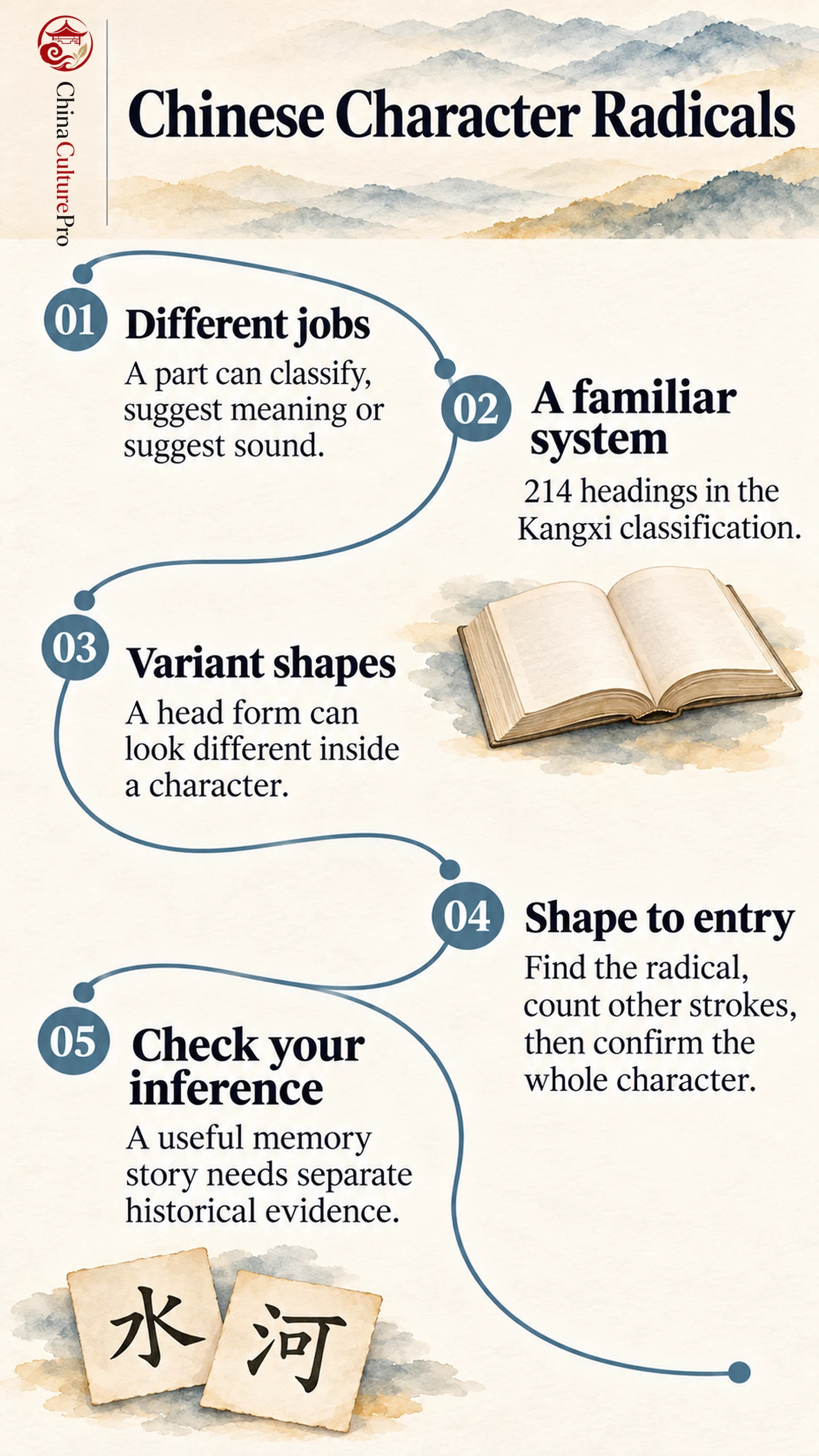
A dictionary radical (部首, bùshǒu) is the part used to classify a Chinese character for lookup. Learning recurring shapes also helps you notice how a character is built, although its indexing part and its other components can do different jobs.
- Lookup: A radical takes you to a dictionary section, usually followed by an additional-stroke group.
- Meaning and sound: Different parts may offer clues to a character’s meaning or pronunciation.
- Variants: The same radical can have a different shape inside another character.
- Count: The well-known Kangxi system has 214 radicals, while other dictionaries can organize entries differently.
Recognizing a part gives you a useful lead. The complete entry confirms the character and its use.
If you can see a character but cannot say it, an alphabetical search gives you little to work with. A radical index offers a route from shape to an entry. This makes radicals a useful part of understanding Chinese writing and language, especially when you encounter an unfamiliar name or a printed word. [1][4]
Three Jobs a Character Part Can Do
A character component (部件, bùjiàn) is a recurring part within a character. “Component” is a wider category than “dictionary radical.” In learning materials, radical is sometimes used loosely for many character parts. For dictionary work, the narrower classification meaning is more useful. [2]
| Function and term | What it does |
|---|---|
| Dictionary radical (部首, bùshǒu) | The part a dictionary uses to file a character under a heading. |
| Semantic component (形旁, xíngpáng) | A part that contributes a clue about meaning or a meaning category. |
| Phonetic component (声旁, shēngpáng) | A part that contributes a clue about pronunciation. |
One part can do more than one job. The water shape in a character can supply a meaning clue and also be the part chosen for the dictionary index. A different component may supply a sound clue. Seeing two recognizable pieces therefore does not establish that a character has two indexing radicals. [2][6]
Why the Number 214 Matters
The 214-radical classification associated with the Kangxi dictionary remains a familiar reference system. Its headings run from simple shapes to much more complex forms. The number refers to dictionary categories. It is not a count of every recurring component in the script or every character a learner needs to recognize. [3][4]
Modern references may adapt their radical lists, use simplified forms, or allow more than one search path to an entry. A list learned in one dictionary can therefore differ from the index in another. Before searching, check how that particular reference handles variants and additional strokes. [4]
A modern classification and the history of Chinese character forms answer different questions. The first helps locate an entry, while the second investigates how a form developed. [2][6]
Recognizing Radicals in Different Shapes
A component may change shape to fit into a larger character. Water appears as 水 when written independently and often as 氵 on the left. The examples below pair a recognizable head form with a common shape used inside characters. [3]
| Head form | Common component shape | Contoh |
|---|---|---|
| 水, shuǐ, water | 氵 | 河, hé, river |
| 手, shǒu, hand | 扌 | 打, dǎ, to hit |
| 心, xīn, heart | 忄 | 忙, máng, busy |
| 人, rén, person | 亻 | 你, nǐ, you |
A shape used inside a character does not always have the same stroke count as the independent head form. This matters when an index groups radical headings by their full forms. Distinguish finding the heading from counting the strokes left over in the actual character. Familiarity with Chinese stroke order helps keep those two counts clear. [3][4][5]
Looking Up a Character With an Unknown Pronunciation
A radical-and-stroke index combines a likely classification part with the strokes outside it. Use the instructions belonging to the dictionary in front of you. The process below describes a common route. [4]
- Inspect the character and choose the likely indexing part.
- Find that radical or its variant in the dictionary’s radical table.
- Count the strokes outside that part.
- Search the corresponding additional-stroke group and match the whole character.
- Read the entry to confirm pronunciation, meanings and example words.
For 河, the water component is 氵 and the other part is 可. The dictionary entry places 河 under 水 with five additional strokes and eight strokes in the whole character. The heading 水 has four strokes as an independent character, while 氵 contributes three visible strokes in 河. Counting 可 directly gives the correct five additional strokes. [5]
If the first choice does not produce a match, try the reference’s alternative radical or total-stroke search. Once an entry appears, compare the whole glyph before accepting it. The broader guide to Chinese dictionaries covers how shape-based and pronunciation-based searches fit together. [4]
Using Components Without Inventing Etymologies
Meaning and sound clues are useful starting points. They are often partial, and their relationship to modern pronunciation may be less obvious than a beginner expects. A familiar-looking piece can help you remember a character without providing a reliable account of how it was first formed. [2][6]
Separate three learning notes when studying a new character. Record its complete shape, its pronunciation with tone, and one real word in which it occurs. Then add a component observation if it helps recognition. This keeps a memory aid connected to the character you actually need to read. A story invented for memorization can remain a learning device, while a historical explanation needs evidence about earlier forms. [1][6]
FAQs About Chinese Character Radicals
Is every character component a radical?
A character can contain several components. A dictionary radical has the particular job of classifying the character for lookup, so the two terms are not interchangeable.
Can a radical tell me how to pronounce a character?
The indexing part alone usually cannot give the full pronunciation. A phonetic component may supply a partial sound clue, which should be checked in a dictionary.
Do I need to memorize all 214 radicals first?
You can start with common parts encountered in real characters and learn to use the table in your dictionary. The full set is a reference system that you can consult as needed.
Sumber
[1] Princeton University. Radicals and Components of Characters
[2] Shi Pui Donald Li and colleagues. Functional Orthographic Units in Chinese Character Reading: Are There Abstract Radical Identities?
[3] Taiwan Ministry of Education. Summary List of 214 Chinese Radicals With Various Forms
[4] Unicode Consortium. Unicode Han Database, Unihan
[5] Taiwan Ministry of Education. Concise Mandarin Dictionary Entry for 河
[6] Duke University. Exercises for Chinese Characters