

Quick Answer: How Do You Start Chinese Calligraphy?
Start with a brush, black liquid ink, practice paper and one model of regular script (楷书, kǎishū). Make a few simple strokes to see how the brush responds to pressure, then copy one character and compare your result with the model. [1][2][3]
- Tools: Use a brush that comes to a controllable point, an ink dish and practice paper. [1][3]
- Model: Choose a clear example with a readable shape and a stroke-order guide. [2][4]
- Practice: Compare the start, width and finish of each mark. Change one thing on the next attempt. [2][3]
Bottled ink and simple practice paper are enough to start. The traditional inkstick and inkstone are useful when you want to learn that part of the craft. [1][4]
A first session can answer a small question. Can you widen a stroke and bring the brush back to a point? Once you can see the effect on paper, you have a better basis for copying a character. Use the same paper, ink and model for a few tries so you can tell what changed.
Choose a Brush, Ink, Paper and Model
The Four Treasures of the Study (文房四宝, wénfáng sìbǎo) are brush, ink, paper and inkstone. For an initial session, a small dish can hold liquid ink. If you use an inkstick, the inkstone gives you a surface for rubbing the stick with water to make liquid ink. [1][4]
Choose a brush with a tip you can bring together into a point. A larger brush can help you see pressure changes while making generous practice strokes. Set aside a scrap of the same paper to test the ink. Blank newsprint is one inexpensive option for exercises. Xuan paper (宣纸, xuānzhǐ) belongs to a particular paper tradition and is available when you want to explore other surface effects. See the guide to Chinese calligraphy brushes for tool differences. [1][3][6]
Use one clear character in regular script. A useful model shows the whole character and its stroke order. A calligraphy copybook lets you return to the same hand and proportions on later practice days. [2][4]
A First Chinese Calligraphy Practice Session
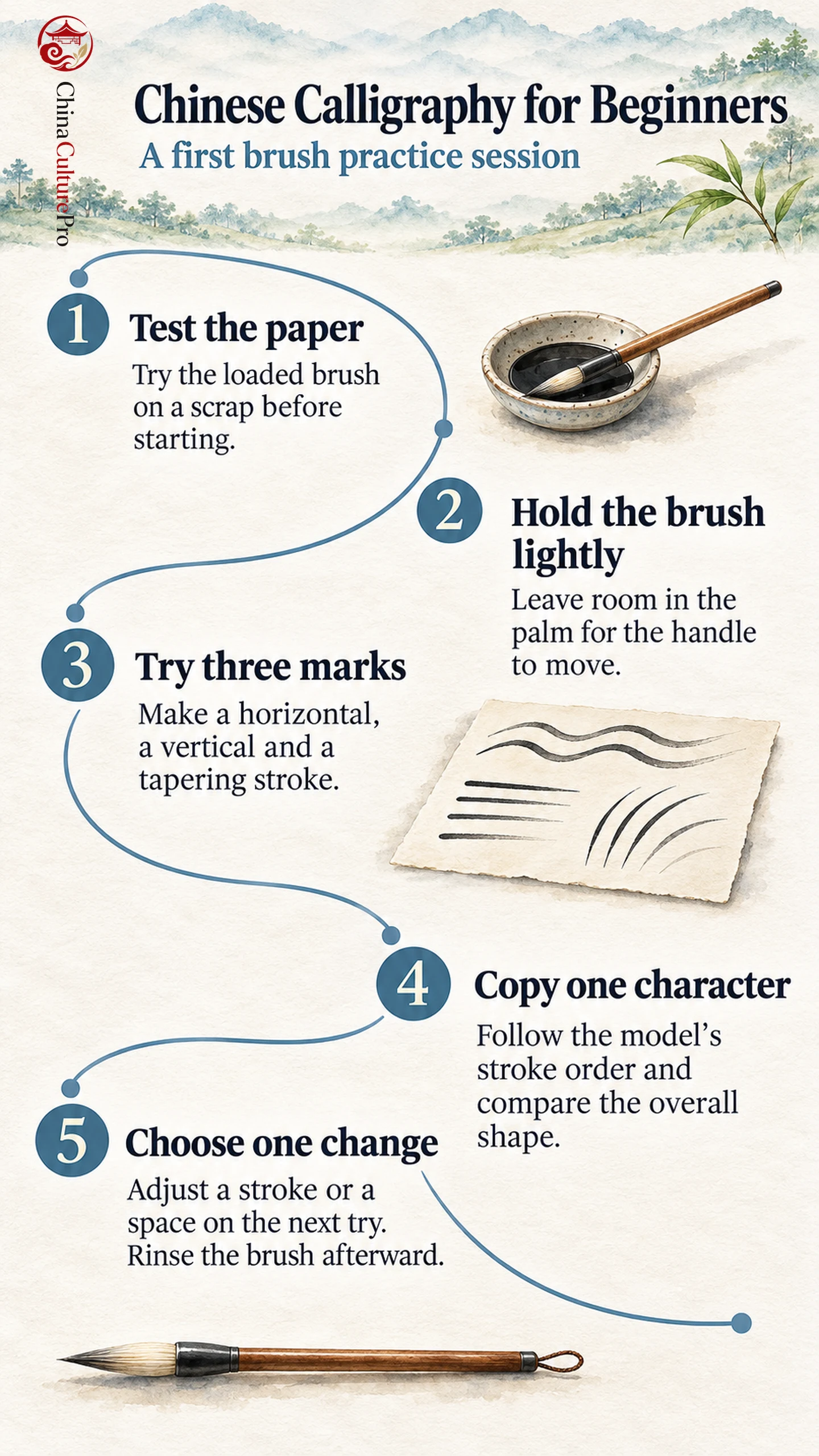
1. Prepare the Writing Surface
Set the paper flat on a surface you can wipe or protect. Keep the ink dish within reach. Load the brush, then test it on a scrap to see how much the mark spreads. [1][3]
A pool of ink can mean the brush is overloaded. A fuzzy edge can also come from an absorbent sheet. Start with a smaller load and see how the next line changes. Compare two marks on the same paper before changing the pressure. [2][3]
2. Find a Relaxed Grip
Support the handle between the thumb and fingers, with the index and middle fingers guiding the front and the ring finger supporting it from behind. Keep space in the palm so the handle can move. [3]
Start near upright and aim for a grip light enough to lift and turn the tip. If your hand stiffens, pause and try another slow mark. [1][3]
3. Practice Three Marks
Make a short horizontal line, a vertical line and a mark that broadens and tapers. Compare what happens when you press gently and then lift. [2][3]
Repeat each mark at a similar size. On the taper, lift gradually and check whether the final tip narrows cleanly. Compare two attempts on the same paper with a similar ink load. [2][3]
4. Copy One Character
Follow the stroke order in the model and aim to keep the parts in the same relative positions. Compare the overall shape before adjusting a single stroke. [2][4]
Begin with a simple form you can identify, such as a model of 十 (shí, ten). The Eight Principles of Yong (永字八法, Yǒngzì Bāfǎ) use 永 (yǒng, enduring) to study eight traditional brush actions. The eight count refers to brush actions, some of which can occur within a single written stroke. Save this more complex model for after the first simple character. [2][5]
5. Compare and Clean Up
Set the practice sheet beside the model. Choose one change to try next, such as the length of a stroke or the space between parts. Rinse the brush with the tip pointing down until the excess ink is gone. [1][2][3]
A note about pressure, spacing or ink loading gives you a clear starting point for the next session. For finished examples, how to read Chinese calligraphy explains what to look for in the strokes and spacing. [2]
FAQs About Chinese Calligraphy for Beginners
Which Script Should a Beginner Start With?
Regular script gives you a clear view of many individual strokes and the structure of a character. That makes it a useful starting point for copying a model. [2][4]
Do You Need to Know Chinese Before Practicing?
You can begin with a supplied model. Check the character’s meaning and stroke order so you know what you are writing and can practice it consistently. [2][4]
Do You Need Xuan Paper or an Inkstone?
Practice paper and bottled ink can serve for the first exercises. An inkstone becomes part of the setup when you grind an inkstick. Different papers give you different results to compare as you gain control. [1][3][4][6]
Sumber
[1] Columbia University, Asia for Educators. Classroom Exercise: Introduction to Chinese Calligraphy
[2] The Metropolitan Museum of Art. Kaligrafi Tionghoa
[3] Asian Art Museum. An Introduction to Chinese Brushpainting Techniques
[4] Smithsonian National Museum of Asian Art. Understanding Chinese Characters
[5] Tsinghua University Press. Introduction to Calligraphy for Middle School
[6] UNESCO. Traditional Handicrafts of Making Xuan Paper