
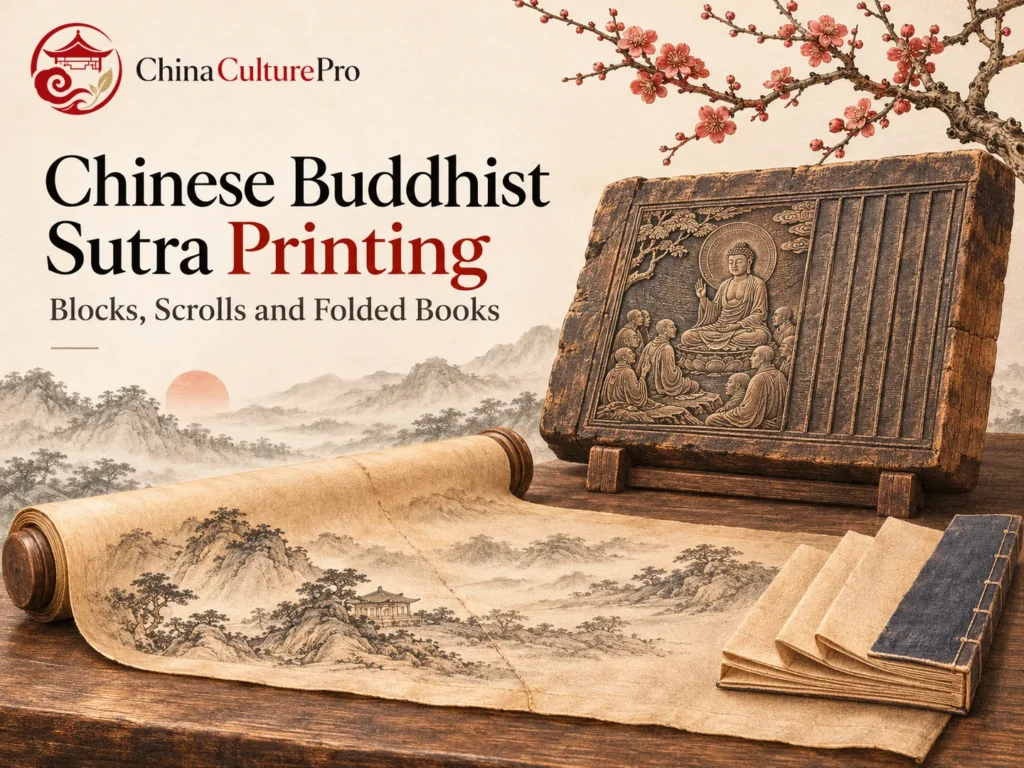

Quick Answer: How Were Buddhist Sutras Printed in China?
Chinese Buddhist printers used woodblock printing (雕版印刷, diāobǎn yìnshuā) to transfer carved text and images onto paper. One block could produce multiple impressions of the same text or image.[1][2][4]
- A dated scroll: A copy of the Diamond Sutra (金刚经, Jīngāng Jīng) found at Dunhuang is dated 868.[2][3]
- A printed canon: The Northern Song Kaibao Canon (开宝藏, Kāibǎo Zàng) brought many Buddhist texts into one large printing project.[4]
- Book forms: Surviving prints include scrolls and accordion-fold books with an opening illustration.[2][5]
The date on a printed copy identifies the object or edition. The text it contains may be centuries older.

A Buddhist print can tell you who paid for it, whom they wanted to honor and how the sheets were joined. In the case of the Diamond Sutra found at Dunhuang, the information about the patron sits at the opposite end from the picture.
What a Woodblock Made Repeatable
A carver removes wood around characters or a design. Ink transfers from the raised parts to the paper. Text and pictures can both be printed this way. Reusing the block gives a new copy the same layout. This craft is part of the larger history of Chinese printing and relied on the skills behind papermaking as well as carving.[1]
What the 868 Diamond Sutra Records
The Dunhuang scroll consists of seven printed sheets joined into a length of about five metres. An image opens the scroll. At the end is a colophon, a note recording that Wang Jie sponsored production for distribution on behalf of his parents in 868. The frontispiece introduces the scripture, and the colophon preserves the commission. The date makes this the earliest surviving complete printed book with an explicit date in the British Library’s account.[2][3]
From One Scripture to a Printed Canon
The Northern Song court commissioned the Kaibao Canon. Work on the blocks began in 971 and the initial set of blocks was completed in 983. A canon includes many works, so the undertaking meant coordinating editions, carvers and printing across a much greater body of text. The estimated count of 130,000 blocks gives a sense of its scale.[4]
What Changed When a Book Folded
The Met’s 1615 first volume of a Buddhist repentance liturgy has accordion folds and an opening woodblock illustration. Folding changes how a reader opens the book and moves through its panels. Compare the repeatable impressions of these prints with a rubbing taken directly from a sutra pillar.[5]
FAQs About Chinese Buddhist Sutra Printing
Does the date 868 mark the invention of printing?
It dates this surviving Diamond Sutra. The copy’s design and production already show a developed printing practice.
Why did people sponsor sutra printing?
Distribution could be a religious act. Wang Jie’s colophon explicitly links making copies available with honoring his parents.
What is the difference between a sutra and a canon?
A sutra is an individual scripture. A canon is a collection of many works, including sutras and other kinds of Buddhist texts.
Sumber
[1] UNESCO Intangible Cultural Heritage. China Engraved Block Printing Technique
[2] International Dunhuang Programme. Dunhuang Collection Items: Printed Diamond Sutra
[3] International Dunhuang Programme. Buddhism on the Ground: Colophon of the Diamond Sutra
[4] Darui Long and Jinhua Chen, editors. Chinese Buddhist Canons in the Age of Printing
[5] The Metropolitan Museum of Art. Sutra of the Repentance Ritual of Great Compassion, Volume 1