
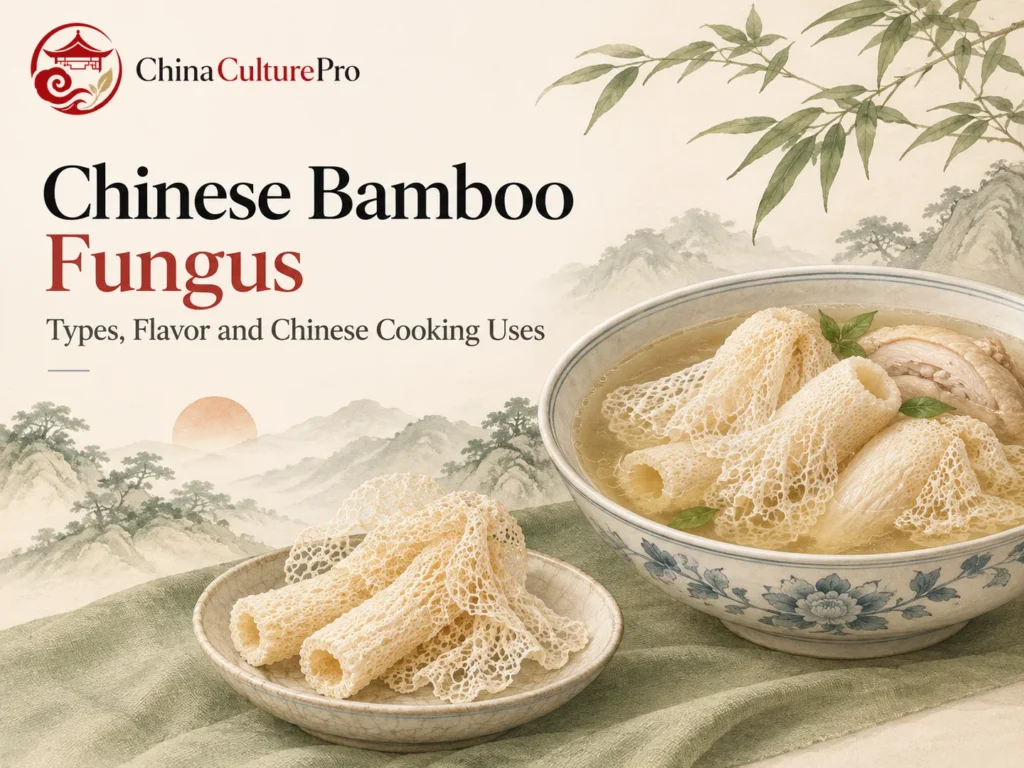

Quick Answer: What Is Chinese Bamboo Fungus?
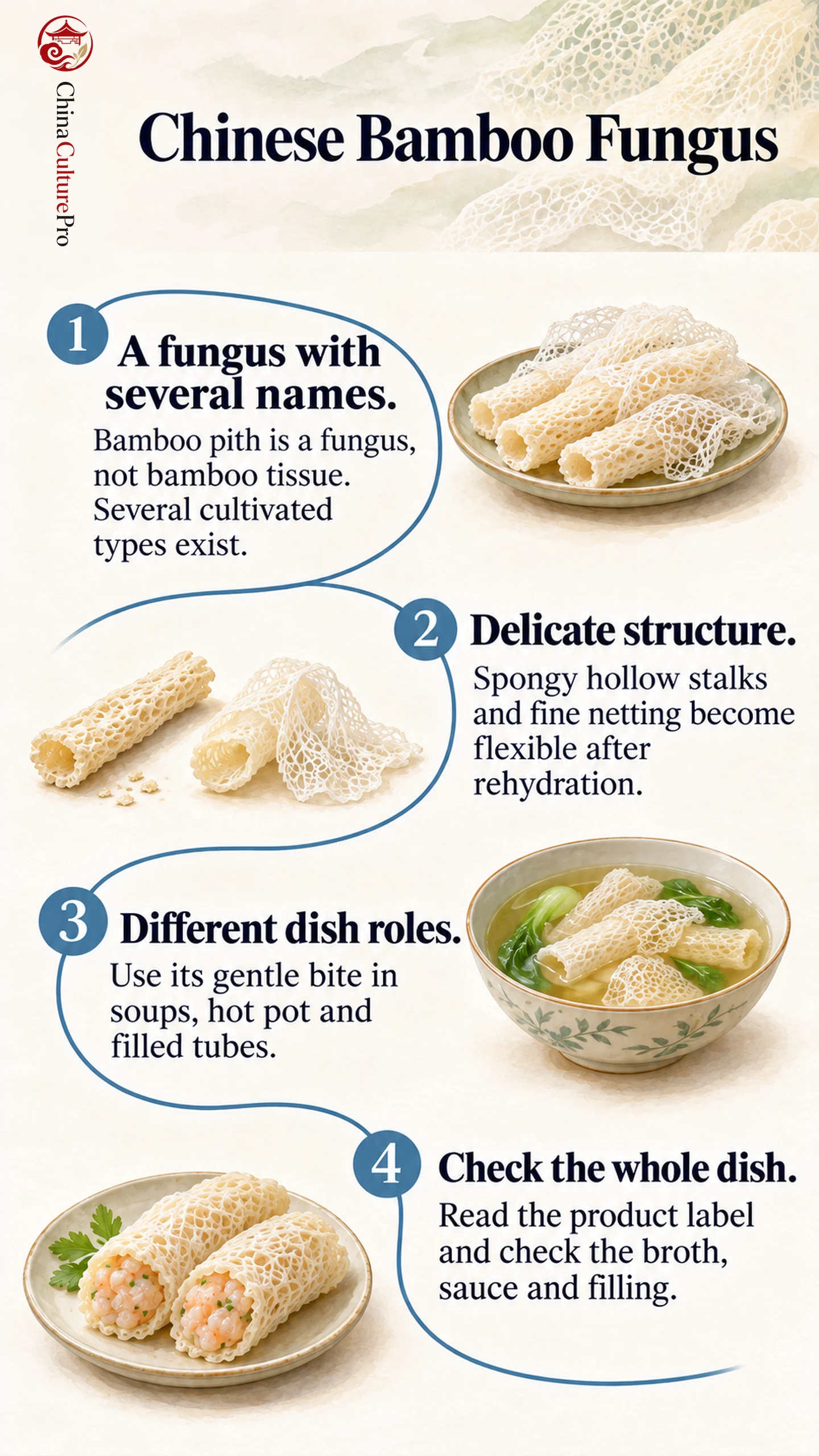
Chinese bamboo fungus (竹荪, zhúsūn) is an edible fungus, commonly sold dried with hollow, spongy stalks and delicate netting. English labels also say “bamboo pith” or “bamboo mushroom”; it is not bamboo tissue.[1][3]
- Flavor: Mild, allowing broth and other ingredients to remain prominent.
- Texture: Airy and delicate, with a slightly crisp bite.
- Uses: Soups, hot pot and stuffed dishes, as well as some mixed vegetable preparations.
Use labeled culinary products, rather than identifying wild mushrooms from appearance.
Those pale, lacy pieces in a soup bowl are valued as much for their bite as their flavor. To understand bamboo fungus, separate the cultivated ingredient from bamboo vegetables, then look at how drying, rehydration and the surrounding dish change what reaches the table.
A Fungus with Several Names and Cultivated Types
Zhusheng (竹笙, zhúshēng) is another Chinese name for the ingredient. A natural science museum identifies the long-skirt form as Phallus indusiatus. The broader market name, however, covers more than that one species.[1]
Chinese cultivation accounts distinguish several types. A Beijing agricultural project worked with the following three, showing that the everyday ingredient name is broader than a single variety.[2]
| Cultivated type | What the name distinguishes |
|---|---|
| Long-skirt bamboo fungus (长裙竹荪, chángqún zhúsūn) | A type named for its long, netlike skirt. |
| Short-skirt bamboo fungus (短裙竹荪, duǎnqún zhúsūn) | A separate cultivated type with a shorter skirt. |
| Red-volva bamboo fungus (红托竹荪, hóngtuō zhúsūn) | A type named for the reddish structure at its base. |
These are cultivated types, rather than retail grades of the same crop. Compare them with other Chinese culinary mushrooms. Products such as sour bamboo shoots are plant vegetables, a different ingredient category.
Dried Tubes, Lacy Skirts and a Delicate Bite
The hollow stalk has a spongy wall, while the attached skirt is a much finer mesh. Drying makes the ingredient light and brittle; rehydration makes it flexible. The stalk and skirt therefore give different impressions in the mouth even when served together.[3][4]
A firsthand cooking account describes mild sweetness and a smooth, silky texture with a little crunch. It is less strongly mushroom-flavored than fleshier varieties. The combination of tenderness and a slight crispness is a texture of the fungus itself, without frying.[5]
Its porous structure takes up broth, carrying the surrounding seasoning into each bite.[6]
Soups, Hot Pot and Stuffed Preparations
In Chinese soups, the pale pieces bring a light, textured contrast. Chicken broth is one familiar pairing; the stock supplies much of the richer flavor.[1][6]
It also appears among hot pot ingredients and in stir-fries. Mixed vegetable dishes can use it for a different bite among denser mushrooms or vegetables.[4][5]
The hollow tube can hold a filling. One version combines shrimp-filled tubes with asparagus and chicken stock; others use minced meat or fish paste. The filling changes the dish’s flavor without changing the wrapper ingredient.[6][7]
Buying, Rehydration and Ingredient Checks
Buy clearly labeled culinary products from a reliable supplier. Dried packets are familiar in Chinese groceries, but fresh fungus and immature, egg-shaped products also appear in cultivation supply. Their forms should not be treated as identical or given the same preparation directions.[2][4]
Follow the product’s cleaning and trimming instructions. Dried pieces need rehydration before cooking; the fine mesh needs gentler handling than the stalk.[3][5][6]
Keep dried fungus sealed, cool, dry and away from sunlight; refrigerate after soaking. Check additives too: packaged bamboo fungus can contain sulphites.[6][8]
For vegetarian food, check the broth, sauce and stuffing for stock, seafood or meat.[6][7]
FAQs About Chinese Bamboo Fungus
Is bamboo pith part of the bamboo plant?
No. Bamboo pith is an English market name for this fungus, not the plant’s inner tissue.
Is bamboo fungus the same as bamboo shoots?
No. Bamboo shoots are young plant shoots; bamboo fungus is a mushroom ingredient.
Does bamboo fungus taste strongly of mushrooms?
Usually its flavor is mild. Its airy, delicate bite is a major reason cooks use it.
Is a bamboo fungus dish always vegetarian?
No. Check the filling and broth; chicken stock, meat or seafood may be included.
Sumber
[1] National Museum of Natural Science, Taiwan. Long-Skirt Bamboo Fungus: Specimen and Food Identity
[2] Beijing Municipal Bureau of Agriculture and Rural Affairs. Bamboo Fungus Cultivation in Beijing
[3] South China Botanical Garden, Chinese Academy of Sciences. Long-Skirt Bamboo Fungus: Structure
[4] Jean, Wok and Kin. Bamboo Pith: Dried Form and Texture
[5] Cornell Mushroom Blog. An Unlikely Delicacy: The Basket Stinkhorn
[6] Cheng Tai Global. Bamboo Fungus: Culinary Forms and Storage
[7] DayDayCook. Stuffed Bamboo Fungus with Shrimps
[8] New Zealand Ministry for Primary Industries. Bamboo Fungus: Archived Product Recall Information