

Quick Answer: What Is Chaozhou Woodcarving?
Chaozhou woodcarving (潮州木雕, Cháozhōu mùdiāo) is a folk carving tradition from the Chaoshan (潮汕, Cháoshàn) region of eastern Guangdong. It decorates buildings, furniture and objects used in rituals. Carvers often work in camphor wood, creating deep scenes with openings between their layers. Many pieces also carry lacquer and gold leaf. [1][2][4][5]
- Carving: Figures, plants and animals can appear at several depths.
- Finish: Lacquer, paint and gold leaf change how the carved surface reads.
- Setting: Pieces include beam fittings, shrines and objects for use at ceremonies. [1][3][4]
A gilded carving can be part of a building or a freestanding object. Its original placement helps explain why it was shaped that way. [3][4][6]
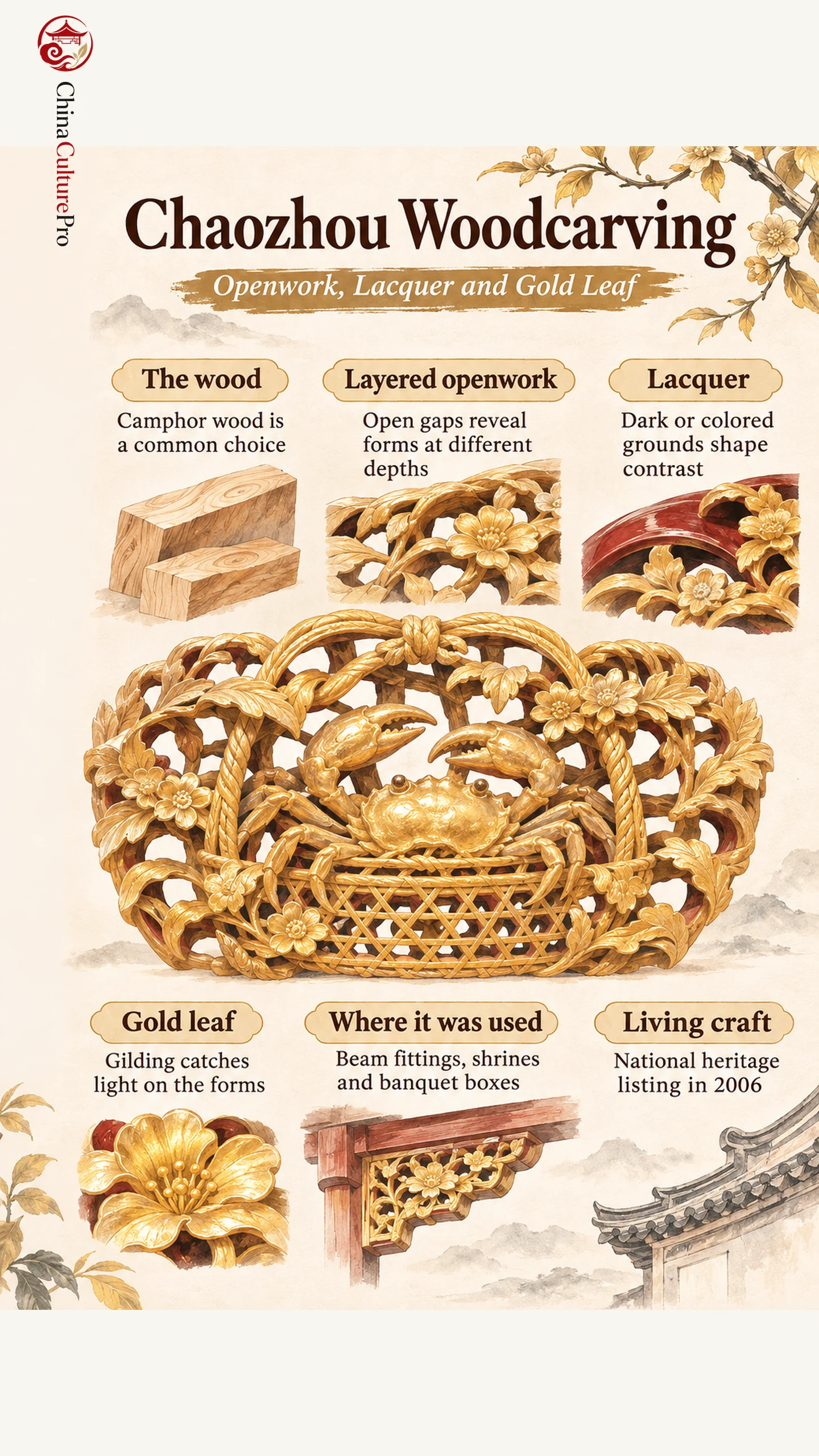
In a carved crab basket, the strips that look like woven bamboo can be part of the same piece of wood as the animals climbing over them. The effect depends on what the carver leaves in place as much as on what is removed.
Why Camphor Wood and Openwork Go Together
Camphor wood is a common material in heritage descriptions of the craft. The heritage demonstration describes wood with enough toughness for fine carved work. In openwork a narrow stem or strip of basket weave may remain between much larger openings. A raised design in relief keeps a backing surface. Layered openwork (多层镂通, duōcéng lòutōng) creates openings through parts of the composition so that elements at different depths remain visible. [1][2][3]
A branch, leaf or figure can sit partly in front of another element. The gaps make the overlap clearer and bring shadow into the design. Chaozhou workshops also used techniques such as carving in the round and incised carving. Choosing among these methods changes how much wood remains visible behind a design. That choice also helps distinguish architectural pieces from freestanding sculpture within Chinese woodcarving. [1][2][3]
How Lacquer and Gold Leaf Change the Surface
Gilt wood gets its appearance from applied materials. The carving makes the forms, lacquer coats the surface, and gold leaf highlights selected areas or large sections. The national heritage register describes gold used with black lacquer and gold combined with multicolored surfaces. Against a dark lacquer ground, a gilded edge can mark a figure’s outline. On a colored ground, paint and gold can differentiate the details of the scene. [1][2][5]
The register also describes work that keeps the natural color of the wood. Guangdong Museum has exhibited a polychrome corbel with a scene from The Tale of the Lychee Mirror, alongside gilded beam fittings and objects. That corbel uses color as part of a narrative scene, while gilded objects in the same exhibition use gold to draw attention to the carved forms. The finish also connects the craft with traditions of Chinese lacquerware. [1][4][6]
What Two Guangdong Museum Pieces Reveal
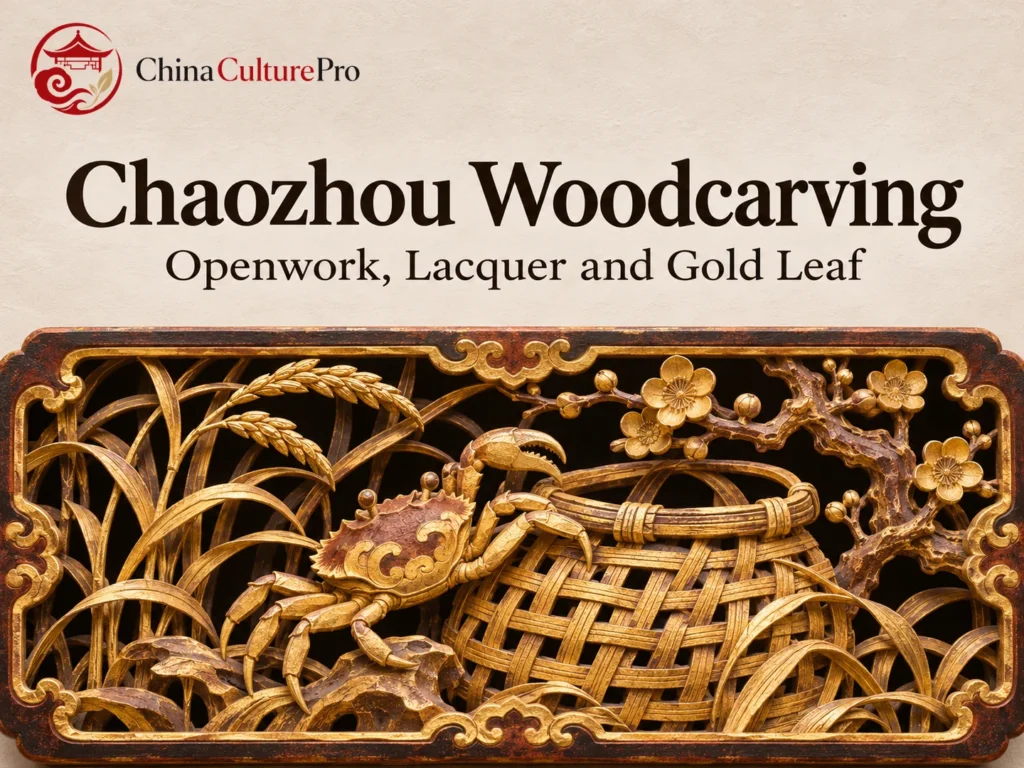
A gilded beam bracket in Guangdong Museum, dated to the Republican period, features a crab basket that resembles woven bamboo. Five crabs move across the rim, sides and bottom, and plum branches curve around the top. The museum reads the aquatic subject in relation to hopes for a plentiful catch. The holes around the rim help separate the outline of a crab from the pattern of the basket beneath it. [3]
A Qing beam-frame fitting in the same collection is about six centimeters thick. Fish and water plants occupy different depths, and the museum identifies a lobster on a bending reed as the focus. The whole scene fits into a piece about 47 centimeters wide. The museum distinguishes carved fittings from the main load-bearing beams and columns, whose surfaces could instead be decorated with gold lacquer painting. That difference helps explain why a small fitted panel can show so much open space. [3]
Where the Craft Lives Beyond the Museum
Chaozhou carvings furnished shrines, decorated architectural interiors and appeared on objects such as banquet boxes. The heritage register identifies gilded and carved architectural decorations in Chaozhou’s Jilüe Huang Ancestral Hall. In Chinese ancestral halls, the placement of carved parts establishes how viewers would see them, often set into an interior or above eye level. In a museum catalog, the architectural name preserves part of that original relationship. [1][4][5][6]
Chaozhou woodcarving entered China’s national intangible cultural heritage register in 2006. The register records that Gu Liuxi (辜柳希, Gū Liǔxī) began as an apprentice to Chen Chunyan. Gu became known for openwork crab and lobster baskets and went on to teach in vocational settings. In the older beam bracket, the basket is fitted to a building. In Gu’s independent work, the basket can be the entire sculpture, with the viewer free to look around it. [1][5][7]
FAQs About Chaozhou Woodcarving
Is every Chaozhou woodcarving gilded?
Finishes vary. The heritage register describes gold leaf used with dark lacquer or color, and it also identifies carvings that retain the natural color of the wood. [1][2][6]
Does Chaozhou woodcarving come only from Chaozhou city?
The historic tradition extends across eastern Guangdong, including places in present-day Chaozhou, Shantou and Jieyang. The name reflects a regional craft associated with the former Chaozhou prefecture. [1][4]
Why do some Chaozhou woodcarvings show crab baskets?
Crabs and baskets offered a way to represent local aquatic life and hopes for abundance. The holes in a basket also suit a carving technique that makes space part of the design. [3][6][7]
Sumber
[1] Museum Digital Warisan Budaya Takbenda Tiongkok. Chaozhou Woodcarving: Chaozhou Project
[2] China Intangible Cultural Heritage Digital Museum. Skills of Representative Heritage Practitioners
[3] Guangdong Museum. Chaozhou Woodcarving Exhibition: Selected Objects
[4] Guangdong Museum. Beauty of Gilt Wood: The Art of Chaozhou Woodcarving
[5] National Museum of China. Carving and Painting: Chaozhou Woodcarving Exhibition
[6] Guangdong Museum. Gilded Glory: Chaozhou Woodcarving
[7] China Intangible Cultural Heritage Digital Museum. Representative Practitioner: Gu Liuxi