


Quick Answer: What Do Mushrooms and Ruyi Heads Mean?
In Chinese art, lingzhi (灵芝, língzhī) is a fungus associated with longevity and, in imagery about immortals, the idea of immortality. A ruyi (如意, rúyì) is a scepter whose name means “as you wish.” Its head can resemble a mushroom cap or a rounded cloud.[1][2][4][6]
- A mushroom with a stem: Look for a cap growing from a stalk, sometimes with smaller caps beside it.[2][3]
- A head on a handle: A broad terminal at the end of a long shaft identifies the complete scepter form.[1][3]
- A head without a handle: The outline may be repeated as a pattern on porcelain or extended into the lobes of an embroidered collar.[4][5]
One object can carry both good wishes, and its shape alone may leave room for more than one reading.[2][4]
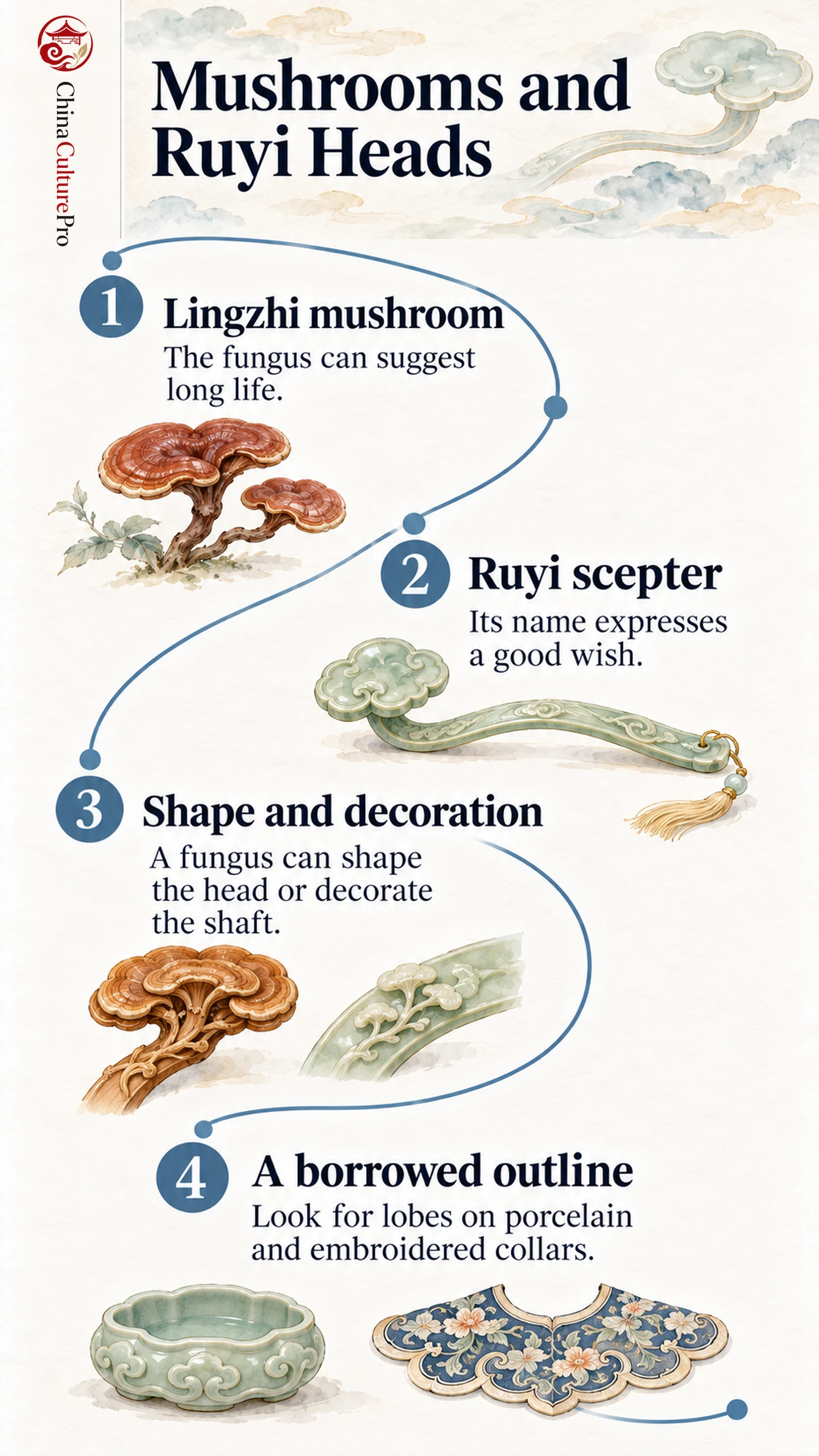
A rounded cap can look strikingly different depending on where it sits. On a carved stem it can read as a fungus. On a vessel, the same curve may be the edge of a cloud. Look at the outline and what it belongs to before assigning a meaning.[2][4]
The Mushroom, the Scepter and Its Head
A recognizable lingzhi motif may show a rounded or fan-shaped cap on an irregular stem. Smaller forms clustered along the stem can reinforce the reading. In a courtly or domestic setting the motif may express a wish for long life. A scene concerning immortals can give the fungus a different narrative role.[2][3][6]
The ruyi scepter is a shaped object. A seventeenth- or eighteenth-century boxwood example is about 27 centimeters long. Scepters of this kind were given as gifts and could be displayed on stands or upright among other objects. The relationship between the head and the length of the shaft helps distinguish a whole scepter from an ornament that borrows its end shape.[1]
In Chinese auspicious imagery, separate features on one object can express different wishes. The word ruyi gives the scepter its wish for things to go as desired. A fungus form can add the longevity association. A fungus painted on porcelain or carved along a shaft can carry its association independently of the head shape.[1][2][4]
Two Qing Scepters With Different Shapes
An eighteenth-century boxwood scepter is 38.1 centimeters long. Its narrow, uneven stem branches into small fungus-like growths, and its upper end opens into a broad cap with carved surface details. A side view gives the design much of its effect. It shows how the irregular stem thickens into a cap, as if the whole handle and head grew together. The fungus is the organizing form of the carving.[2]
On an eighteenth-century nephrite example, the carved pattern works in another way. The shaft curves toward a turned-over head, and a lingzhi spray lies in relief along the shaft. A bat appears on the broad head. The fungus is one of the smaller images within the scepter design. Follow the relief spray along the shaft and then look at the bat on the terminal. Their positions tell you which motif you are describing.[3]
A later Qing scepter with a nephrite body makes the overlap especially clear. Its cloudlike terminal also resembles lingzhi. The shape accommodates both readings, while the shaft still tells the viewer what kind of object it is. Such pieces explain why catalogues sometimes use “fungus-shaped” and “cloud-shaped” for very similar contours.[6]
From a Scepter Head to Porcelain and Dress
A celadon brush washer from the Kangxi reign, 1662–1722, shows what happens when the shape leaves the shaft. The rounded forms are impressed in relief on the porcelain. On this piece they are interpreted as auspicious clouds (祥云, xiángyún) with the outline of a ruyi head and the fungus of immortality. The combination expresses a wish for good things to come about. A small vessel can carry the association without depicting anyone holding a scepter.[4]
An embroidered cloud collar adapts the profile to a different surface. The collar sits across the shoulders, where the lobes can spread around the neck opening. An embroidered collar style popular in the nineteenth and twentieth centuries borrowed the profile of the scepter’s head. When a collar is laid flat, the rounded forms define its outer edge. On the brush washer, similar forms are a relief pattern within the surface instead.[4][5]
For a pattern with uncertain identification, the material, position and company the motif keeps are worth checking. A cap paired with smaller growths supports a fungus reading. A scalloped form repeated in a band or arranged around a neckline may work first as an ornamental outline. An inscription or a documented matching object can make the intended wish more specific.[2][4][5]
FAQs About Auspicious Mushrooms and Ruyi Heads
Is every cloud-shaped form a ruyi head?
Clouds can have their own role in a design. A repeated lobed outline may resemble a ruyi head, but the decoration and the object it appears on help establish the connection.[4][5]
Can the same object express longevity and wish fulfillment?
Yes. A fungus-shaped ruyi can combine the longevity association of lingzhi with the wish conveyed by the name of the scepter.[1][2]
Sumber
[1] The Metropolitan Museum of Art. Ruyi Scepter in the Shape of a Fungus of Longevity
[2] Cleveland Museum of Art. Scepter in the Shape of a Ruyi Fungus
[3] Royal Collection Trust. Ruyi Sceptre, RCIN 23692
[4] Asian Art Museum. Kangxi Brush Washer, B60P2294
[5] Asian Art Museum. Embroidered Cloud Collar
[6] The Walters Art Museum. Ruyi Scepter with Motifs of Longevity