

Quick Answer: What Is the Amitabha Sutra?
The Amitabha Sutra (佛说阿弥陀经, Fóshuō Āmítuó Jīng), or Shorter Sukhavativyuha Sutra, describes the western realm of Amitabha Buddha and how followers might aspire to rebirth there.[1]
- Two Chinese versions: The early fifth-century translation attributed to Kumarajiva (鸠摩罗什, Jiūmóluóshí) is T0366. The Tang translation by Xuanzang (玄奘, Xuánzàng) is T0367.[2]
- Core sequence: Shakyamuni describes the realm, explains holding the Buddha’s name in mind and invokes testimony from other Buddhas.
- Related texts: The Larger Sutra narrates the vows of Dharmakara, the future Amitabha. The Contemplation Sutra gives visualization teachings in a different narrative setting.[3]
This guide follows the shorter sutra and compares its passages with a single, documented Chinese mural.

The sound of birds and wind is one way into this short scripture. To a reader encountering jeweled trees and vast lotus flowers for the first time, the setting can seem like an inventory of marvels. Read a little further and the text explains what listening there is supposed to do.
Two Chinese Translations of the Shorter Sutra
The Taisho numbers T0366 and T0367 are catalogue identifiers, useful even when websites or publishers use different English titles. The standard catalogue dates Kumarajiva’s translation to 402 and Xuanzang’s to 650.[2]
One difference is easy to check toward the end. Kumarajiva groups the Buddhas who endorse the teaching by six directions, including above and below. Xuanzang’s version also describes the intervening directions. This is a way to distinguish the two versions when an excerpt includes this passage.[1]
How the Text Moves From Description to Practice
The Realm and Its Sounds
Shakyamuni addresses his disciple Shariputra and describes Sukhavati (极乐世界, Jílè Shìjiè), the western land of Amitabha Buddha. Lotus blossoms and jeweled pools give it a visible form. Birds and wind through the trees make sounds that prompt recollection of the Buddha, the teaching and the community. In the text, the landscape itself reminds its inhabitants of Buddhist practice.[1]
Holding the Name and Aspiring to Rebirth
The passage on holding the name connects hearing and retaining the Buddha’s name with sustained attention and the aspiration to rebirth. Kumarajiva’s text refers to a span of one through seven days. In Chinese Pure Land Buddhism, this passage helps explain nianfo (念佛, niànfó), a practice of recollection that often takes the form of repeating the name aloud.[1][4]
How Cave 220 Gives the Pure Land a Shape
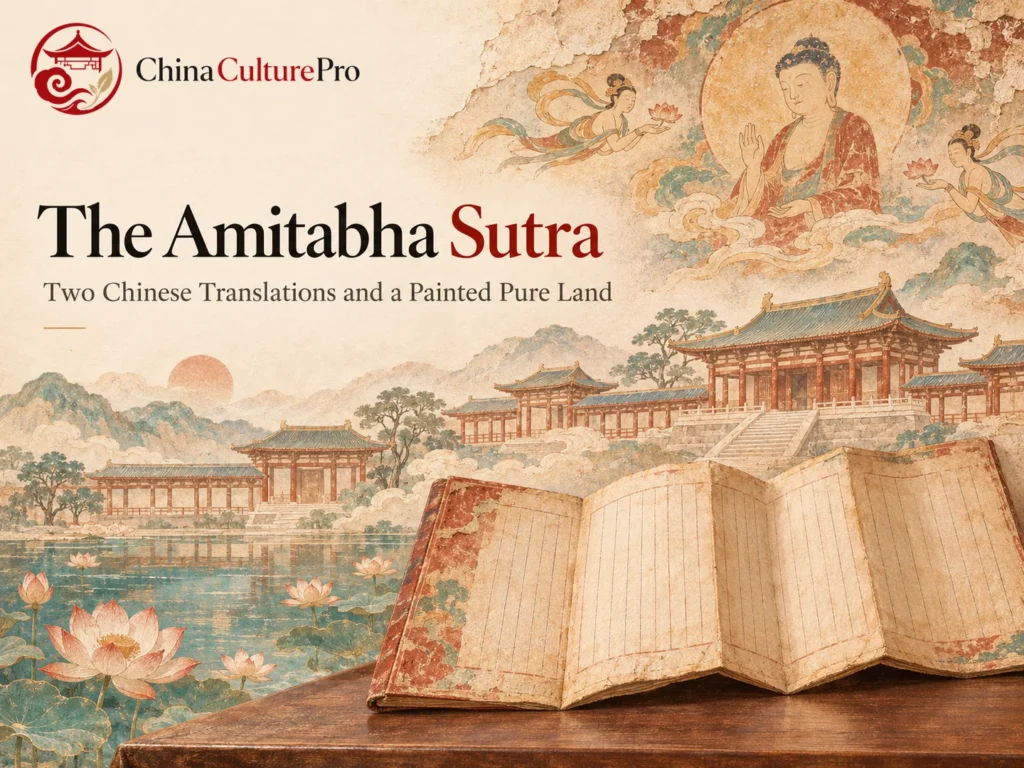
At Dunhuang, the Mogao Grottoes’ Cave 220 contains an early Tang painting on the south wall of its main chamber. The Dunhuang Academy identifies the scene with the Amitabha Sutra and describes an upper paradise, a central zone of water and ground below. Read the pools as part of the mural’s composition, then return to the sutra to see what the painting cannot literally reproduce: the birdsong and wind that prompt recollection. Explore other Dunhuang murals for more examples of scriptures rendered in paint.[5]
FAQs About the Amitabha Sutra
Is the shorter sutra an abridgment of the Larger Sutra?
The shorter and larger texts are transmitted as distinct scriptures. The larger one includes Dharmakara’s vows. The shorter one opens with Shakyamuni teaching Shariputra and moves from describing the western realm to holding the Buddha’s name in mind.
Why might an English edition say Amitayus?
Amitayus is another name associated with the Buddha of this Pure Land. BDK’s English edition calls the short text The Smaller Sutra on Amitayus.
Where can I compare the Chinese translations?
Look for T0366 and T0367 in a Chinese Buddhist canon. Dharma Drum Institute’s parallel edition displays both alongside translations.
Sumber
[1] Dharma Drum Institute of Liberal Arts. Amitabha Sutra, parallel Chinese versions and translations
[2] Lewis R. Lancaster and Sung-bae Park. The Korean Buddhist Canon, descriptive catalogue, entries K 192 and K 193
[3] BDK America. The Three Pure Land Sutras
[4] Jakub Zamorski. Practice and Understanding in Modern Chinese Pure Land Buddhism
[5] Dunhuang Academy. Digital Dunhuang, Mogao Grottoes Cave 220