

Quick Answer: Who Was Zhang Xuan?
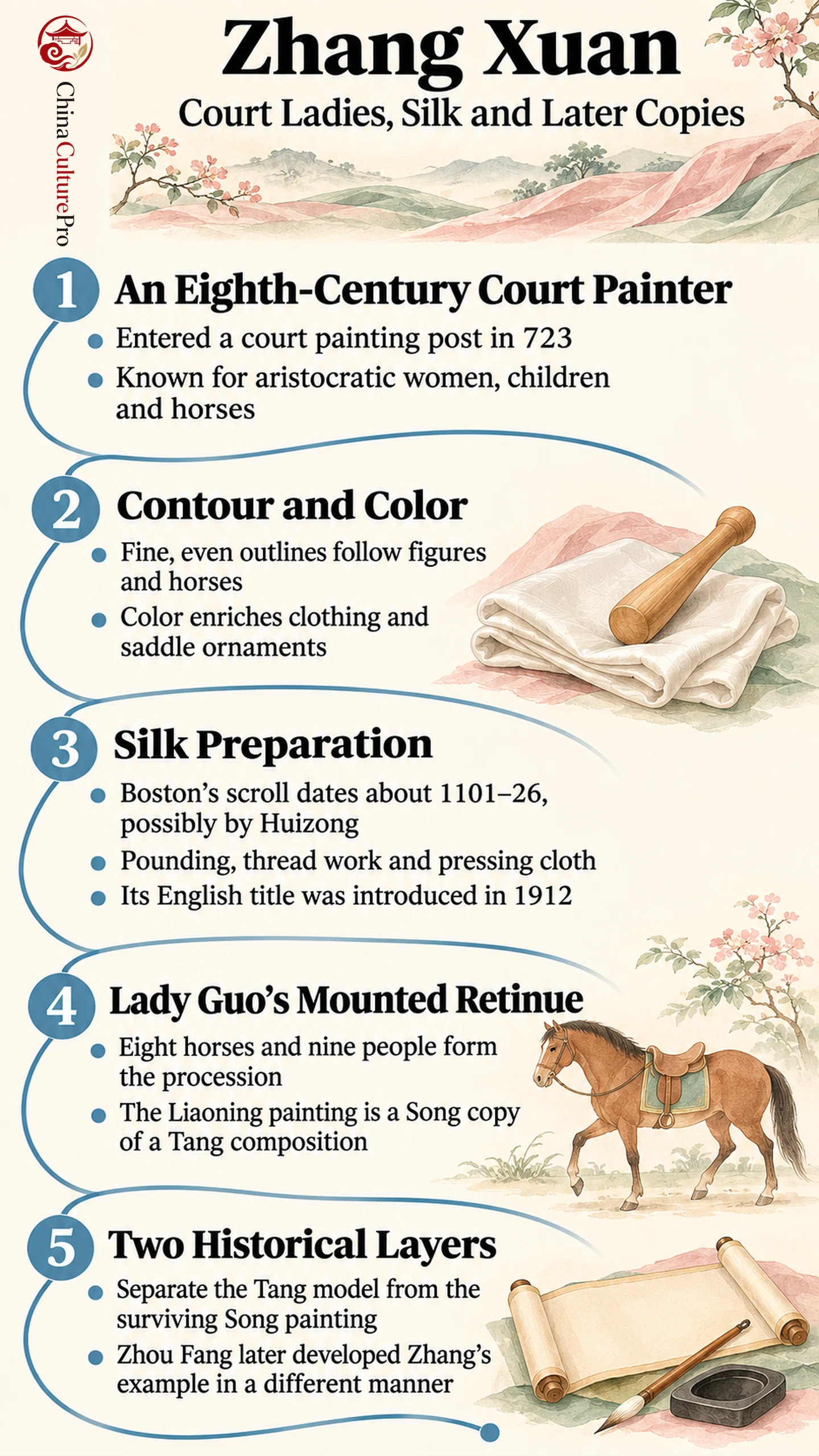
Zhang Xuan (张萱, Zhāng Xuān) was an eighth-century Tang painter known for aristocratic women, children and horses. His two best-known compositions survive through Song copies. [1]
- Figures: Gesture, dress and grouping organize the action.
- Technique: Controlled outlines work with carefully chosen color.
- Transmission: The Tang composition and a surviving Song painting belong to different historical moments.
Attributions to Emperor Huizong should retain the qualification used for the particular surviving work.
A raised pestle and a turning horse create very different movements. Zhang’s reputation encompasses both shared work and elegant leisure, with the arrangement of figures carrying much of each composition’s interest.
An Eighth-Century Painter of Women and Horses
From Jingzhao, present-day Xi’an, Zhang entered a court painting post in 723. His birth and death dates are unknown. Court-lady painting (仕女画, shìnǚhuà) was one of his specialties, alongside children and horses. [1]
His iron-wire drawing (铁线描, tiěxiànmiáo) uses fine, even contours that follow bodies, clothing and horse forms. Color enriches garments and saddle ornaments. [1]
Within Chinese figure painting, the outline can convey more than a boundary. Follow a sleeve from shoulder to wrist: its turns can suggest a bent arm, while a broad area of cloth holds the figure together. A guide to painting techniques helps distinguish that work of the line from the effect of color.
Silk Preparation: Gesture, Fabric and Shared Activity
Court Ladies Preparing Newly Woven Silk (捣练图, Dǎoliàn tú), in Boston, is a handscroll in ink, color and gold on silk, dated about 1101–26 and possibly by Emperor Huizong. [2][4]
The composition arranges twelve figures into activity groups involving pounding, thread work and smoothing or pressing silk. [6]
Trace how an action connects people: a length of cloth requires coordinated handling, whereas a raised tool creates a pause before its downward motion. Bent bodies, hands and flowing sleeves give the work its visual tempo. Look at the intervals between the groups as well as the activity within them.
These scenes offer a point of entry into silk history. They represent work on cloth and thread, rather than a complete diagram of every stage from raising silkworms to weaving fabric.
The familiar English title was introduced when the scroll entered the MFA in 1912; its Chinese title refers to pounding silk. The title itself is therefore part of the work’s history of interpretation. [3]
Lady Guo’s Outing: Rhythm in a Mounted Retinue
Lady Guo and Her Retinue on a Spring Outing (虢国夫人游春图, Guóguó fūrén yóuchūn tú) is preserved in Liaoning as a Song copy of Zhang’s composition. [1]
The mounted procession includes eight horses and nine people. [6] Changing distances between the riders can make the group seem to open out, gather together and move onward. Notice how a horse’s head or a rider’s turned upper body creates a small variation within the shared direction of travel.
Clothing and the organization of attendants contribute to the presentation of elite status. [5] For clothing history, the useful questions include how robes sit on a mounted body and how color separates neighboring figures.
Compare this movement with the silk scene. One composition builds relationships around a task; the other coordinates people and animals within an outing. Both reward attention to the shape of a group rather than only to isolated faces.
A Tang Style Seen Through Song Copies
The Song paintings preserve compositions connected to an earlier Tang artist. A catalogue or label should distinguish the historical model, the surviving painting and any attribution of the copyist.
Read later inscriptions and seals as part of that history, noting which name belongs to the model and which to the copyist. [4]
The later painter Zhou Fang also worked from Zhang’s example before developing a different manner. [6] Their profiles provide a route through changing approaches to women in painting.
Such pictures belong within women’s cultural history, while also reflecting artists’ choices and patrons’ interests. A refined painted scene selects and organizes its subjects; it does not represent the full range of women’s lives. [3]
FAQs About Zhang Xuan
Are the Boston and Liaoning paintings Tang originals?
They are later Song paintings preserving compositions associated with Zhang Xuan. Boston’s attribution to Emperor Huizong remains qualified. [1][2][4]
Does the Boston painting show silk being woven?
Its principal activities concern pounding, working with thread and pressing cloth. It is not a scene of women operating a weaving loom. [6]
Can these paintings be used to study Tang clothing?
Yes, with attention to their history. The surviving works are Song copies, and their dress imagery reflects artistic and patron choices. Compare them with other visual and material evidence. [1][3]
Sources
[1] Palace Museum, Beijing. Zhang Xuan
[2] Victoria and Albert Museum. Masterpieces of Chinese Painting: Image Bank, Court Ladies Preparing Newly Woven Silk
[3] Museum of Fine Arts, Boston. Court Ladies or Pin-Up Girls?
[4] University of Chicago, East Asian Scroll Paintings. Court Ladies Preparing Newly Woven Silk
[5] Liaoning Provincial Museum, via the Chinese Museums Association. Chinese Horse Painting Exhibition: Lady Guo’s Outing
[6] Tsinghua University Art Library. Court-Lady Painting Handscroll Exhibition