

Quick Answer: Who Was Han Huang?
Han Huang (韩滉, Hán Huàng; 723–787) was a Tang official and painter associated with rural subjects and animals. His celebrated surviving work, Five Oxen (五牛图, Wǔniú Tú), gives five cattle distinct bodies, poses and expressions.[2][3]
- Period: His career belongs to the Tang dynasty (唐朝, Tángcháo).
- Work: Five Oxen is an ink-and-color handscroll on paper.
- Importance: Ordinary livestock receive sustained attention as individual subjects.[1][2][3]
The scroll’s later inscriptions and conservation history are different from the evidence for its original making.
Five animals stand across a long sheet, yet each seems to have its own temperament. Han Huang’s Five Oxen rewards looking at small differences in stance, gaze and outline, while its later history shows how a painting can gather meanings beyond its original setting.
An Official Who Also Painted
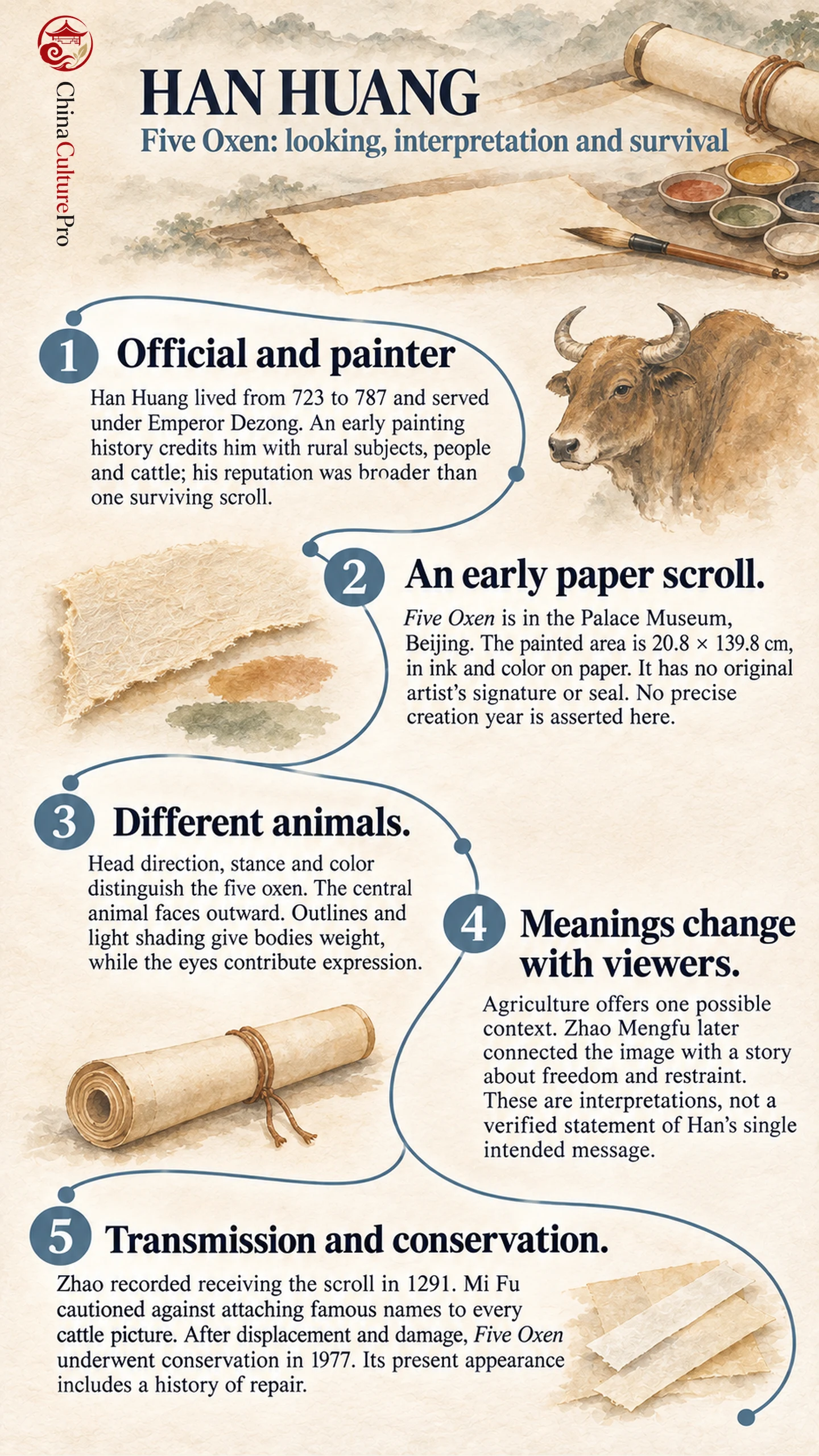
Han came from Chang’an (长安, Cháng’ān), in present-day Xi’an. His high administrative career included service under Emperor Dezong (唐德宗, Táng Dézōng). The Tang-period text Tangchao Minghua Lu (唐朝名画录, Tángcháo Mínghuà Lù) describes a senior official who continued to paint amid demanding public responsibilities.[1][3]
That account praises rural customs, people and cattle among his subjects. His reputation consequently extends into figure painting (人物画, rénwùhuà) as well as livestock, even though Five Oxen dominates discussion today. Early praise establishes a remembered artistic range; it does not identify additional securely surviving originals.[3]
Five Oxen: The Surviving Scroll
| Caractéristique | Recorded detail |
|---|---|
| Collection | Palace Museum, Beijing |
| Support and medium | Paper; ink and color |
| Painted area | 20.8 × 139.8 cm |
| Artist’s signature | No original signature or seal |
The museum assigns the work to Han Huang and the Tang period. It is an exceptionally early surviving painted scroll in the history of paper; its precise creation year is not established.[1]
How Five Animals Become Individuals
The oxen do not repeat one profile. Some move or turn their heads; the central animal faces outward toward the viewer. Changes in body color, neck angle and stance produce a sequence of encounters rather than a uniform row.[2]
Strong outlines articulate the skeleton and the surrounding flesh. Light colors and varied shading give weight to the bodies, while carefully attended eyes animate them. These methods of modeling combine a sturdy overall form with small expressive details.[2]
The largely open setting concentrates attention on the animals. Looking from head to body to feet reveals how a change in posture alters the apparent character of each ox.[2]
Agriculture and Later Interpretations
Cattle’s role in farming makes agricultural associations plausible. This offers a context for interpreting the painting, without establishing Han’s personal purpose.[2]
Painting colophons (题跋, tíbá) are written responses attached to an image or its scroll mounting. In one, Zhao Mengfu (赵孟頫, Zhào Mèngfǔ) recalled a story contrasting a restrained ox with one roaming freely, and associated the painting with that idea. This records a collector’s reading of freedom and service, rather than proving one fixed message for all five animals.[4]
Collecting, Restoration and Artistic Legacy
Collected colophons record Zhao receiving the scroll in 1291. Such inscriptions and seals make later ownership and appreciation part of the evidence available to viewers.[4]
The critic Mi Fu (米芾, Mǐ Fú) warned against assigning every cattle picture to a famous specialist. Later records also link Dai Song (戴嵩, Dài Sōng) with Han’s cattle-painting tradition. Together, these accounts reveal both artistic influence and the difficulty of attaching old names to surviving pictures.[4]
After leaving the imperial collection in 1900, the scroll was recovered in the twentieth century. In 1977, conservator Sun Chengzhi (孙承枝, Sūn Chéngzhī), at the Palace Museum’s workshop, treated its damaged paper through cleaning, repair and remounting.[5]
FAQs About Han Huang
Are Han Huang and Han Gan the same painter?
No. Han Gan (韩幹, Hán Gàn) is the Tang horse painter; Han Huang is associated especially with cattle.[3]
Is Five Oxen painted on silk?
No. The Palace Museum records ink and color on paper.[1]
Did Han Huang sign the surviving scroll?
No. The museum records no original artist’s signature or seal.[1]
Are the five oxen all shown in the same pose?
No. Their differing stances, head directions and expressions are central to the composition.[2]
Sources
[1] The Palace Museum, Nie Hui. Han Huang: Five Oxen
[2] Shanghai Municipal Government, cultural feature. Five Oxen: an enduring painting
[3] Zhu Jingxuan, Tangchao Minghua Lu. Han Huang: early account
[4] Shuhua Huikao, volume 39. Han Huang: collected painting records and colophons
[5] The Palace Museum, Nie Hui. Five Oxen: transmission and conservation