


Quick Answer: What Is Yellow Mud Street About?
Yellow Mud Street (黄泥街, Huángní Jiē) is an early novella by Can Xue (残雪, Cán Xuě). The residents of a decaying street struggle to explain a strange presence associated with Wang Ziguang (王子光, Wáng Zǐguāng). Their guesses accumulate around the declining S Machinery Factory (S机械厂, S Jīxièchǎng), whose reputation survives its physical decline.[1][2]
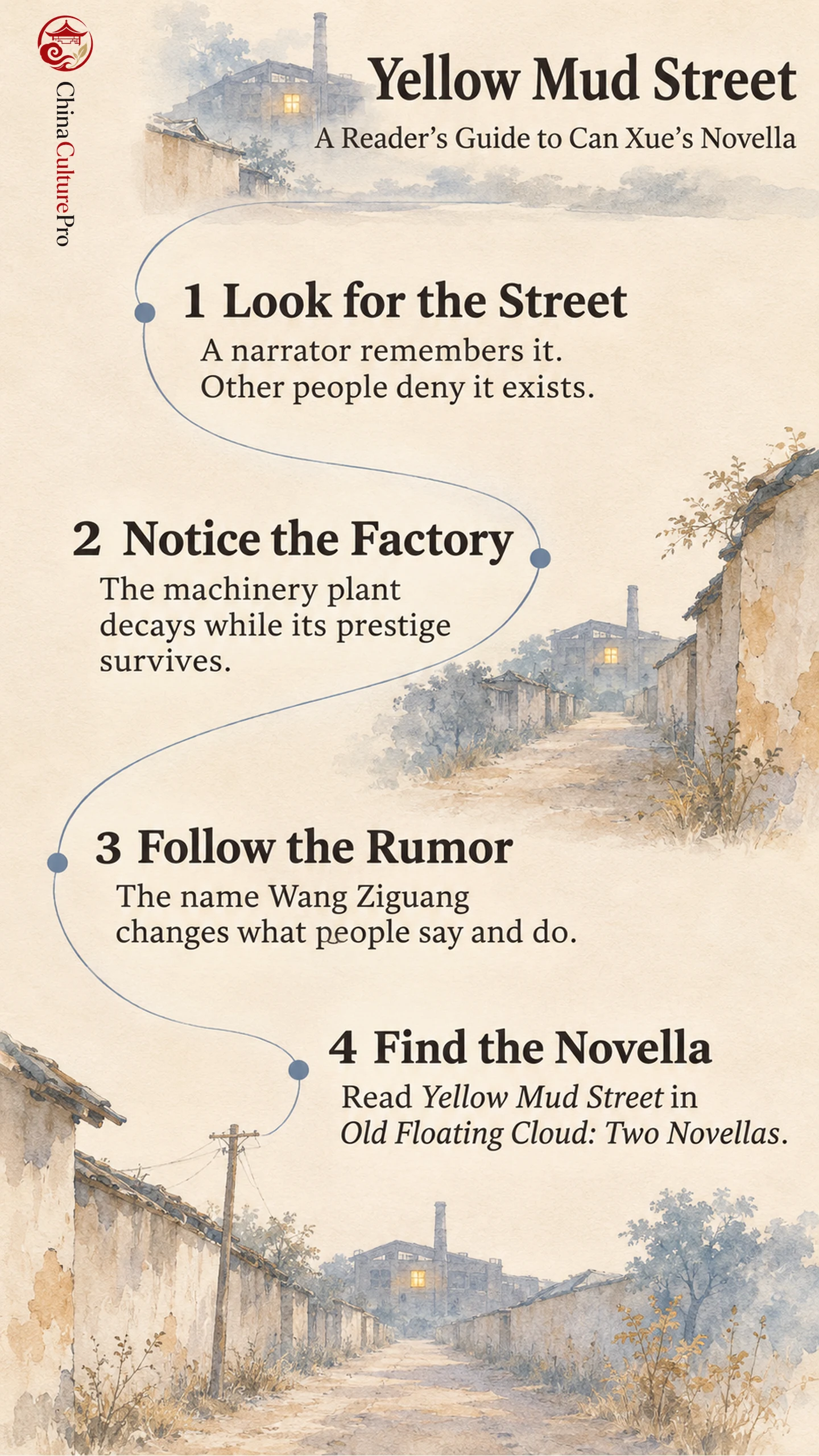
- Opening: A narrator remembers the street and goes looking for it after others deny that it exists.[3]
- Chinese publication: The novella appeared in the literary magazine Zhongguo in November 1986.[4]
- English edition: Find it in Old Floating Cloud: Two Novellas, translated by Jian Zhang and Ronald R. Janssen. The companion novella is Old Floating Cloud (苍老的浮云, Cānglǎo de Fúyún).[5]
Start with what people see, remember and repeat. Those details are the most useful bearings in a story that keeps changing the ground under its readers.
A place name usually helps a narrator establish where a story begins. Here it gives the narrator something to argue with other people about. The title names a street, and the first pages make a reader work out how anyone could be sure it is there.
How Can Xue Introduces a Street No One Can Confirm
The narrator remembers a street near the city, but other people say it does not exist. Searching through yellow dust, the narrator asks passersby for directions and meets only stares. Ruined buildings and falling ash eventually seem to offer something more solid than an answer, even as the scene slides into a dream.[3]
Can Xue makes the physical details unusually hard to ignore. You can imagine the dust in the narrator’s eyes before you know whether this is the same street they remember. Notice how quickly the questions change. At first you want to know whether the narrator has arrived. Soon you have to ask what would count as evidence of arrival.
Try a short first pass through the opening. On a second pass, mark one detail the narrator remembers, one thing seen on the walk and one thing other people say. As you compare the three, look for a detail that the narrator takes as familiar but no one confirms.
Why the Factory and Wang Ziguang Belong Together
The S Machinery Factory once operated day and night. It now shows signs of decay, yet people continue to speak of it as a source of prestige and a link to official power. When an uncertain presence becomes the object of speculation, the responses include superstition, political language and official inquiry.[1]
The factory offers a way to read the rumors. Its condition and its standing in people’s speech have come apart. Something similar happens with Wang Ziguang. People can attach consequences to a name long before they agree on who or what the name refers to. Compare Chen Qiufan’s Waste Tide, where the workings of the recycling industry matter as much as the story its investors tell about it.
Can Xue described Wang as a character without a body and treated the light suggested by his name as central to her writing of the story.[2]
That account gives you a way to read the gap between a missing body and an active presence. Wang matters because he changes what people say and do. A settled description of his appearance would change the part those competing accounts play.
What the Novella Draws From Chinese History
The novella can be read alongside memories of the Cultural Revolution. One line of scholarship relates the story’s fearful atmosphere and enclosed spaces to images that recur in Can Xue’s fiction and accounts of her childhood.[8]
That context helps explain why a slogan or an investigation can change the atmosphere of a conversation. Keep it beside the details of a scene. The worn factory, the dream and the competing descriptions of Wang still ask different things of a reader than a historical record would.
Can Xue named Lu Xun and Xiao Hong when recalling her early ambitions. She also described her revisions moving this first work further from the kind of realism with which she had begun.[2]
For another approach to distortion in modern Chinese literature, try Mo Yan’s The Republic of Wine and compare what happens when an inquiry encounters contradictory accounts. The Seventh Day gives its narrator an afterlife from which to observe social divisions, another way to set recognizable problems in an unfamiliar world.
Where to Find Yellow Mud Street in Translation
Look for Old Floating Cloud: Two Novellas in a library catalog. Northwestern University Press’s cloth edition is listed for 1991, and the paperback is dated May 1992 with ISBN 9780810109889. The volume title also names the other novella, so check the contents for Yellow Mud Street.[1][5]
For the Chinese text, search for 黄泥街 with 残雪. The People’s Literature Publishing House collection with ISBN 9787020188833 includes the novella’s sections on the street and its factory, the arrival of Wang Ziguang, the heavy rain and the demolition.[7]
Five Spice Street (五香街, Wǔxiāng Jiē) is a separate novel by Can Xue about the residents of a street speculating over a woman known as Madam X. It is a useful next book if the shifting group voice in Yellow Mud Street is what you want to follow.[6]
FAQs About Yellow Mud Street
Is Yellow Mud Street the same as Five Spice Street?
They are separate works. Yellow Mud Street follows the talk around Wang Ziguang and a declining factory. Five Spice Street centers on a neighborhood’s speculation about Madam X.[1][6]
Who translated Yellow Mud Street into English?
Jian Zhang and Ronald R. Janssen translated the novella in Old Floating Cloud: Two Novellas.[5]
Does Wang Ziguang have a physical body?
Can Xue described him as a figure without a body. Readers can follow the consequences of his presence through the stories that circulate around him.[2]
Sources
[1] Northwestern University Press. Old Floating Cloud, Paperback
[2] Can Xue, MIT Chinese Culture and Writing. Can Xue Interview
[3] Can Xue. Yellow Mud Street, Chinese Opening
[4] New Hunan. Can Xue’s Literary Career and Yellow Mud Street
[5] BiblioVault. Old Floating Cloud: Two Novellas
[6] Yale University Press. Five Spice Street
[7] People’s Literature Publishing House. Yellow Mud Street, Chinese Collection Contents
[8] Song Shifeng, Journal of Chinese Language and Literature. The Cultural Revolution in Can Xue’s Fiction