


Quick Answer: What Is White Deer Plain About?
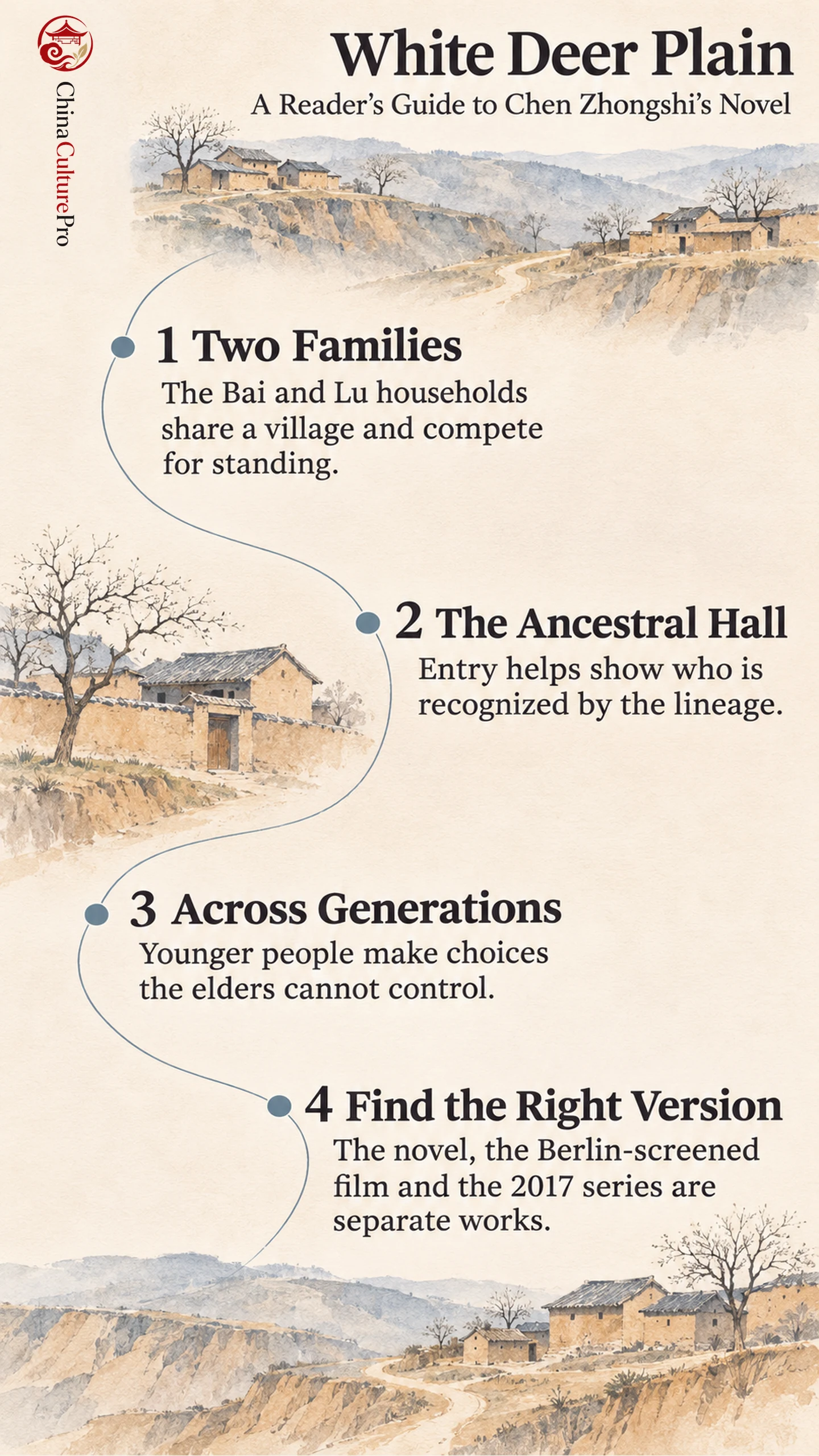
White Deer Plain (白鹿原, Báilù Yuán) is a novel by Chen Zhongshi (陈忠实, Chén Zhōngshí) about two interwoven rural families in the Guanzhong (关中, Guānzhōng) region of Shaanxi. The Bai and Lu households compete for standing as changes in politics, land and marriage test the village’s rules across generations.[4]
- Where to start: Follow Bai Jiaxuan (白嘉轩, Bái Jiāxuān) and Lu Zilin (鹿子霖, Lù Zǐlín), then pay attention to the younger generation and the people excluded from lineage life.[2][3]
- Publication: The novel appeared in the magazine Dangdai in 1992–93, came out as a book in June 1993 and received the fourth Mao Dun Literature Prize in 1997.[1]
- Adaptations: The film shown at Berlin in 2012 and the 2017 television series adapt the same novel separately.[7][8]
The guide focuses on the families, the ancestral hall and the choices that introduce the novel’s conflicts. It leaves the later fates of the characters for readers.
The first line introduces Bai Jiaxuan through his pride in having married seven women.[2] That is a striking fact about the way he sees himself. Ask who else could tell the history of those marriages and which details they might consider worth remembering.
How the Bai and Lu Families Share a Village
The Bai and Lu families live in the same fictional village, so their rivalry plays out within a set of shared institutions. Bai Jiaxuan draws on the authority of a lineage elder and the village compact (乡约, xiāngyuē), a set of rules governing conduct. Lu Zilin has comparable economic standing but provides a rival source of influence in the village.[2]
A reader can start with the rivalry and then loosen the family labels. Bai Ling (白灵, Bái Líng), Bai Jiaxuan’s daughter, and Lu Zhaopeng (鹿兆鹏, Lù Zhàopéng), of the Lu family, both pursue ideas the elder finds difficult to accommodate.[2]
A shared surname does not tell you what someone will do when family expectations collide with political commitments.
Use the Shaanxi culture guide for regional orientation. The village gives the novel a way to hold competing experiences of political change close together. A decision made in one household can affect a neighbor, an employee or a relative elsewhere in the village.
What the Ancestral Hall Decides
When Heiwa (黑娃, Hēiwá) comes home with Tian Xiaoe (田小娥, Tián Xiǎo’é), Bai Jiaxuan opposes their relationship. Heiwa and Xiaoe make a home in a cave dwelling by the village. Heiwa is barred from entering the ancestral hall to honor the ancestors.[3]
The exclusion gives the village a visible boundary. Look at who can enter a place associated with ancestor worship and whose household ends up at the edge of the village. Compare this with how Chinese family genealogy records belonging in a different form. For another novel that makes belonging visible through a boundary, The Tibetan Mastiff shows how differently riders and dogs understand the same boundary.
It is also worth reading Xiaoe and Bai Ling as separate characters. Both come into conflict with the rules around them, but their positions and choices differ. An account of lineage power can flatten their stories unless it pays attention to whose help they can call on and what refusing a demand costs each of them.[9]
For a comparison in modern Chinese literature, Eileen Chang’s The Golden Cangue also shows family rules working through money and intimate life. Its concentration on one household gives a closer view of how obligations and resentment accumulate inside a family.
How to Read the Generations and the History
The novel moves from the late Qing dynasty through twentieth-century wars and political changes. Those events press on the village through land and authority, but the novel asks you to notice how different people answer them from the same place.[4]
On a first reading, keep a short list with two columns, one for names and one for obligations. Place Bai Jiaxuan, Lu Zilin, Bai Ling and Lu Zhaopeng on it, then add Heiwa and Tian Xiaoe. The useful question when someone returns after several chapters is who now expects them to keep a promise, take a side or obey an elder.
Yu Hua’s To Live makes a useful companion if you are reading for the relation between private life and public upheaval. Fugui’s account stays close to what one man can remember. Chen Zhongshi’s novel gives the conflict room to move through several households.
How to Find the Novel and the Adaptations
Search for 白鹿原 by 陈忠实. A Chinese People’s Literature Publishing House edition is cataloged under ISBN 9787020127573. A record with an English alternate title such as The Plain of White Deer can still describe a Chinese-language book, so check the language field.[5]
The French translation, Au pays du cerf blanc, was published by Éditions du Seuil in 2012, with Shao Baoqing and Solange Cruveillé credited as translators. Its ISBN is 9782020964609.[6]
Wang Quan’an’s feature played at the 2012 Berlin International Film Festival, where Lutz Reitemeier received a Silver Bear for cinematography. The 2017 television adaptation features Zhang Jiayi as Bai Jiaxuan. Use the director or release year if a listing gives only the shared title.[7][8]
FAQs About White Deer Plain
Is White Deer Plain based on a real village?
Chen placed a fictional village in a recognizable part of Shaanxi. The landscape and local institutions draw on his knowledge of the region, while the Bai and Lu families belong to the novel.[3][4]
What does White Deer Plain mean as a title?
It renders the Chinese place name Bai Lu Yuan. The title names the landscape through which the novel traces the lives of the two families.[2][4]
Are the film and television series the same adaptation?
They are separate productions. Wang Quan’an directed the feature screened in Berlin in 2012, and Liu Jin directed the 2017 television adaptation.[7][8]
Sources
[1] People’s Literature Publishing House. Twenty Years of White Deer Plain Editions
[2] Chen Zhongshi, China Writers Association. From Lived Experience to the Experience of Life
[3] China Writers Association. The Narrative World of White Deer Plain
[4] China Publishing Group. White Deer Plain, Publisher Overview
[5] CiNii Books. Bai Lu Yuan, Chinese Catalog Record
[6] Bibliothèque nationale de France. Au pays du cerf blanc, 2012
[7] Berlin International Film Festival. Bai lu yuan / White Deer Plain, Competition
[8] Xinhua. Screen and Stage Versions of White Deer Plain
[9] Jun Wang, English Language and Literature Studies. On the Images and Tragedies of Three Females